HumanPort
Built at Meta Global AI Developer Hackathon · Oct 26, 2026 · Remote
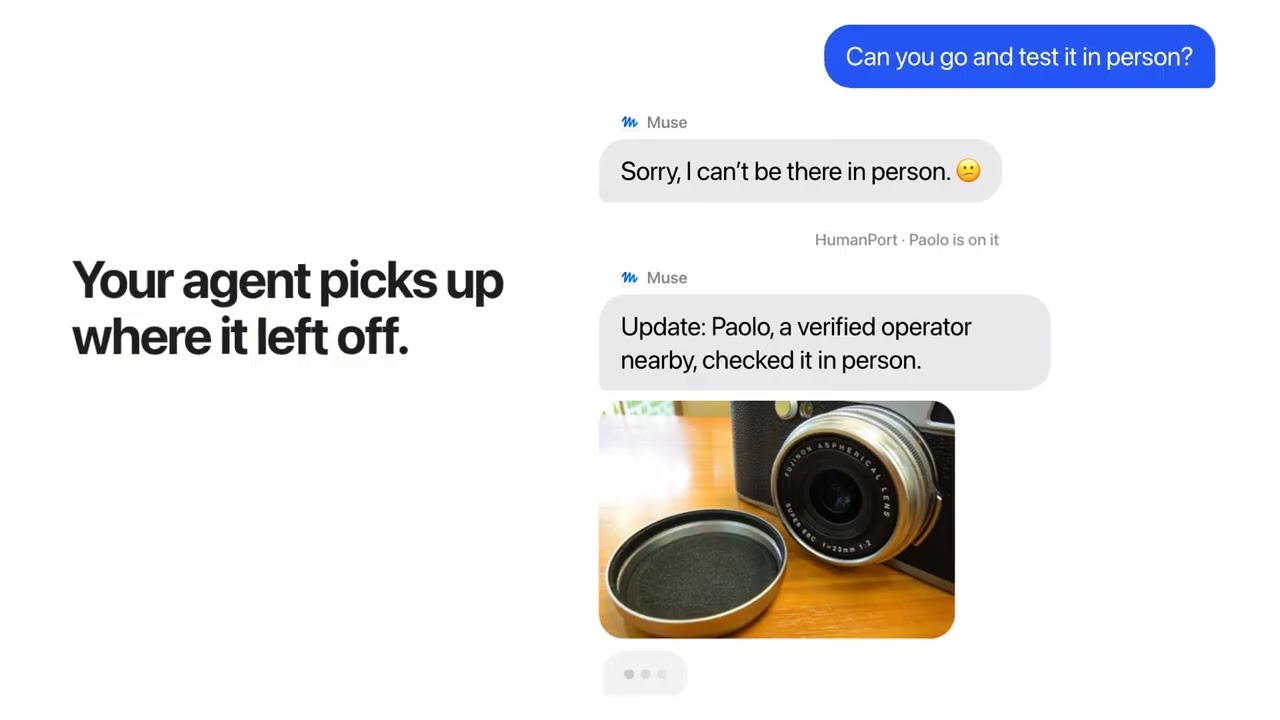
Agents are getting good at everything that happens on a screen. Then they hit a wall. "Is this used camera really in good condition?" "Does this venue actually look like the photos?" "Is the new bakery any good?" Questions like this need someone to physically be there. Today the agent stops and hands the problem back to you. Meanwhile, millions of skilled remote workers want flexible, trustworthy extra income. The Philippines' IT-BPM workforce alone is about 1.9 million people. These workers already do this kind of work, judgment-heavy tasks to a checklist, for clients they never meet. WHAT IT DOES HumanPort is the port between an AI agent and the physical world. 1. The agent asks. It sends one request in plain English, with a budget. 2. Muse Spark 1.3 scopes it. The request becomes a structured brief and a concrete checklist, as strict JSON. The output is something a human can do and a machine can check. 3. A human does it. A nearby operator accepts the task on their phone, goes there and works through the checklist. 4. SAM 3.1 checks the evidence. The operator's photo is segmented for the objects the checklist asked about, such as camera and lens. The agent gets grounded proof instead of a promise. 5. Muse Spark 1.3 closes the loop. It reads the findings and writes the agent's next step, such as making an offer, booking or walking away. WHO BENEFITS - People who use AI agents: their agents can finish real-world errands instead of stopping halfway. - Skilled remote and gig workers: paid, well-scoped tasks that fit around a day job. - Agent builders: one call adds physical-world reach to any agent.