BeeCensus
Built at Meta Global AI Developer Hackathon · Oct 26, 2026 · Remote
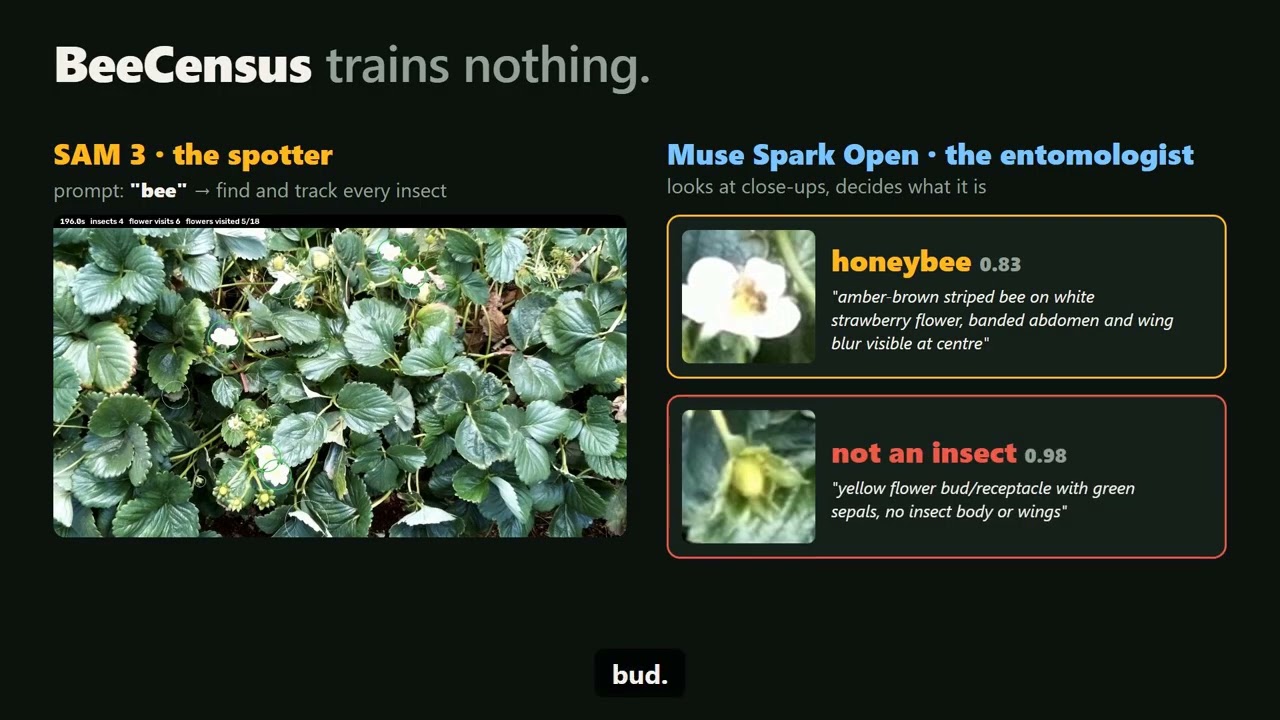
BeeCensus turns a fixed camera over flowers into a pollinator census: which insects visited, how often, and which flowers got no visit, with no training data. Today pollinators are counted by volunteers watching a 50x50 cm patch for 10 minutes (the FIT Count), and every camera system so far trains its own detector on thousands of labelled frames for one crop and one camera. BeeCensus hands the job to Meta's open-weight models. SAM 3 scans each second for anything matching the word "bee" and tracks it at 15 fps in quarter-frame tiles, so a 30-pixel bee stays visible; frame differencing adds bees too blurred for SAM 3. Muse Spark Open acts as the entomologist: it checks every candidate before any tracking, names each insect's FIT Count group (honeybee, bumblebee, hoverfly, wasp, ...) or rejects it as a bud, green fruit or plot label, and writes a note for the grower. The output is a FIT Count table, a flower-visit log, a coverage map of flowers no bee reached, an evidence gallery and a CSV. On ten 10-minute videos from a public Monash strawberry-farm dataset, BeeCensus found 21 of the 23 honeybees tracked by Polytrack, a YOLOv4 tracker trained on 2,231 labelled bees from those same farms, including 2 of 2 in four videos held back until the pipeline was frozen. 86 of the 95 tracks it reported are real insects.