TULA
Built at Meta Global AI Developer Hackathon · Oct 26, 2026 · Remote
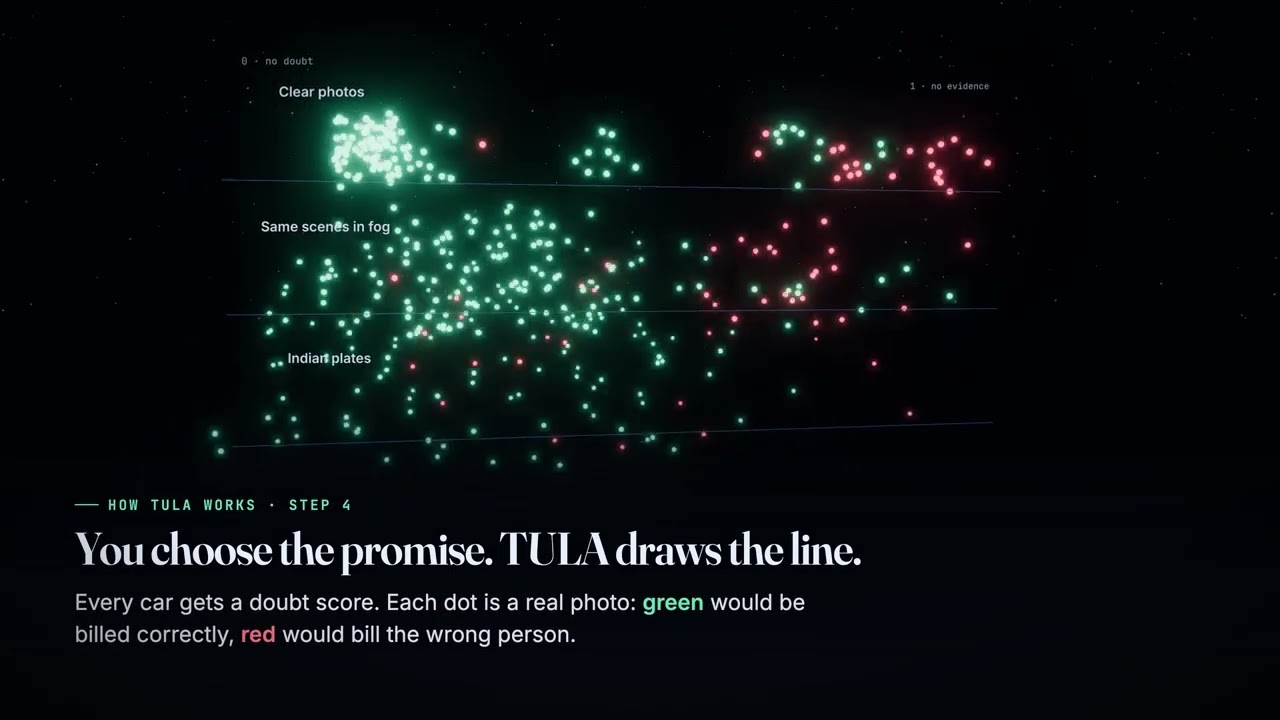
At an Indian FASTag toll, cars still slow down and wait. Abroad, they drive under a camera at full speed and get the bill later. India is now moving to that barrier-free system, and that raised a question for me: if no person checks the bill, who catches the mistakes? One wrong digit in a number plate sends the fine to a stranger, and in India an unpaid notice doubles after 72 hours. TULA is a safety check that sits between the camera and the bill: 1. Meta's SAM 3.1 finds the number plate and the car in the photo. 2. Two readers read the plate separately: an open-source plate reader and Meta's Muse Glimmer 30B. Glimmer also tells me the car's make, colour and type, which is how a cloned plate on the wrong car gets caught. 3. TULA checks both reads against the FASTag and the registered vehicle and gives each car a doubt score. 4. Then it decides: charge, wait for the next camera, or send to a person with a written reason. Today's systems charge whenever the model says it is "90% sure", but being sure is not the same as being right. TULA lets the toll operator set a promise, for example "at most 5 wrong bills in 100", and uses conformal risk control to keep it, separately for fog, clear weather and Indian plates. I tested it on 1,050 real plate photos, including 232 foggy ones I labelled by hand. Today's approach billed the wrong person 17% of the time, and a single "90% sure" rule reached 12% in clear weather. TULA stayed under 5% in every group while still charging 86% of cars straight away. I also attacked it with cloned plates and swapped FASTags, and it stayed within its limit. The photos and both models' answers are real; the FASTag and registry data are simulated, because no public dataset links them. Website with two live demos: https://copyninja07-07.github.io/tula/