Habitat Watch
Built at Meta Global AI Developer Hackathon · Oct 26, 2026 · Remote
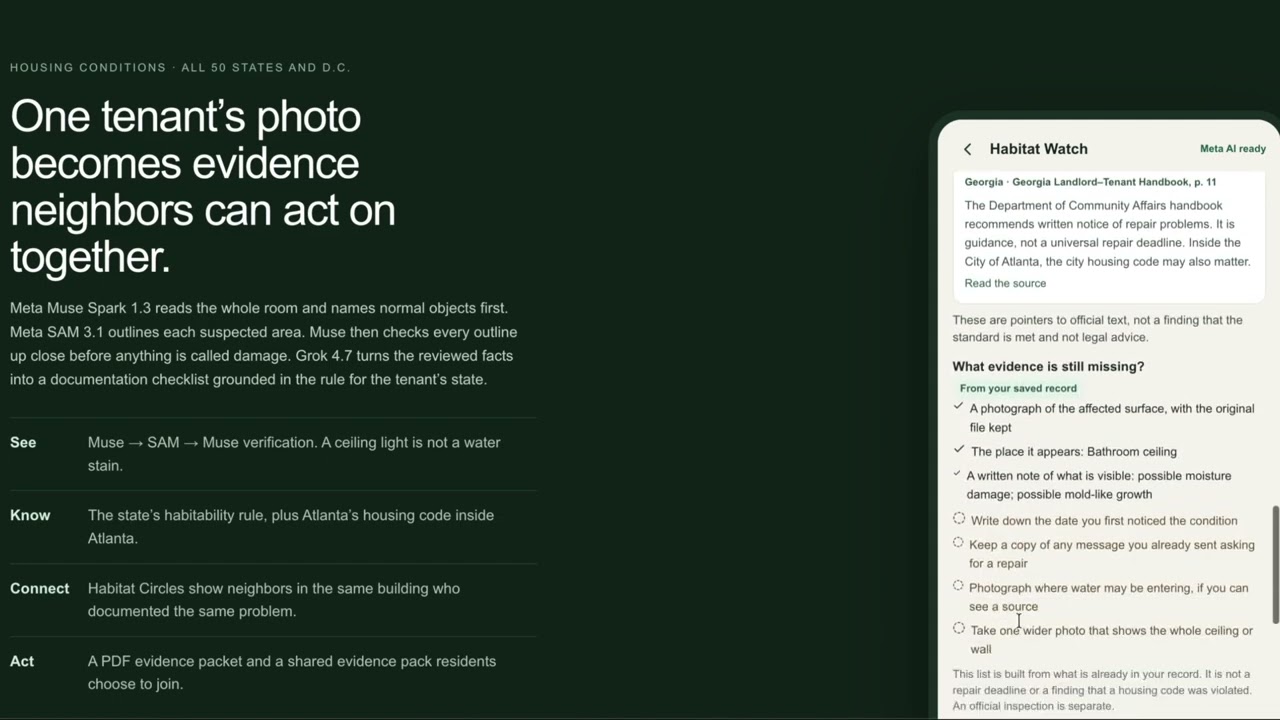
Inspiration: The idea for Habitat Watch came from problems we experienced in our own residence hall at Georgia Tech, Bud and Val Peterson. There was a rat infestation on another floor of the building that eventually spread to our floor. The problem was that we had no idea residents on another floor were already dealing with it until it had reached us. That made us realize how disconnected people in the same building can be when it comes to housing issues. We also noticed how slowly some maintenance problems can get resolved. Our showers went without hot water for around three days before the issue was fixed, and some hand dryers in the building have remained broken for weeks. These experiences made us ask a simple question: what if residents could actually see the problems other people in their building were experiencing, document their own issues properly, and recognize when something was becoming a larger shared problem? That became the idea behind Habitat Watch. What it does: Habitat Watch is an AI-powered housing platform that helps residents document housing problems, understand what they are seeing, and connect with other people experiencing similar issues. A resident can upload or take a photo of a problem such as mold-like growth, water damage, pests, electrical hazards, structural damage, or security issues. The image is analyzed using a multi-stage AI pipeline. Habitat Watch identifies the visible issue, highlights the affected area, and creates structured evidence around the report. Residents can then see reports from others in the same building or area through a Community Timeline, where issues are organized into categories such as water and moisture, pests, electrical, structural, and security. Habitat Watch can also identify possible shared patterns across multiple reports. It generates an AI summary of what residents are experiencing, shows the reports and evidence behind that summary, and visualizes where issues are occurring while allowing residents to remain anonymous. The platform also includes a legal-information layer that connects documented conditions to verified local housing resources and helps residents understand what additional evidence they may need or how to structure a repair request. The goal is to turn isolated housing complaints into organized, shared information that residents can actually use. How we built it: We built Habitat Watch as a responsive web application using Next.js and React, allowing the same platform to work on both desktop and mobile browsers. We used Cursor Pro extensively throughout the hackathon to help us rapidly build, debug, and iterate on the application. For the computer vision system, we used Meta Muse Spark 1.3 and SAM 3.1 in a multi-stage pipeline. First, Muse Spark 1.3 analyzes the full image and determines what it is looking at. This allows it to distinguish normal objects such as lights, vents, or shadows from possible housing issues. Muse then passes the suspected issue to SAM 3.1, which performs the segmentation step and highlights the relevant region of the image. Finally, we send that detected region back through Muse Spark 1.3 for a second verification step. This helps confirm that the highlighted area is actually a housing issue rather than a normal object or visual artifact. We also use Grok for the legal-information side of Habitat Watch. Grok works with verified housing-code and local housing-resource information to help connect a documented condition to potentially relevant rules, identify useful additional evidence, and assist with structured repair documentation.