Fieldless
Built at Meta Global AI Developer Hackathon · Oct 26, 2026 · Remote
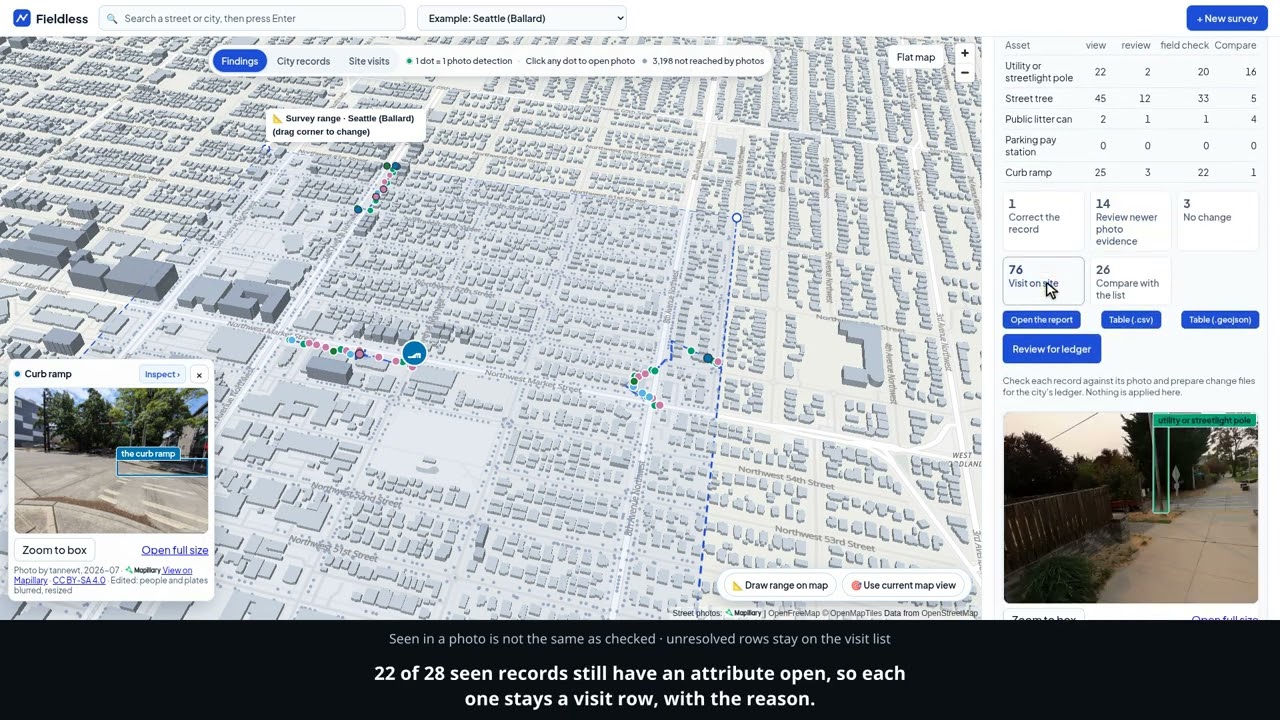
Fieldless automates a first pass of a city street survey from existing public photos and prepares evidence-linked records for human review. A surveyor can compare a photo with a city record, record a proposed change or a hold, and hand off a source-bound review package for local validation before deciding what needs newer imagery or a site visit. Live app: https://edward321416--fieldless-web.us-east.modal.run (new photo surveys are budget-capped). Read-only example surveys: https://huggingface.co/spaces/BBONG1201/fieldless. Code: https://github.com/edward321416-maker/fieldless. All the project code was built during the hackathon. In 2022 I was one of about twenty people my district paid to walk its streets for three months. Where each street light stood was not marked exactly, so we kept looking around to find it. Fieldless prepares evidence before a crew goes out. Pick a place or draw a box. The app shows photo availability and estimated cost. SAM 3.1 finds items by name; Muse Spark checks each item's question with a box, a reason or an unclear answer. Muse Spark Open gives a second opinion on possible US defects. One engine records poles, trees, litter cans, pay stations, curb-ramp warning surfaces, entrance steps and walkway obstructions. In Ballard, Seattle, the initial survey covered about 0.92 km (0.923 km unrounded) in 10.3 minutes for $3.33 in Meta API charges. Separate second looks added $2.30: a $5.63 Meta API subtotal, about $6.10 per km, for the review list. Baseten, hosting and human review are excluded. The list's end-to-end time and actual fieldwork savings have not been measured. The Ballard photos reach 94 of 3,292 city records considered for this example (2.9%). The initial survey matched 27; second looks raised presence observations to 53. The current list has 18 desk-review candidates and 76 records requiring additional checks. Close competing records and unclear details stay unresolved; proximity does not prove two records describe one object. Another 26 objects are candidates to compare with city lists, 7 unresolved. These categories are not measured visits avoided, and the other 3,198 city records remain outside the photos' reach. In Review for ledger, search for a record, inspect its dated evidence and explicitly assess facility identity and photo clarity. Drafts and decisions recover in the same browser; blocked storage and tab conflicts are visible. Handoff package previews proposed before/after values and downloads the source list, review journal and both CSVs as one file. The local CLI checks the current GeoJSON's properties and coordinates plus the city's permitted fields. A dry run writes nothing; applying creates a separate copy and audit trail. Typed reviewer names are self-asserted, and nothing writes into an official city system. Survey items are sentences rather than separately trained detectors. Muse Spark drafts an item such as "fire hydrant", tries SAM prompts and calibrates against Muse Spark Open on 18 reused photos. This is model agreement, not independent accuracy. Saved bike-rack and hydrant examples are open; new item creation needs a code. The hydrant run's Meta API cost was $0.61; Baseten is excluded. Muse Glimmer runs on our Modal H100 for optional bulk checks; cold starts made small runs slower and no cheaper, so the live app uses Muse Spark. Limits and evaluation: - An AI assistant checked 57 Ballard findings: 43 right, 3 wrong, 11 unclear. This is not human ground truth or validation of review decisions. Thirty real records and blank human-evaluation forms are prepared; no independent human results are claimed. - New York matched 9 of 79 reached records (79 of 666 in the area); its current list has 5 review candidates and 74 additional checks. An AI assistant judged 52 of 63 findings right. Capitol Hill has 28 candidates among 107 reached records. Candidate counts and record matching measure different things. - Photos are dated observations. Ballard uses May-July 2026 survey photos and September 2025 panoramas; Capitol Hill uses older survey photos. Current conditions may differ. Slopes, widths and small height differences need other evidence. Photo dates never overwrite city date fields. - New online surveys produce findings, costs and a report. City-record comparison and update lists are generated offline for three saved examples; the demo labels that transition. Functional demo decisions are test inputs, not independent reviews or municipal approvals. - Existing tools including Project Sidewalk also use AI. The demonstrated combination is sentence-defined items, multi-item surveying and evidence-linked record review. A like-for-like productivity advantage over other tools or a full walking survey has not been measured. Next: evaluate untouched photo sequences and have city reviewers assess suggestion quality and review time before claiming avoided visits or total savings.