MNEMOS
Built at Meta Global AI Developer Hackathon · Oct 26, 2026 · Remote
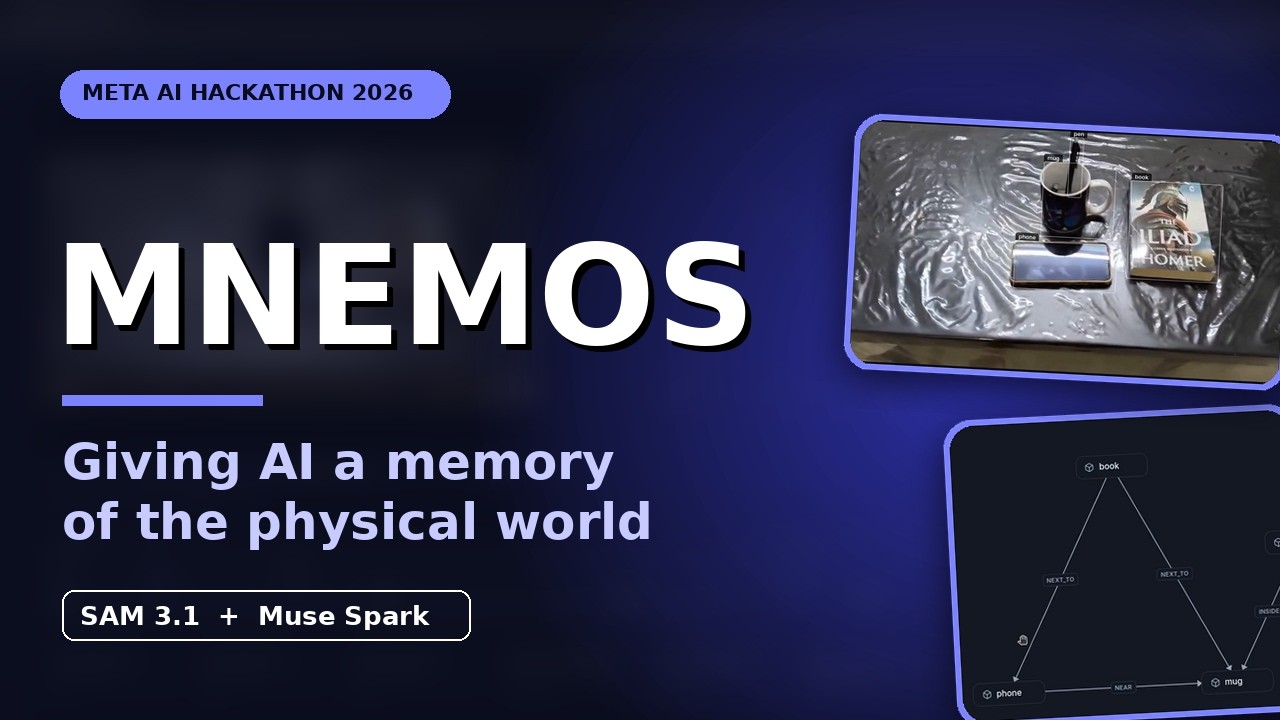
MNEMOS - Persistent Spatiotemporal Memory for AI Systems What if AI could not just see the world, but remember how it changes? Current vision-language models can interpret images and videos, but they often lack persistent memory of objects, their relationships, and how environments evolve over time. MNEMOS bridges this gap by giving AI systems persistent spatiotemporal memory. MNEMOS transforms video streams into structured, queryable memories of the physical world. By combining Meta's SAM 3.1 for object segmentation and tracking, a temporal knowledge graph powered by Neo4j, and Muse Spark for multimodal reasoning, MNEMOS enables AI to understand not just what exists in a scene, but what has changed, when it changed, and how objects relate to one another. How It Works Visual Perception: SAM 3.1 identifies and tracks objects across video frames, maintaining their identities over time. Persistent Memory: Observations, object relationships, and temporal events are stored in a Neo4j knowledge graph. Temporal Reasoning: Muse Spark interprets the structured memory and visual evidence to answer natural-language questions about the environment. Evidence-Based Answers: Users can ask questions such as "What changed in the room?", "Where was the object last seen?", or "What happened in the last hour?" and receive context-aware responses grounded in recorded observations. Why It Matters MNEMOS moves beyond traditional video understanding by introducing persistent, structured memory that can be queried and reasoned over. Potential applications include robotics, autonomous systems, smart environments, industrial monitoring, and assistive AI.