ZTL Engineer
Built at Meta Global AI Developer Hackathon · Oct 26, 2026 · Remote
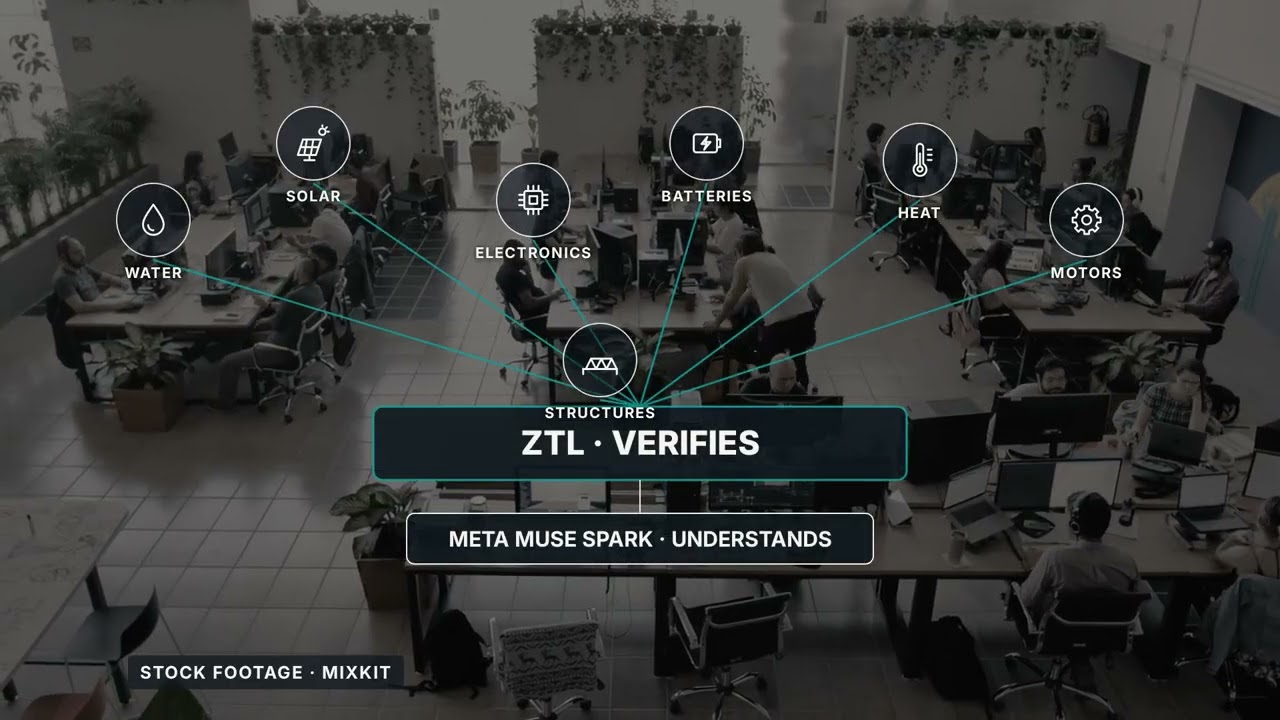
TRY IT LIVE: https://engineer.ztljudge.com (no install; a few questions an hour per visitor) An independent check of an engineering promise, for anyone. Muse Spark reads, the ZTL stand proves. The problem. Every pump, every solar kit comes with a seller's promise that it will work. To check it you need an engineer, and a UNESCO estimate puts developing countries at fewer than five engineers for every ten thousand people. Freelance engineering rates run $40-150 an hour, a written check can take a week, and professional simulation software can cost twenty thousand dollars. So the promise is often taken on trust, and a wrong one is found out after the money is spent. What ZTL Engineer does. You ask in plain words, in your own language (the demo uses French), and attach what you have: a photo of a nameplate, a datasheet PDF, a seller's price list, or an engineering file (a circuit netlist with its BOM, a truss model). Muse Spark reads it and writes a formal design problem: quantities with their tolerances or ranges, physical laws, requirements. What nobody measured, the person gives as a range. The ZTL stand then proves the design holds for every value in those ranges (EARNED), refutes it with a concrete failing point (REFUTED), or says honestly that it cannot vouch (OPEN). Given a catalogue, it finds the cheapest design that holds and proves that every cheaper one fails. Example from the demo: a technician asks in French whether the seller's solar pump will give a village 8 m3 of water a day, giving the unknown drawdown as 5-15 m. The seller's pump is refuted (2.8 to 8.2 m3/day over that range); a second pump is proved, at least 9.6 m3/day. Other examples: the cheapest solar kit that keeps a rural clinic's vaccine fridge on through two cloudy days; a published datasheet example whose resistor does not guarantee its current limit once its own tolerance is counted. What it proves, and what it does not. The proof is about the problem as the AI wrote it: if a nameplate value is misread or the physics is too simple, the proof is of the wrong problem. So every value the AI read is listed with where it came from, marked "AI read", and the person can correct any of it and recalculate; the report shows the whole problem, laws included. The problem file runs again on the open-source stand, with no AI, and gives the same verdict. It is not an engineer's stamp; it is a checkable proof, for people who have no engineer to ask. The live demo has the heavy tasks off (a small server). An MCP server lets any AI agent ask the same stand for an independent check. Built during the hackathon (the repository's commit history is the record): the web app, the Muse Spark agent with its tool loop and guard rules, the import of circuit and truss files, the MCP server, reports, demo tasks, security hardening, the public demo, and the demo video tooling. Pre-existing open-source dependencies by the same author: ZTL (Zero-Trust Logic) and ztl-stand, both Apache-2.0. The code was written with Claude (Anthropic); the video's voice and illustrations are AI-generated.