Vigiax
Built at Meta Global AI Developer Hackathon · Oct 26, 2026 · Remote
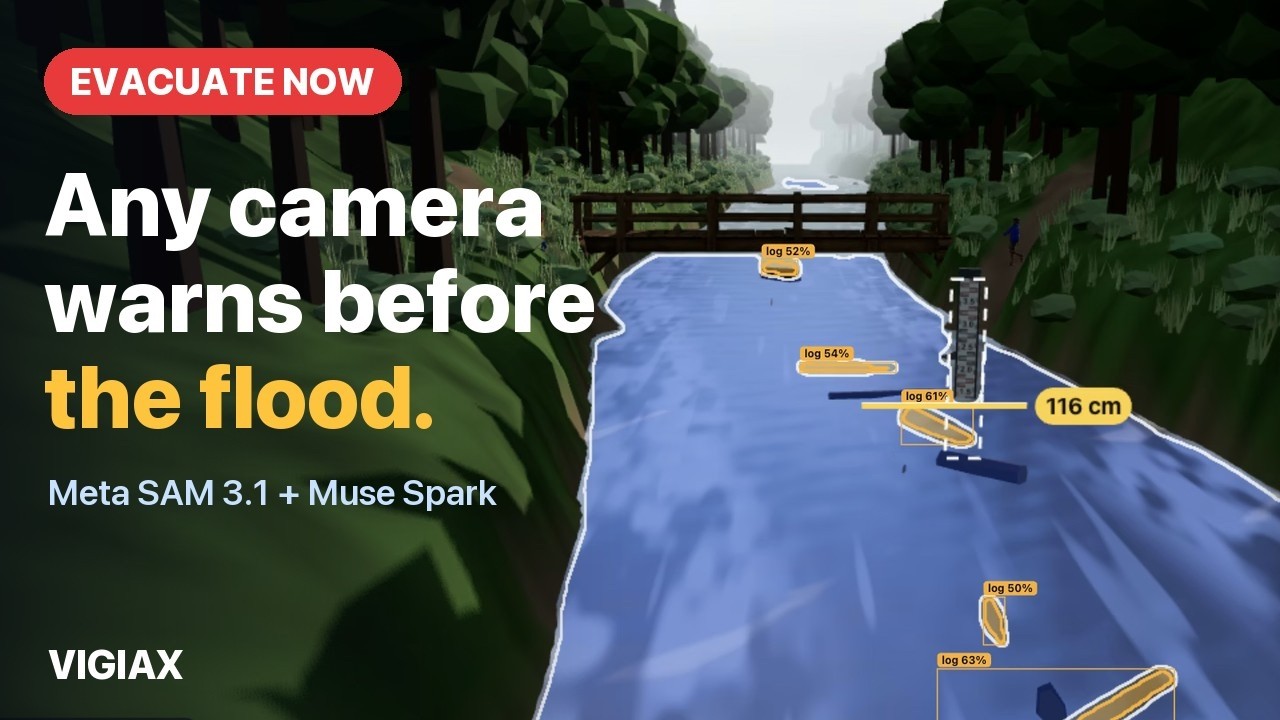
Vigiax: any camera becomes a flash-flood early warning system. Live product: https://vigiax.bukivo.com Live digital twin (trigger a flood yourself): https://vigiax.bukivo.com/twin/ What existed before the hackathon: nothing. All of Vigiax was built during the event, from 26 October to 4 November 2026. The problem. Flash floods kill more than 5,000 people a year, more than any other kind of flood (WMO), and heavy rain is becoming more frequent and more intense, with human-induced climate change the likely main driver (IPCC AR6). A third of the world's people still have no early warning system (WMO). In Colombia, flash floods (crecientes súbitas) come down mountain creeks in minutes and kill people every rainy season: Medellín alone has about 4,200 creeks and fewer than 30 level sensors (SIATA). Where there is no sensor, someone still has to go and look at the water. What Vigiax does. A camera points at a creek and a staff gauge. - Every 5 seconds, SAM 3.1 finds the water and Vigiax reads the level where the water meets the gauge, along with the rate of rise. - Fixed rules raise the alert level from those measurements, with no language model in that loop. - When something changes, Muse Spark reads the scene: mud, a debris flow, logs and rocks, people on the bank. - An agent on Muse Spark Open decides whether to hold or raise the alert, and a verifier checks every number it cites against the measurements. - People who signed up get the alert on WhatsApp, in plain words, from fixed templates filled with measured values. The cheap loop runs on every frame and the language models wake only on events, so a station can watch 24/7 within budget. Built for places with poor signal. On 2G the node sends only the gauge crop. With no signal it reads the gauge itself and sounds a local siren, and over LoRa it sends a 10-byte packet per reading. The digital twin. Anyone can test it in a 3D Andean valley in the browser: - Trigger a flash flood or a debris flow, add rain, mud, logs and people on the bank, and switch the network to 2G, no signal or LoRa. - Get the alert on your own phone over WhatsApp. Results. Every number comes from a run in the repo's eval/ folder. - Simulated flash flood with three people on the bank: the agent raised evacuate 23 s before the water reached the line, 8 s ahead of the rules alone. - Simulated debris flow: the camera loses the water in thick mud and the rules alone never warned. The scene reading raised evacuate 61 s before the flow reached the line. - Real river (USGS webcam on the North Canadian River, Oklahoma): - Through a 3.66 m flood, SAM 3.1 read the level with a mean error of 6.9 cm against the official gage. - No false alarms in 21 calm days. - The agent raised the alert an hour before the rules. - 27 days of watching cost $1.35 in model calls. HOW TO TRY IT (for judges) 1. See it work (2 minutes). Open https://vigiax.bukivo.com/twin/. The camera node starts by itself. Press Flash flood: the peak arrives in about a minute (the settings offer 2, 5 or 10). SAM 3.1 measures the water every 5 seconds and the alert climbs to evacuate. Open Alerts (top right) to see the agent console: what woke the agent, what Muse Spark saw, Muse Spark Open's decision, the verifier's check, and the tokens and cost of each run. 2. Get the alert on your phone. In the twin, press step 3, Get the alert on your phone, and scan the QR code. It opens WhatsApp with a message ready to send. Send it, then trigger a flood. The subscription ends by itself 24 hours after your last message. 3. Try a debris flow. Open the settings (the sliders icon next to Flash flood), go to Scene, turn on Debris flow and trigger a flood. The camera loses the water in the mud, but Muse Spark still sees it. 4. Lose the signal. In the camera node card, switch the network to No signal or LoRa during a flood. The node keeps measuring by itself and sounds its local siren. 5. The live GPU view (optional). In the SAM panel, enter the judge code RIVER-JXYS-KZNJ, press Unlock and then Turn on. A GPU with the open-weights SAM 3.1 starts in 30–120 seconds, and the masks then follow the water, people and logs live. It turns itself off a few minutes after nobody is watching. The level is always measured by SAM 3.1 on the Meta Model API; the GPU only draws the live view.