nukirk
Built at Meta Global AI Developer Hackathon · Oct 26, 2026 · Remote
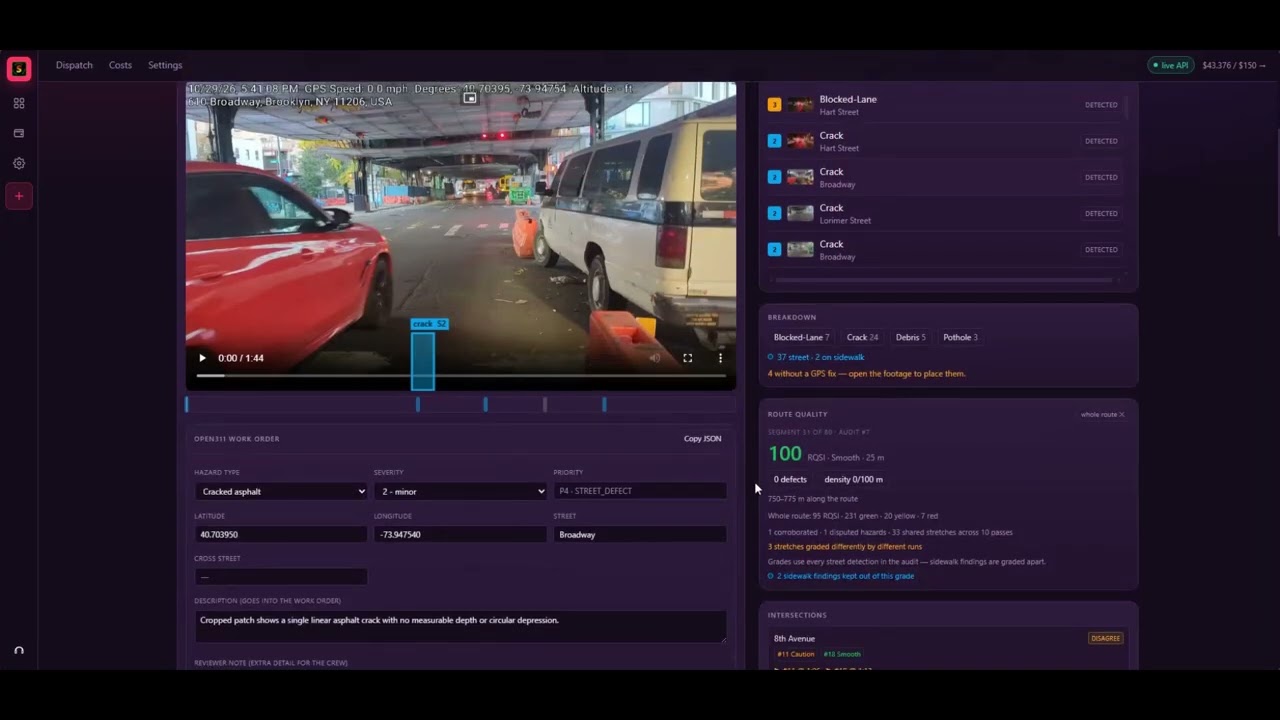
StreetScan: Automated Urban Hazard & Infrastructure Auditor StreetScan converts passive video footage—from dashcams, action cams, and handlebar cameras—into verified, geo-tagged municipal work orders. Instead of requiring citizens to manually stop and fill out complex 311 forms while navigating traffic, StreetScan automates physical street auditing through a multi-stage perception and reasoning pipeline. Core Capabilities: Ingest & Extraction: Streams raw MP4/MOV footage, parses embedded GPS tracks via ExifTool, or extracts coordinates directly from burned-in video timestamps and overlays using OCR. Temporal Hazard Tracking: Employs SAM 3.1 to generate pixel-accurate polygon masks across continuous frames, discarding transient optical noise with an IoU temporal persistence filter. Multimodal Classification & Triage: Routes segmented hazard crops to Muse Spark, which reasons across depth cues, edge deterioration, surrounding scene context, and visible street signs to classify defects (potholes, cave-ins, cracking, debris, blocked lanes) and assign municipal urgency ratings (1–5). Multi-Pass Consensus & RQSI: Reconciles overlapping route footage using maximum bipartite matching to automatically verify corroborated defects and flag disputes. Computes a continuous Route Quality & Safety Index (RQSI) across 100-meter segments and exports standards-compliant Open311 JSON and GIS payloads. Civic Realism: Distinguishes roadway defects from sidewalk accessibility barriers, ensuring a cracked pedestrian curb is recorded without improperly degrading driving route safety scores. The core architectural pipelines—temporal segmentation filtering, multi-pass bipartite consensus, and dual-rate transcoding—are fully built and verified across 169 automated assertions. Live video ingestion hit an active pipeline regression right at the deadline window, but the architecture, telemetry, and pre-seeded audit inspection represent the working system state.