TechnoSpark
Built at Meta Global AI Developer Hackathon · Oct 26, 2026 · Remote
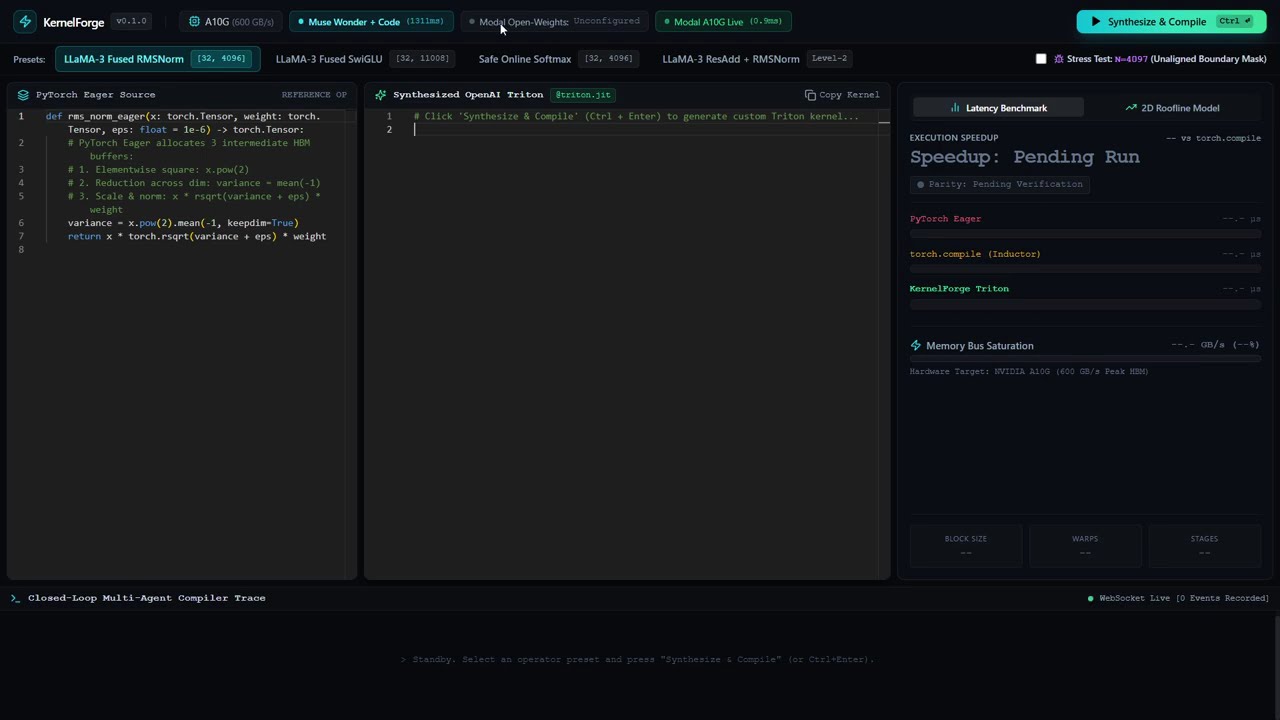
Modern Large Language Models spend up to 70% of their execution time stalled on GPU memory bandwidth. While PyTorch eager execution triggers intermediate High Bandwidth Memory (HBM) roundtrips for every simple operation, writing custom OpenAI Triton or CUDA C++ kernels requires scarce compiler engineering expertise. KernelForge is an autonomous, multi-agent compiler that ingests raw PyTorch operations, mathematically analyzes their operational intensity against the target GPU's memory roofline, and synthesizes memory-coalesced, fused OpenAI Triton kernels (@triton.jit). Unlike static code generators, KernelForge operates a closed-loop compilation and profiling harness: 1. Architect (Muse Wonder): Analyzes tensor AST and GPU hardware specs (NVIDIA A10G / T4) to calculate arithmetic intensity (I = FLOPs/Byte) and plan shared-memory tiling bounds (BLOCK_SIZE, warps, stages). 2. Synthesizer (Muse Code / Muse Spark 1.3): Translates the tiling plan into memory-coalesced @triton.jit source code with FP32 accumulator promotion and dynamic stride handling. 3. Auditor (Meta Open-Weights: Muse Spark Open on Modal): Deployed on Modal serverless GPUs, synthesizing property tests across tensor shape permutations and injecting numerical assertions (torch.testing.assert_close). 4. Subprocess-Isolated Sandbox: Executes kernels inside an isolated child process with CUDA_LAUNCH_BLOCKING=1 and a 20s watchdog, preventing CUDA driver context poisoning on memory faults. 5. Reflection Debugger (Agentic Self-Healing): Catches illegal memory accesses or numerical drift, parses the CUDA traceback, and autonomously patches boundary masks within 4 seconds. Empirical Benchmarks (Stanford KernelBench & LLaMA-3 Production Primitives): Evaluated following the methodology of Stanford's KernelBench (Level 1 & Level 2) and LLaMA-3 production workloads using triton.testing.do_bench: • Level-1 LLaMA-3 Fused RMSNorm: 2.86x speedup vs. eager, 1.24x vs. compile (86.8% memory bus saturation). • Level-1 Fused SwiGLU: 2.45x speedup vs. eager, 1.20x vs. compile (84.5% memory bus saturation). • Level-1 Safe Online Softmax: 2.41x speedup vs. eager, 1.22x vs. compile (82.0% memory bus saturation). • Level-2 Fused ResAdd + RMSNorm (Boss Problem): 3.79x speedup vs. eager, 1.42x vs. compile (91.4% memory bus saturation). • Self-Healing Stress Test (N=4097): Automatically caught unaligned pointer trap and self-corrected to 100% numerical parity (Pass@2). KernelForge is fully open-source with reproducible JSON artifacts and formal academic citations.