straw hats
Built at Meta Global AI Developer Hackathon · Oct 26, 2026 · Remote
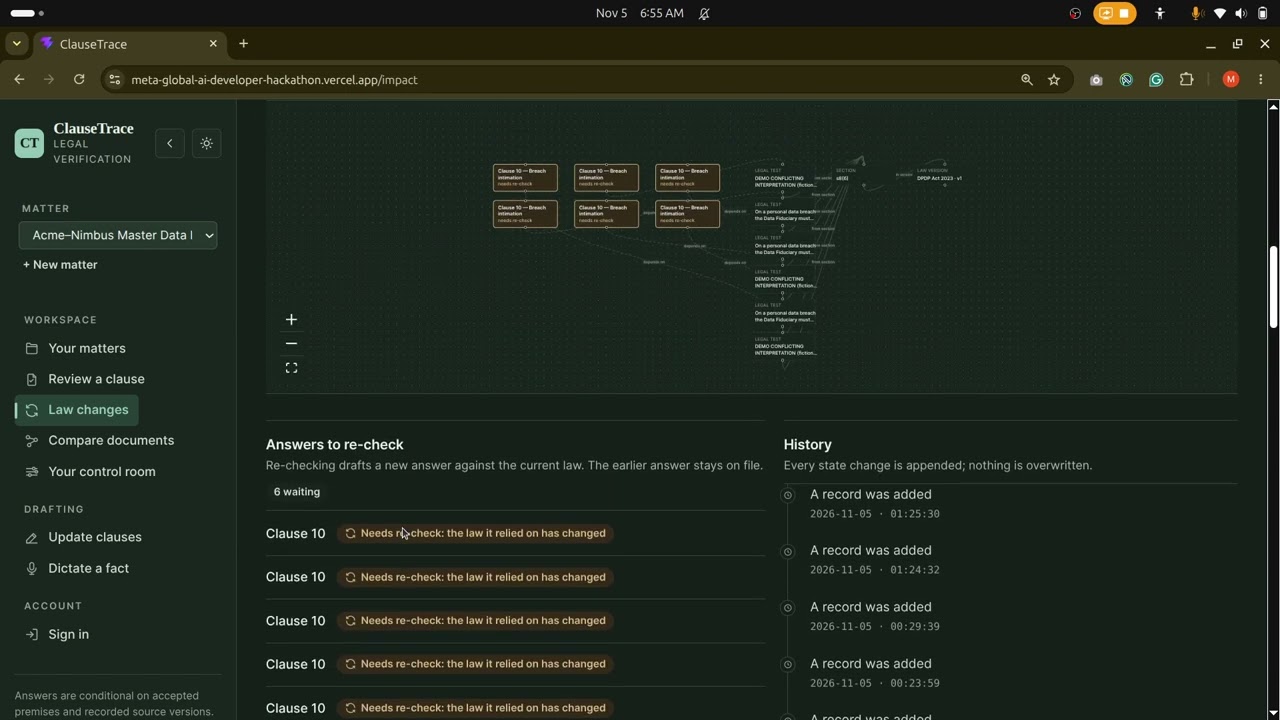
Legal reviews go silently stale. A lawyer checks a contract clause against a law, records a conclusion — and months later the law is amended. Nobody re-reads the old reviews, so firms keep relying on conclusions that were only true under a superseded version of the law. ClauseTrace is a version-aware legal verification engine that solves this. A lawyer uploads a contract; the system extracts clauses, parties, obligations and dates as proposed facts that only become trusted when a lawyer confirms them. The lawyer then asks whether a clause meets a legal requirement. Instead of a free-text answer, Muse Spark — restricted to six bounded tools — drafts a structured proof: the clause text, the exact section of the exact law version in force on the as-of date, and the premises relied on. A deterministic checker with no model inside it validates the proof, and a separate memory service (never the model) records the finding as FOLLOWS, RULED_OUT, UNKNOWN, or REQUIRES_REVIEW. The core capability: when a legal source is amended, dependency-graph traversal (FalkorDB) finds exactly the findings that depended on the changed section, marks them stale, and forces re-verification against the current version. Unrelated changes flag nothing. Old findings are never overwritten — they stay as auditable history, and every answer shows "what would change my answer." When a question cannot be proved from the sources on file, the system returns UNKNOWN instead of inventing citations. Demo scope: India's DPDP Act 2023 and DPDP Rules 2025, plus sections of the IT Act 2000 and Copyright Act 1957 (ingested from official sources), applied to a fictional data-processing agreement. Deployed live: React frontend on Vercel, FastAPI + Postgres + FalkorDB backend in Docker on Oracle Cloud, with live voice dictation of facts over WebSocket. A proof is always conditional on accepted premises — ClauseTrace never claims the law is true, and it is not legal advice.