NeuroMuse
Built at Meta Global AI Developer Hackathon · Oct 26, 2026 · Remote
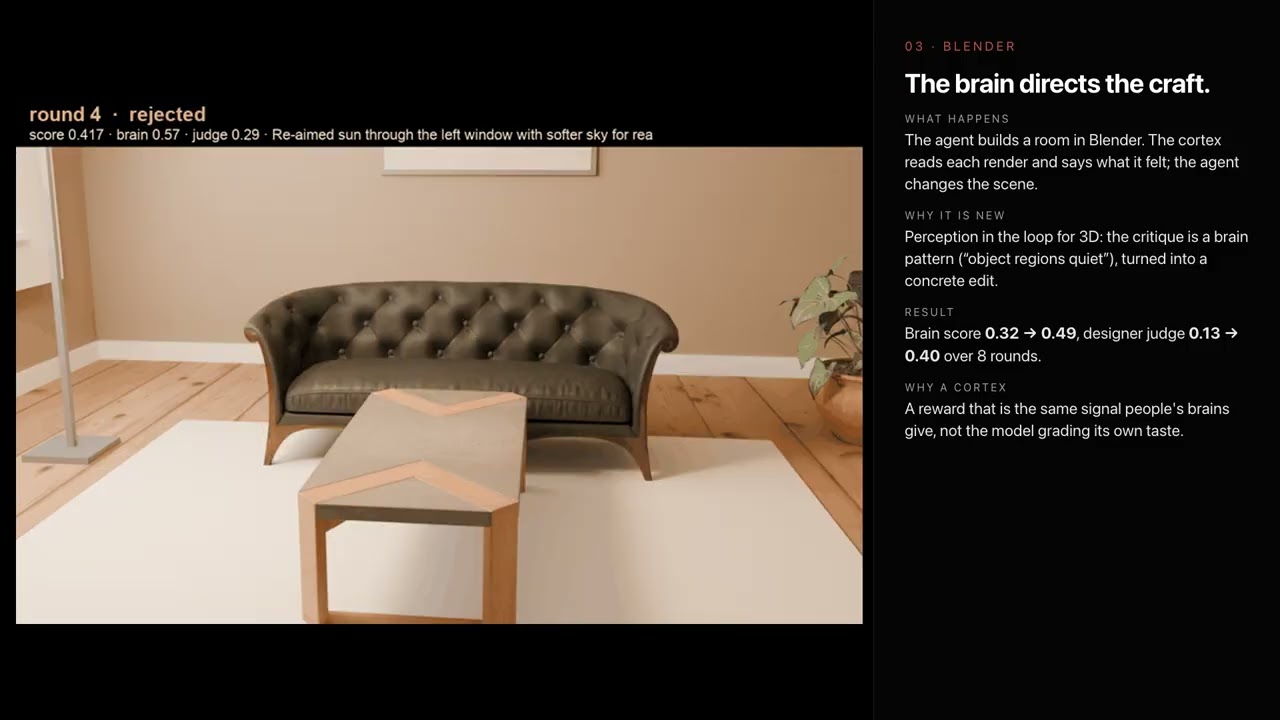
NeuroMuse is the Muse with a cortex: an assistant whose opinions come from a predicted human brain instead of improvised prose. The problem: ask any assistant what it thinks of your photo and it says "looks great". It never looked, and it cannot say why. People who make visual decisions for a living (pop-up store operators, marketers, creators) need an opinion that can justify itself, admit when it does not know, and learn their own taste. What it does: - Looks before it speaks. A photo, a 6-second glasses clip, a paragraph or a sound goes through Meta's TRIBE v2, which predicts the human cortex (20,484 points, every second). Five calibrated heads (Aesthetic appeal, Attention capture, Desirability, Reach, Human-likeness) score it with a percentile and a confidence. - Answers as its own brain, in plain words: "My place-mapping side lights up first; my desirability sits at the bottom, and I'm 93% sure of that." Below 0.3 confidence it says the signal is faint and asks you instead of guessing. - Works like Meta glasses: a first-person view keeps a rolling 6-second clip; you ask by voice and hear the answer. - Tunes to your brain: every like or dislike is stored with its cortex state; a sleep pass refits a personal head and writes your taste as readable rules with effect sizes. Memory lives in brain states, not words, so 1,000 memories cost zero prompt tokens. - Directs real work: the cortex critiques each version, an art director picks a craft tool (keep a real asset, fetch a photo, model the product or room in Blender, re-time an ad), and the agent rebuilds. It has evolved real websites, furnished a 3D room and made a 12-second ad. - Refuses to cheat: a result only counts if its facts are the brief's own, density is kept, and a blind judge that wrote neither side prefers it. Results (every number from a saved run): Human-likeness head 0.88 holdout AUROC; 360 cortical areas score 0.753 AUROC on 2,500 rated photos vs 0.728 for the raw vision embedding; 14 s per clip on an L40S (from 43 s); ad clips 3/3 wins in blind pairwise judging; 11/16 in a human blind vote; on six real websites it accepted one change (blind P = 0.90) and refused five; zero invented facts shipped. We also report the limits: Reach is barely predictable from any features (~0.56), and the personal head needs more answers before it beats the crowd.