PhyloLoom-AI
Built at Meta Global AI Developer Hackathon · Oct 26, 2026 · Remote
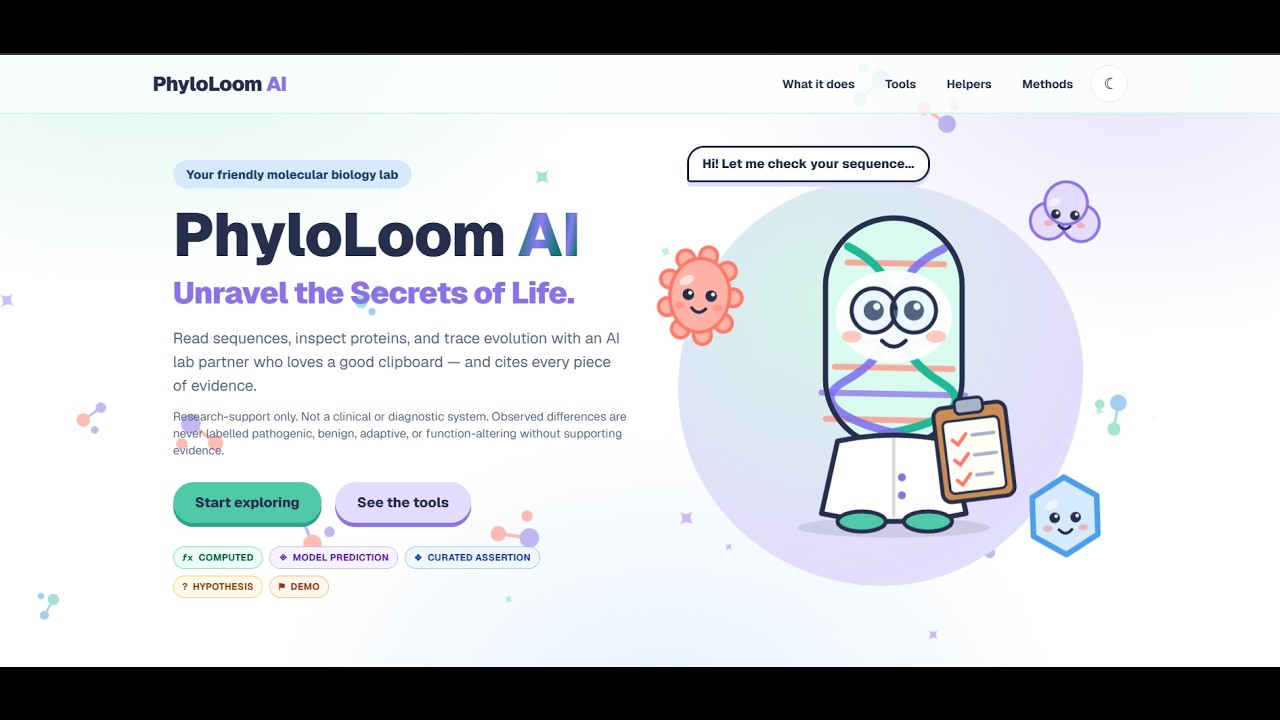
PhyloLoom AI is a biological investigation engine that turns protein and DNA sequence observations into transparent, reproducible investigations. It solves a major problem in computational biology tools: results are often presented as black-box scores, AI-generated interpretations, or isolated calculations that users cannot easily verify, reproduce, or trace back to their underlying evidence. PhyloLoom addresses this by combining a deterministic scientific backend with an evidence-linked AI research copilot. Users can analyze FASTA sequences, compare reference and alternate proteins, detect substitutions and indels, compute physicochemical descriptor changes, explore all 19 alternative amino acids at a selected residue, measure sequence conservation and entropy, identify candidate recurrent substitutions, examine protein-structure contacts, and build exploratory phylogenetic trees. Every result is classified as COMPUTED, MODEL_PREDICTION, CURATED_ASSERTION, LITERATURE, HYPOTHESIS, or DEMO and connected through an Evidence Graph. Users can click a conclusion and inspect the computation, method, parameters, coordinates, provenance, and checksums behind it. If an analysis was not performed or a model was not verified, PhyloLoom explicitly displays “unavailable” instead of inventing a value or presenting zero as a result. The platform integrates Meta’s Muse Spark 1.3 model through the Meta Model API. Muse Spark explains computed results and generates falsifiable scientific hypotheses from a structured EvidenceBundle. Every AI-generated statement must cite a valid evidence ID; uncited statements are demoted to suggestions, and hypotheses remain labelled untested until an approved test is performed. PhyloLoom also addresses common scientific risks such as coordinate confusion between precursor, mature-chain, and submitted-sequence numbering. It never silently converts coordinates and never labels a variant as pathogenic, benign, adaptive, or functionally important without supporting evidence. The final investigation can be exported as a reproducible JSON or HTML report containing inputs, methods, provenance, limitations, and unavailable analyses. In short: PhyloLoom AI is not another black-box mutation predictor. It is an inspectable research workspace that helps scientists and students move from sequence observations to evidence-backed, reproducible, and challengeable biological hypotheses—while clearly separating computation, curated knowledge, model predictions, and speculation.