Asoncode
Built at Meta Global AI Developer Hackathon · Oct 26, 2026 · Remote
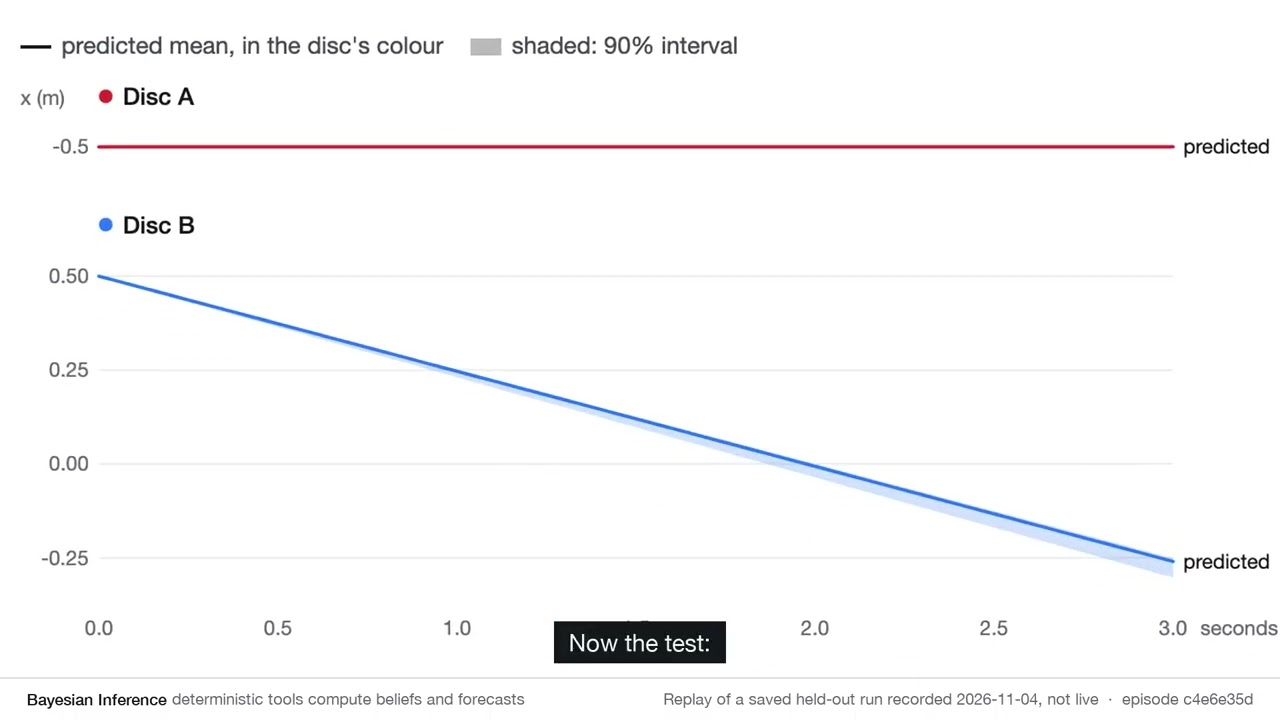
CausalWorld has Meta's Muse Spark run physics experiments from video to work out a hidden link between two discs. At rest, a spring and a rope look identical. Pushing one disc toward the other tells them apart: a spring pushes back and a rope goes slack. Muse looks at rendered frames, reads forecasts from tools, and chooses impulses through function calling. A local color tracker measures each result, an exact Bayesian posterior updates beliefs over mechanism, stiffness, and mass, and a separate evaluator scores a final prediction for a motion no experiment has tried. I wrote the hypotheses and thresholds down first, locked the code before generating the test episodes, and ran each arm once. On 200 held-out episodes, two experiments cut mean final-frame error from 33.07 px to 0.51 px. Muse ran 300 held-out trials with no failures for about $18, and across its 120 free trials it identified the mechanism every time, with a mean error of 0.52 px. Muse did not beat a fixed two-step script, which ties it because the most informative pair of experiments is the same in every episode. This is a small sandbox with two mechanisms and noiseless renders, not a general world model. With damping the model doesn't know about, it never became confident in the wrong mechanism, but its intervals covered the truth only 13% of the time at two probes. The website reports every result with these limits.