Offline Base
Built at Meta Global AI Developer Hackathon · Oct 26, 2026 · Remote
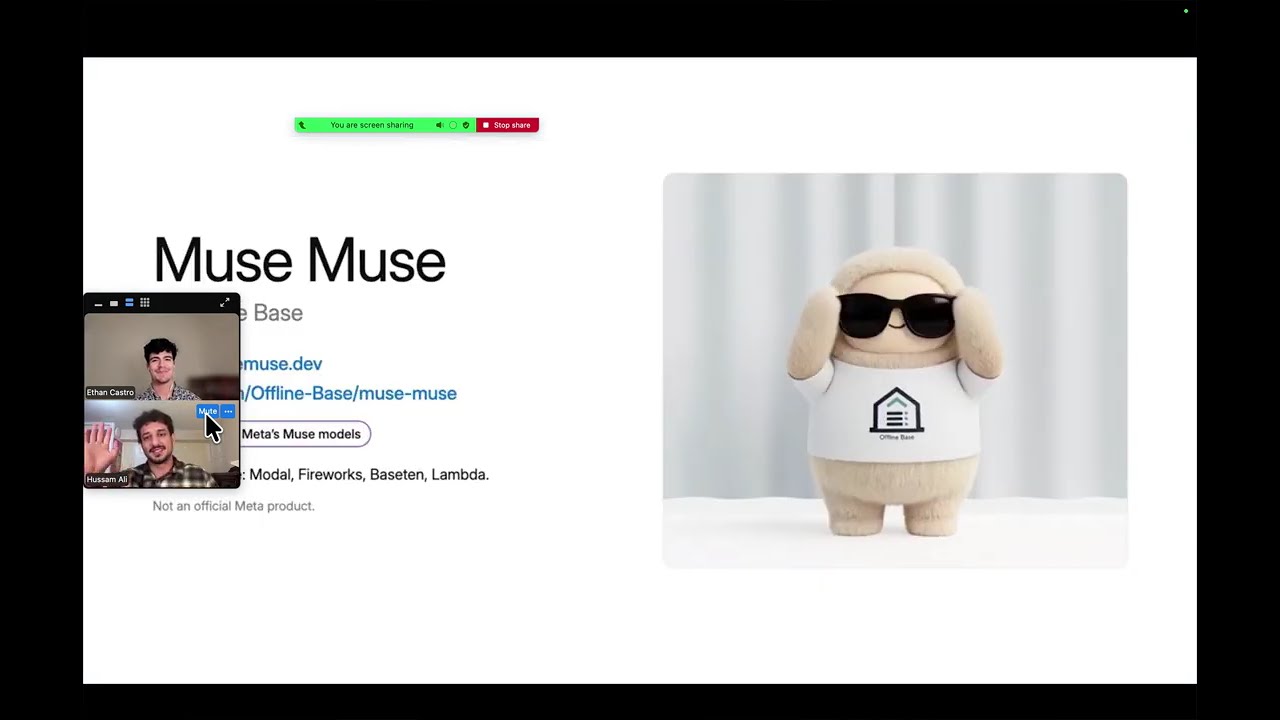
Muse Muse turns inspiration into working software and models using Meta's Muse family. You bring your inspo, a note, a photo or a folder of files, and Muse makes it: a live web app, a tuned model, or a tool an agent can use. The problem: the people closest to real problems, like teachers, small teams and people in regulated fields, can't get custom software or custom models. Building an app takes engineering they don't have, tuning a model takes ML skills and GPUs, and pasting private data into a chatbot isn't an option in schools, aerospace or chip fabs. Build an app from one note: Muse Code writes, tests and deploys a full product, with a build room you can watch and steer. Sixty apps have been built so far and 49 are live, including Pond Survey Counter, which counts objects in photos with SAM 3.1. Train your own model: ask for one, and Muse writes the training data, tunes Glimmer and checks it on held-out examples. Our tutor that only gives hints won 18 of 20 held-out problems after a 28-minute run on one A100 that cost about $0.90. Our own 2026 Glimmer: a scripted run tuned Muse Glimmer 30B on 2026 news. An earlier stage scored 69% on 246 headline questions, against 26% for the base model. Its GGUF files got 1,444 downloads in their first days, and an outside publisher made three more quantizations. The edge: we tuned SAM 3.1 on a Jetson Orin Nano to find our mascot, Jolly. For the prompt "muse", the tuned model boxed 18 objects, about 14 of them Jolly, where the base weights found none. It still flags a few other mascots. The same tune drives a rover through Muse Muse. Privacy: Muse Privacy keeps documents on a device you own, and only tags like [Person 1] leave it. Results that can't be shared safely stay on the device. Meta's docs, all 154 pages, are mirrored with live demos, and 24 Meta cookbook recipes are rebuilt as live apps.