SeismoRescue
Built at Meta Global AI Developer Hackathon · Oct 26, 2026 · Remote
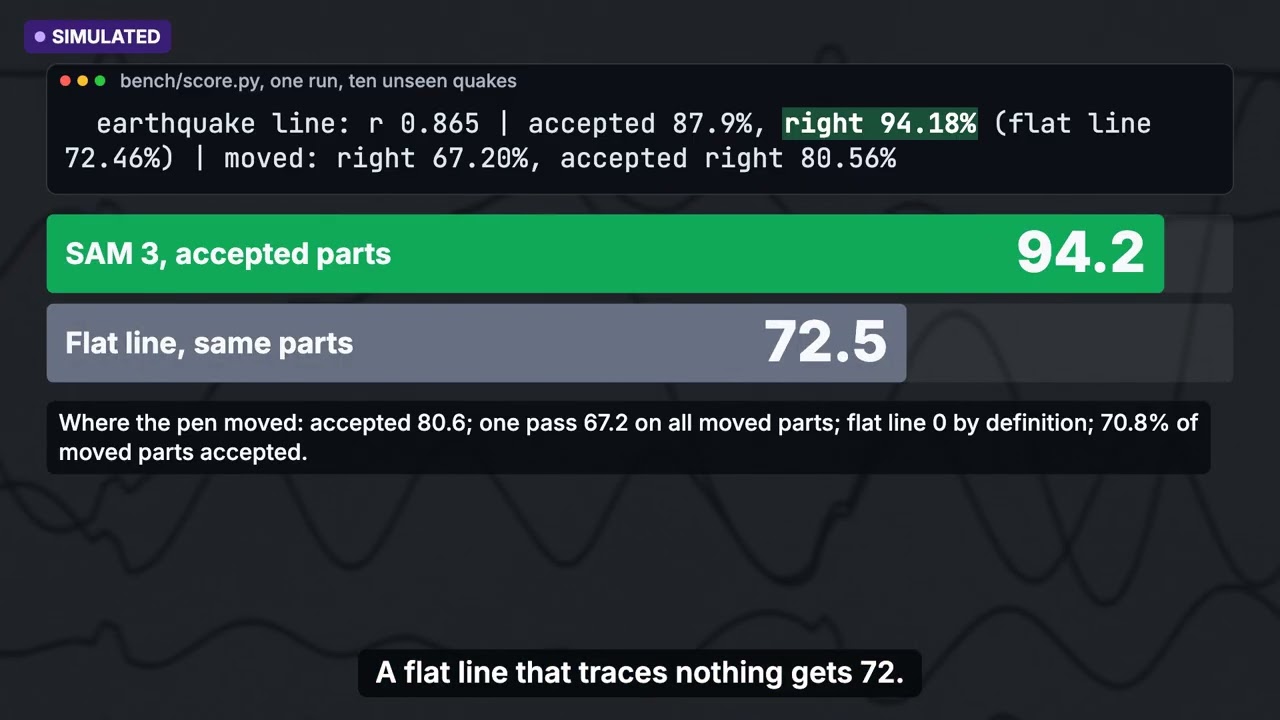
From 1962 to 1978 the World-Wide Standardized Seismograph Network recorded the world's earthquakes on photographic paper, later copied to film chips. The USGS released its scans of these chips under CC0 in 2025, but they are pictures, not data. Turning one back into a waveform fails exactly where it matters: the earthquake trace swings across its neighbours and crosses them hundreds of times. On a tangled synthetic crop, zero-shot SAM 3.1 returns no instances and a classical tracker fails on 58% of columns. SeismoRescue takes one public film chip and returns files: a record sheet (station, start time, the earthquake and the line it should be on), a miniSEED waveform that keeps only the spans where two passes of the tracer agree, and a review list for the rest. A person clicks the right stroke and SAM 3 re-tracks that span (about a second on an RTX 5070 Ti, about 5 s on a laptop); the person accepts or holds it. It also ships a public benchmark for this tracing task, with exact ground truth and a flat-line baseline next to every position score. Results. On 10 unseen earthquakes (synthetic film, rule frozen, run once), accepted earthquake-line columns are within a quarter line spacing 94.2% of the time, against 72.5% for a flat line on the same columns. Where the pen really moved, accepted columns are within a quarter spacing 80.6% of the time (70.8% of those columns are accepted; a flat line scores 0% there), against 67.2% for one pass alone. On real film the accepted path follows the digital record's shape on two smaller quakes (r +0.91, +0.83, the second on a line picked after the run). On two major quakes it does not: almost nothing is accepted on one, and on the other the accepted half scores no better than a flat line. That part stays human work, and the README says so. Border reading: 16 of 20 new public chips right against the archive's file names; on the other 4 the agent matches the chip itself, checked after the test. On 300 more new chips, one unattended run of reading and timing, no tracing: the agent finished 297; on at least 32 of those the file name differs from what the chip prints (two blind readings by Claude, not independent people); at least 8 of its 45 flags were its own misreads. The timing step is the weak part: it supported the line format on 167 of 297, built a time model on 164 (accuracy not measured in this run), and its line count disagreed on 78 of the 113 it could check. The repository has a run anyone can repeat with no key, no GPU and no account, on recorded SAM 3 paths and Spark replies, with their logs and hashes. The live path needs approved access to SAM 3 and a GPU.