Bundlr
Built at Meta Global AI Developer Hackathon · Oct 26, 2026 · Remote
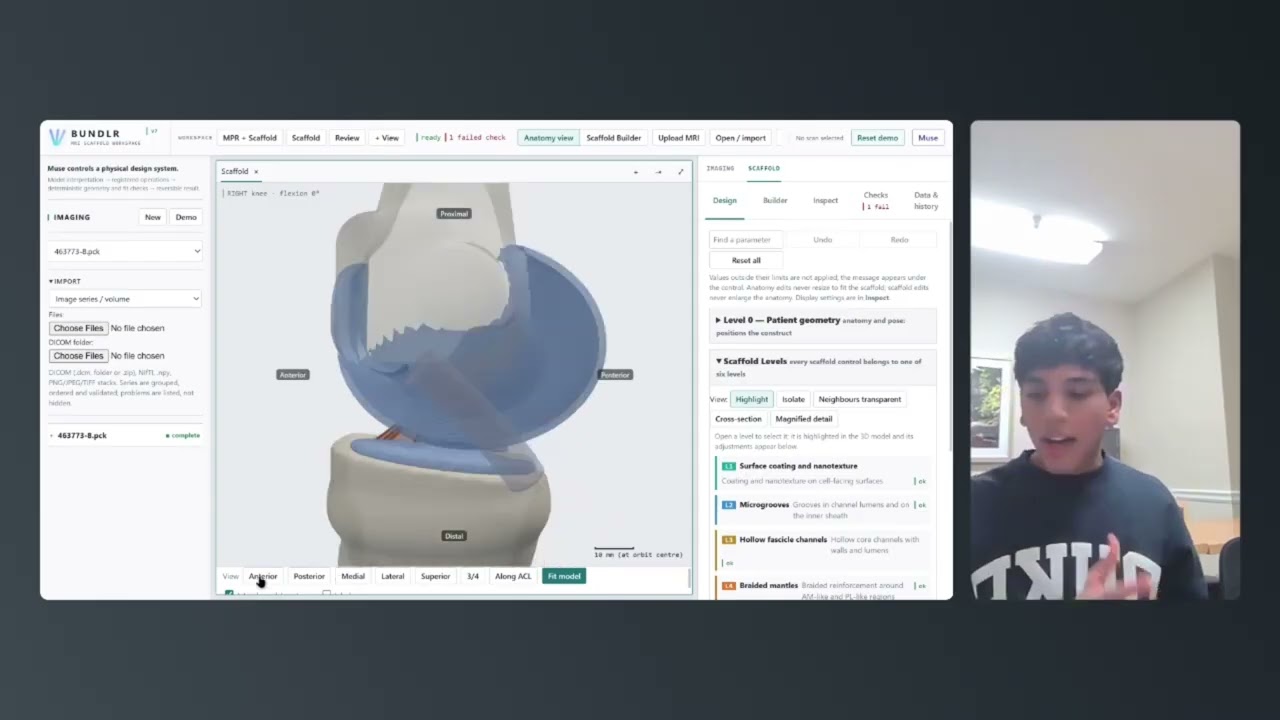
This project is a personalized scaffold that helps a torn ACL heal itself instead of being replaced. A torn ACL almost never heals on its own because it sits inside the knee joint, where joint fluid keeps a stable blood clot from forming between the torn ends. The standard fix is reconstruction, which replaces the ligament with a graft from the patient’s hamstring or patellar tendon. That works, but it creates a second injury, throws away the original ligament and the nerve endings that help the knee sense its position, and comes with a long rehab and real re-tear rates. A newer method called BEAR showed that the ACL can heal if it’s given a bridge: a collagen sponge stitched between the torn ends and soaked in the patient’s blood. But that implant is the same for everyone. It ignores the patient’s anatomy, where the tear is, and which parts of the ligament carry the most load. This project closes that gap. It starts with MRIs of both knees. The healthy knee, mirrored, is the blueprint for what the ACL should look like, and the injured knee shows exactly where it tore. A system of AI sub-agents turns those scans into a 3D model of the rebuilt ligament and uses that model to design the scaffold section by section. It places stronger, slower-dissolving polymer in high-load areas, sets braid angles from published optimal values adjusted to the patient, and concentrates growth factors where healing is needed most. To manufacture it, polymer is injected into a “braided negative,” a mold of tubes that follow a 3-strand braid path. The braid copies the twisted fiber structure of a real ACL, and the porous rods let new tissue grow into the scaffold. The result is a hybrid: the synthetic bridge gives strength early on, and blood-driven natural regrowth takes over as the polymer breaks down. The patient keeps their own ligament, avoids having a graft taken, and gets an implant built for their knee.