Doc'O Clock
Built at Meta Global AI Developer Hackathon · Oct 26, 2026 · Remote
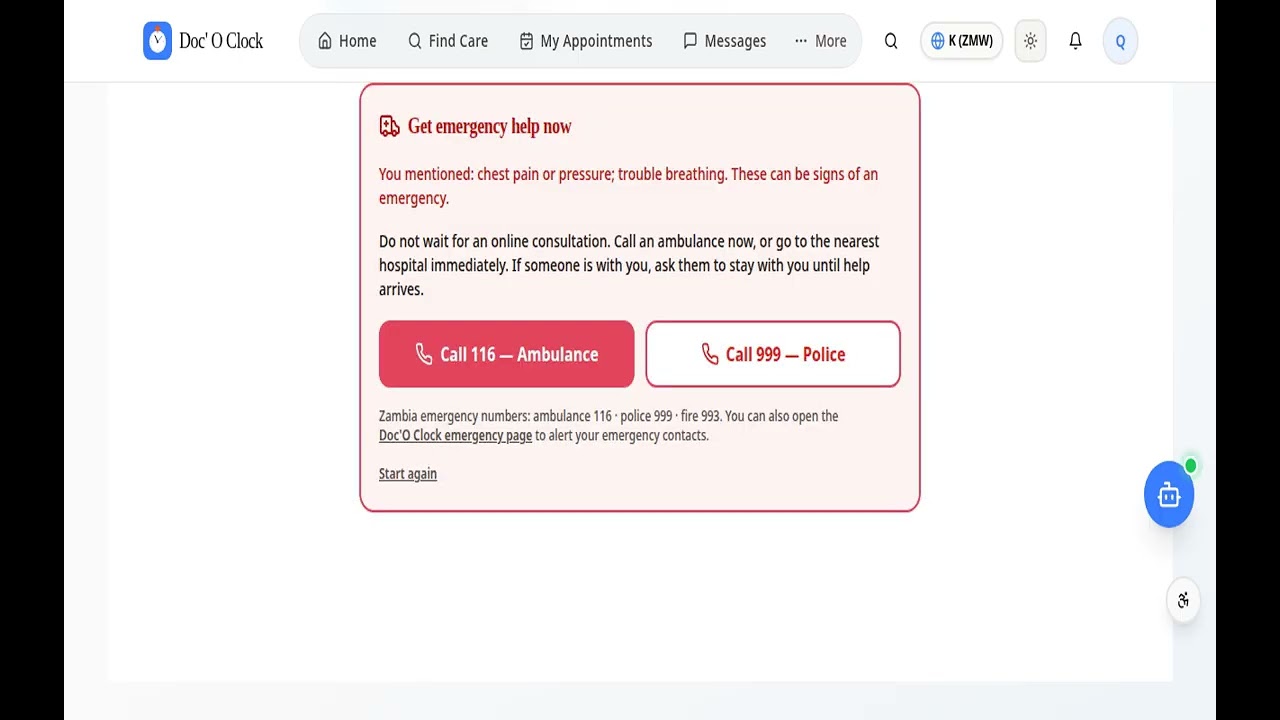
In Zambia, when a person feels unwell, the hardest question is the first one: who do I even see? Patients guess, queue at the wrong facility, travel hours, or wait — sometimes past the point where waiting is safe. During this hackathon we built the Doc'O Clock AI Triage & Care Assistant inside Doc'O Clock, our live telehealth and hospital-management platform, and shipped it to production. A patient describes symptoms through a structured, phone-first intake — or taps a symptom chip on the public landing page — and the assistant does three things: 1. Screens for danger first, deterministically. Before any AI is consulted, a red-flag screen (on the device, and again on the server) checks for chest pain, breathing difficulty, stroke signs, severe bleeding, pregnancy emergencies, fever in a baby under 3 months, and more. A hit produces an emergency screen instantly — tap-to-call 116 (ambulance) — with no network wait and no model in the loop. 2. Guides with Meta AI. When no danger sign is present, a Supabase edge function calls the Meta Model API (Llama 4 Maverick) with an anonymised, symptom-only payload. The model asks up to three targeted follow-up questions, then returns a structured care-routing assessment: an urgency tier, a timeframe, and the right profession from the platform's real 27-profession taxonomy. 3. Hands off into real care. One tap opens the live booking flow with that profession pre-filtered — real providers, real appointments, on the production platform. Safety is architectural, not prompt-deep. Model output is schema-validated and merged under a deterministic rules floor: urgency can only escalate, never de-escalate, and professions outside the taxonomy are rejected. The assistant is care navigation, never a diagnosis — and it is usable by every platform role under least privilege: patients can book; clinicians guiding someone get next steps only within screens they already have, with no patient record opened; everyone else gets own-symptoms guidance only. Privacy is the feature we are proudest of. The flow never asks for a name, email, phone, national ID or address. The edge function rebuilds the model payload field-by-field from a symptom-only whitelist and rejects any request carrying an identifier key. Nothing is stored: the function has no database client, and after full end-to-end testing the platform's AI-history tables held exactly zero rows — verified live. Everything in the public repository was newly built during the hackathon (26–27 October 2026) on top of our existing platform: the triage experience, the client triage engine, the Meta-calling edge function, the safety architecture, and 89 new tests pinning every red-flag category and the privacy contract.