MAKERS
Built at Meta Global AI Developer Hackathon · Oct 26, 2026 · Remote
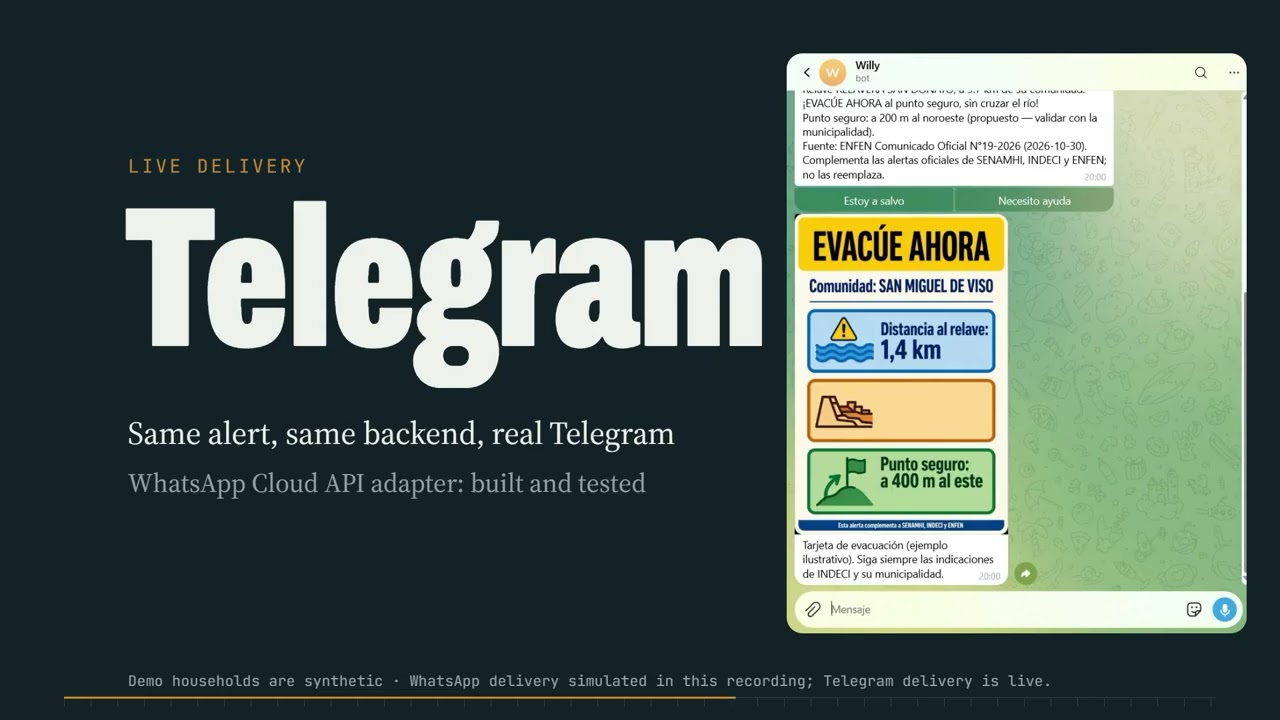
Willay ("to warn" in Quechua) is an early-warning delivery and confirmation layer for El Niño floods and debris flows in Peru, starting with Lima's Rímac and Lurín basins. Peru already produces strong risk knowledge: ENFEN forecasts (Communiqué N°19, 30 Oct 2026: extraordinary coastal El Niño through Feb 2027), SENAMHI warnings and CENEPRED/SIGRID scenarios (more than 9.3 million people at very high risk). What nobody measures is whether a warning reached a household and whether that household moved. In 2017, 143 people died; the Ombudsman found an early-warning system in only 1 of 21 ravines in Lima Este; mud in the Rímac shut Lima's water intakes and left 27 districts without water. Willay consumes those official sources instead of competing with them. Meta models extract and structure official bulletins, plan the response and analyse community video of river gauges. Deterministic rules (official thresholds), not the AI, set the alert level, and a human operator must confirm every evacuation. The warning then reaches households on the messaging apps they already use (WhatsApp Cloud API adapter; live Telegram bot; WhatsApp-style web chat for the demo). Each household answers with one tap — "I'm safe" or "I need help" — or with a voice note or location. "Need help" opens a case on the operator's 3D map. The result is a closed loop: official signal → household → confirmation data that municipalities, regional governments and water utilities do not have today. Evidence: a leakage-free backtest on 78 districts (AUC 0.93 for 2017, 0.63 for 2023; ensemble with CENEPRED 0.90 / 0.75 — we publish the weak year). Guardrails live in code: the model can explain but never escalate, every recipient is allowlisted, and demo households are synthetic.