Rikuy
Built at Meta Global AI Developer Hackathon · Oct 26, 2026 · Remote
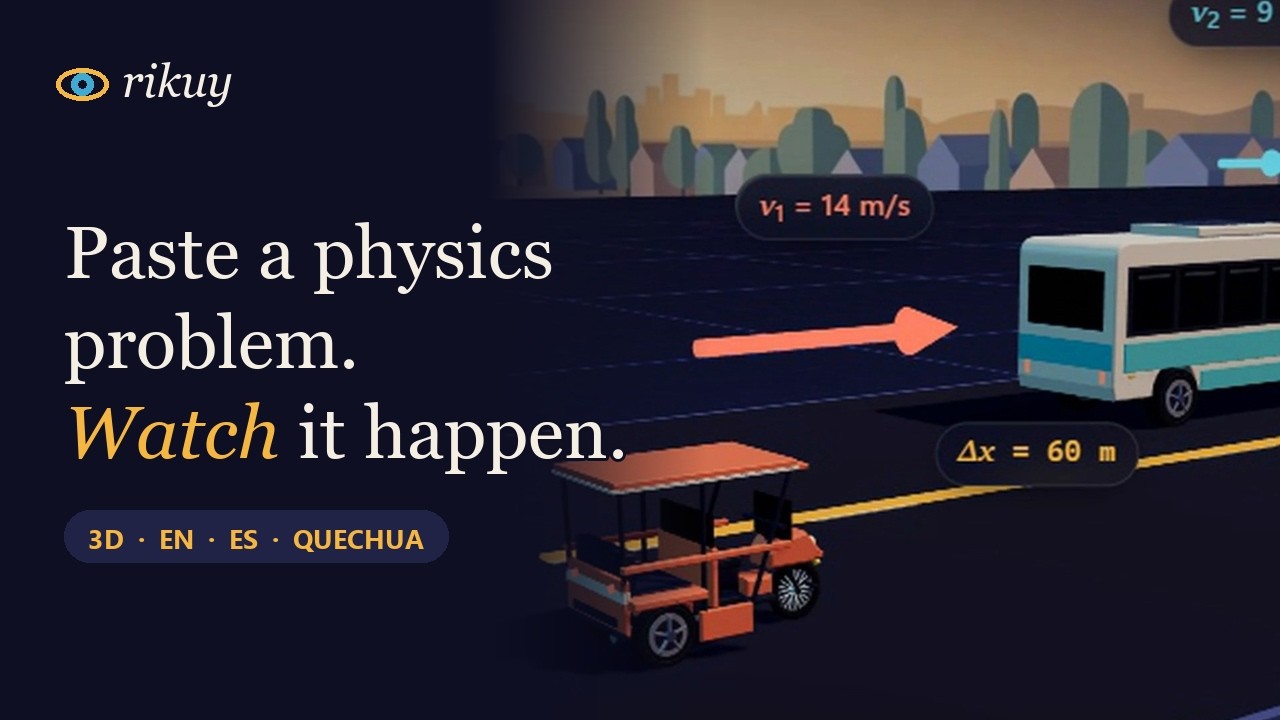
I'm an industrial engineer by profession and a teacher by vocation, and I devote part of my time to teaching. One of the most common problems I see in students is that they can't connect mathematical setups with real situations. They apply the right formula and reach the answer, but without understanding the reasoning behind it: why that equation describes that phenomenon and what each term stands for. Math becomes a procedure to repeat, disconnected from the world they see every day. That's how Rikuy was born. Rikuy means "to see" in Quechua. It takes any problem, typed or as a photo, and turns it into a narrated 3D lesson. The numbers in the problem become a scene the student can watch: the motion, the path and the forces, with a voice that explains it and the solution step by step. The reasoning stops being abstract and happens before their eyes. We started with physics because that's where a simulation adds the most: every problem describes something that moves, and seeing it changes how you understand it. From this base, Rikuy is designed to grow into other fields such as math, chemistry and economics. Rikuy doesn't just show an animation: - It adapts to each student's world. The same problem can happen in a stadium, in their city or in their neighborhood, with objects they know: a chase can be a police car, a pickup, a train or a Peruvian mototaxi. Students can ask for changes, like a basketball instead of a soccer ball, and Rikuy creates a new version of the lesson. One simulation becomes thousands of lessons. - It lets students experiment. They can explore the scene in 3D and change the values (speed, angle, distance) to see instantly how the result changes, understanding how the data relate instead of memorizing a procedure. - It works with any problem. When a problem is new, Rikuy builds the whole lesson with Meta's Muse models and verifies that the physics is correct. When a problem covers the same topic as one already built, Rikuy reuses that lesson and adapts it to the new numbers, so the student gets it in seconds. I also wanted to reach the people educational technology rarely takes into account. In Peru, almost 14% of the population learned to speak in Quechua (2017 Census, INEI), more than 3.7 million people, mostly in rural and Andean areas, and there are almost no science materials in their language. That's why every lesson is explained in English, Spanish and Quechua, with voice and subtitles, so a student can learn in the language of home. Our goal is for every student to understand the real logic behind each problem: not only how it is solved, but why the world works that way.