Merit
Built at Meta Global AI Developer Hackathon · Oct 26, 2026 · Remote
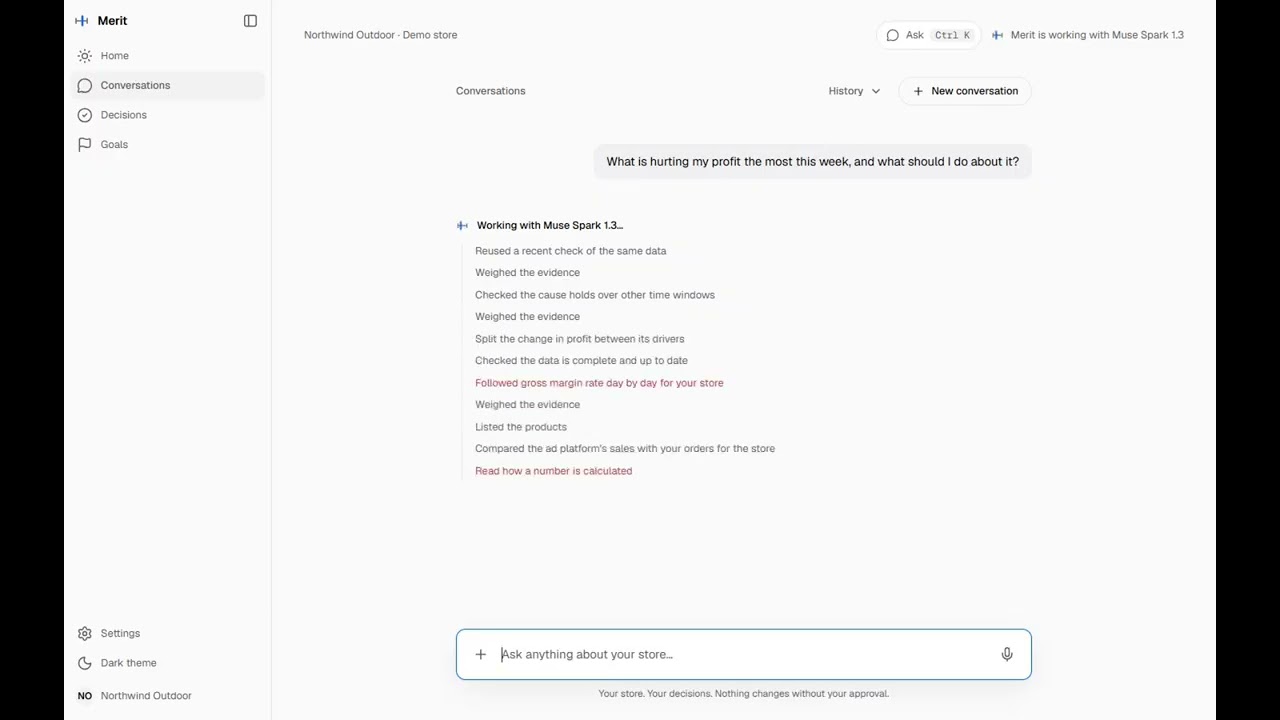
Big brands have data teams. Small stores have a gut feeling. A data analyst costs more than most small online stores earn, so their owners make decisions without looking at the data: they raise an ad budget, launch a promotion, reorder stock, by instinct. When it goes wrong, nobody notices in time. Ads keep paying for a product that is out of stock, a supplier quietly raises prices, refunds creep up, and money leaks for weeks. For a small store, a few bad decisions can be the difference between profit and closing. General AI assistants don't fix this. They answer confidently with numbers they invent, and the owners who can't afford an analyst are exactly the ones who can't check them. Merit is the data analyst these stores can't afford. It watches the store every day, finds where it loses money, proves it with verifiable numbers, acts only with the owner's approval, and measures what each decision actually earned. How Merit works: - Detects: daily checks on sales, ads, refunds, stock and costs, grouped into incidents with ranked root causes and an exact attribution of the profit change. - Proves: no number ever comes from the model. Every figure is computed in SQL on exact decimals, with its formula and lineage; the model can only reference those facts, and a verifier rejects any other number. Click any number to see how it was computed. - Simulates before acting: a store twin compares each option against doing nothing, with calibrated ranges, and code decides go, adjust or avoid. - Acts with approval: a policy engine (spending caps, reversibility, a kill switch, autonomy earned over time) and safe, idempotent execution on the Meta Marketing API. - Measures what it earned: outcomes measured against what would have happened without the action, or an honest "we can't tell yet". - Goals: "+20% net profit in 90 days" becomes a probability and a plan of concrete steps, tracked weekly. - Where the owner already is: daily briefs by email, and WhatsApp, where owners approve from their phone or ask a question by voice note, in plain language, no dashboard needed. Measured on held-out benchmarks: 70% top-1 / 75% top-3 root-cause accuracy across 8 fault types, 1 false profit alert in 30 healthy stores, 0 unsafe outcomes in red-team suites, 0 duplicate executions. It costs about USD 5.81 per store per month: a data analyst's judgment at the price of a coffee. General agents tell you what to do. Merit proves why, simulates before acting, and measures what it earned.