Wildseek
Built at Meta Global AI Developer Hackathon · Oct 26, 2026 · Remote
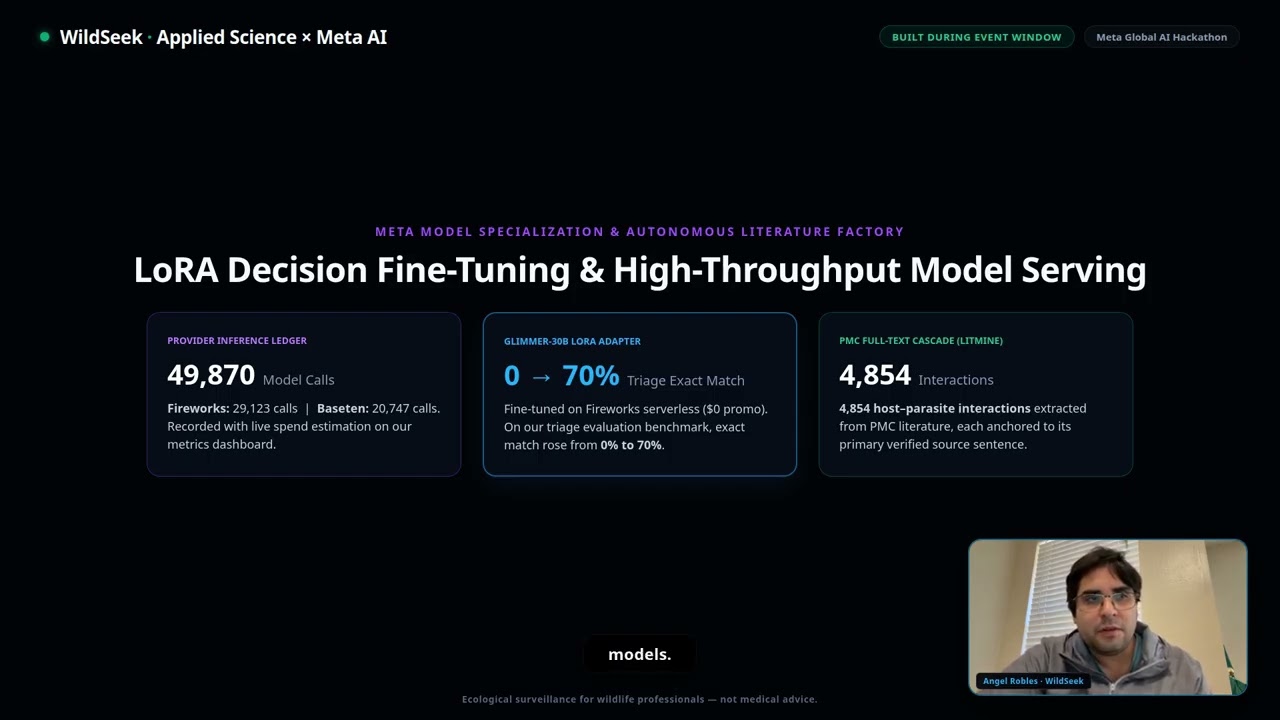
WildSeek is a live surveillance map for bird flu (H5N1) in U.S. wildlife and livestock, at wildseek.ecoseek.org. Diseases that start in wild birds reach poultry farms and the food supply: between 2022 and 2024, 82 million birds were affected on 1,109 farms in 48 states, and egg prices rose from a $1.67 average (2021) to a $6.23 peak (March 2025). WildSeek helps agencies and scientists see where to look first. A wildlife veterinarian or a poultry biosecurity officer opens the map, sees which watersheds and counties carry the most risk, and reads why: which species, which detections, which papers. WildSeek combines 9,139 USDA-APHIS wild-bird detections, niche models for 1,147 species (101,376 fits), and 4,854 host-parasite interactions mined from the literature into risk scores for 2,247 watersheds and 3,109 counties. The results are published as an interactive map, an API, and a plain-language briefing. WildSeek is built as an AI factory on Meta's Muse models. Muse Spark reads full-text papers and extracts each interaction with its source sentence, at $0.0014 per edge. It also reviews ambiguous species models, and flagged 49 of 173 for a person to check, with its reasons. We fine-tuned Muse Glimmer-30B with LoRA on Fireworks, raising passage-triage exact match from 0.0 to 0.70 (28-0 paired wins, $0 training cost). Fireworks and Baseten handle the cloud inference (49,870 calls logged so far). A nightly pipeline rebuilds the map and ships it only if it passes automated review: code and security checks must pass, three of four reviewers (including a Muse judge) must agree, and a cost cap applies. Today's live build scored 4/4. The evidence is public. On 53 held-out hosts from the literature, the susceptibility model reaches an AUC of 0.74. On a held-out Ebola/Lassa reference set, full-text extraction recovers 56% of known host-pathogen pairs, against 16% from abstracts alone. And 15 dated predictions are frozen and tracked in the open, so anyone can check whether the model was right. For Track T2, the frontier we push is turning agentic AI into a working public system: models that read the science, ask a human when unsure, check their own release, and log every call and its cost. Code, evaluations, the SFT dataset (huggingface.co/datasets/alrobles/wildseek-sft) and the LoRA recipe are open, and the pipeline is built to generalize to the next pathogen.