paneller
Built at Meta Global AI Developer Hackathon · Oct 26, 2026 · Remote
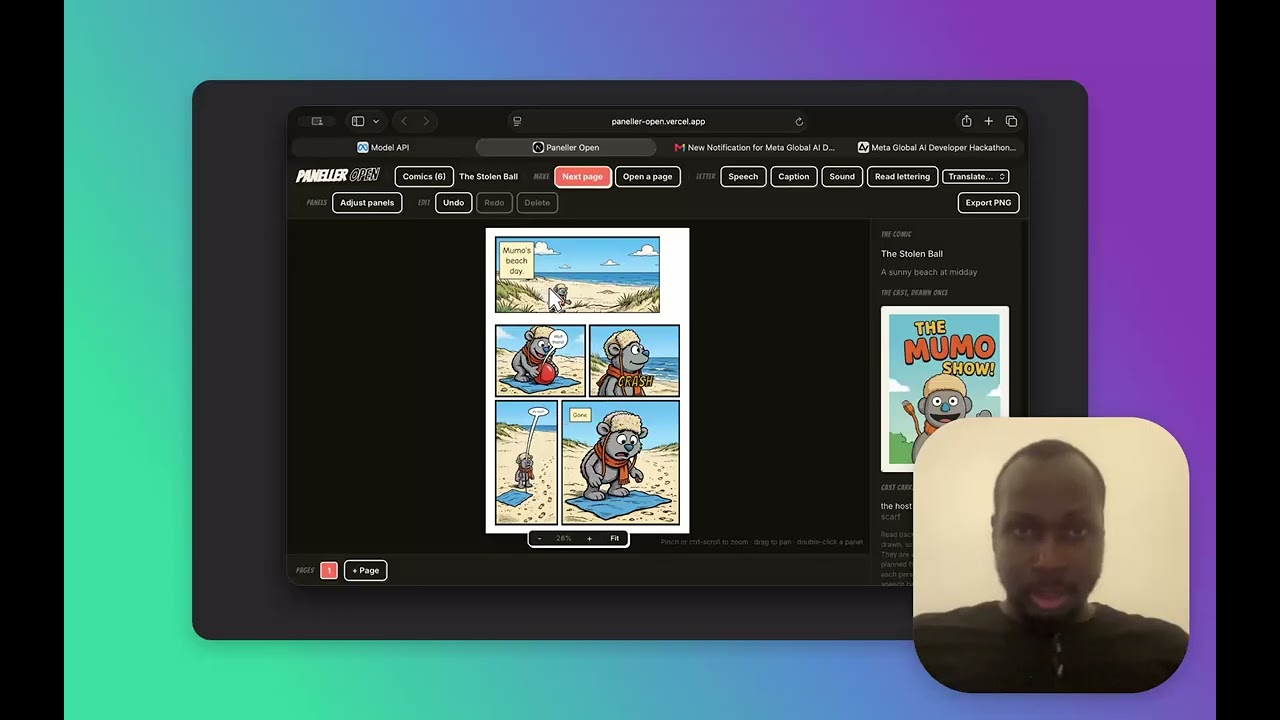
Most people who want to make a comic never make one. Not because they have no story — because a page is weeks of drawing, and the story dies waiting. Paneller Open makes the comic. Type what happens, pick a style, and about forty seconds later a drawn page is on screen with the panels laid out and the dialogue lettered in. Keep going and you have a story: page two is planned knowing who is in it and drawn against page one, so your characters keep their faces and their clothes instead of becoming different people every page. You can cast real people — upload photographs of your own characters and they are drawn into the comic. Then say the whole thing in Yoruba, or Japanese, and the sound effects become noise in that language rather than a dictionary entry: "SKRRRT!!!" becomes "GRIIIT!!!". What makes it a comic maker rather than a picture generator is that nothing is finished until you say so. Every panel is a thing you can grab — move it, swap two of them, resize one, redraw just that panel from an instruction while the rest of the page is untouched. Every balloon is a thing you can edit: the words were never baked into the art, so rewriting a line is just rewriting it, and the balloon re-shapes itself around what it now says. Drag the tail to point at someone else. Undo a hundred steps. That is the hard part, and it is where the models earn their place. Muse Image draws the art deliberately clean, with no lettering anywhere in it, so the words can live on top as real objects. SAM 3.1 then finds every panel, bubble, caption and sound effect on the drawn page, which is what turns one flat picture into parts you can hold. Panels come back as polygons, so a slanted wedge layout works, not just a grid. And because that reading step doesn't care who drew the page, you can also open a page you drew yourself, or scanned, and carry on working on it. Measured honestly: across a six-page test corpus, counted by eye rather than taken from the prompts, it finds 30 panels against 30 drawn, exact on four of six pages, including five slanted wedges and a nine-panel manga page. Sound effects 4/4. Caption boxes are the weak spot at 7/11, and the repo says so. No account, no server, no database — the comic lives in your browser and exports to PNG. Apache-2.0, so any of it can be lifted into your own tool: the Meta client, the segmentation wrapper, the page model, or the editor whole. Live: https://paneller-open.vercel.app
