O Encaixe
Built at Meta Global AI Developer Hackathon · Oct 26, 2026 · Remote
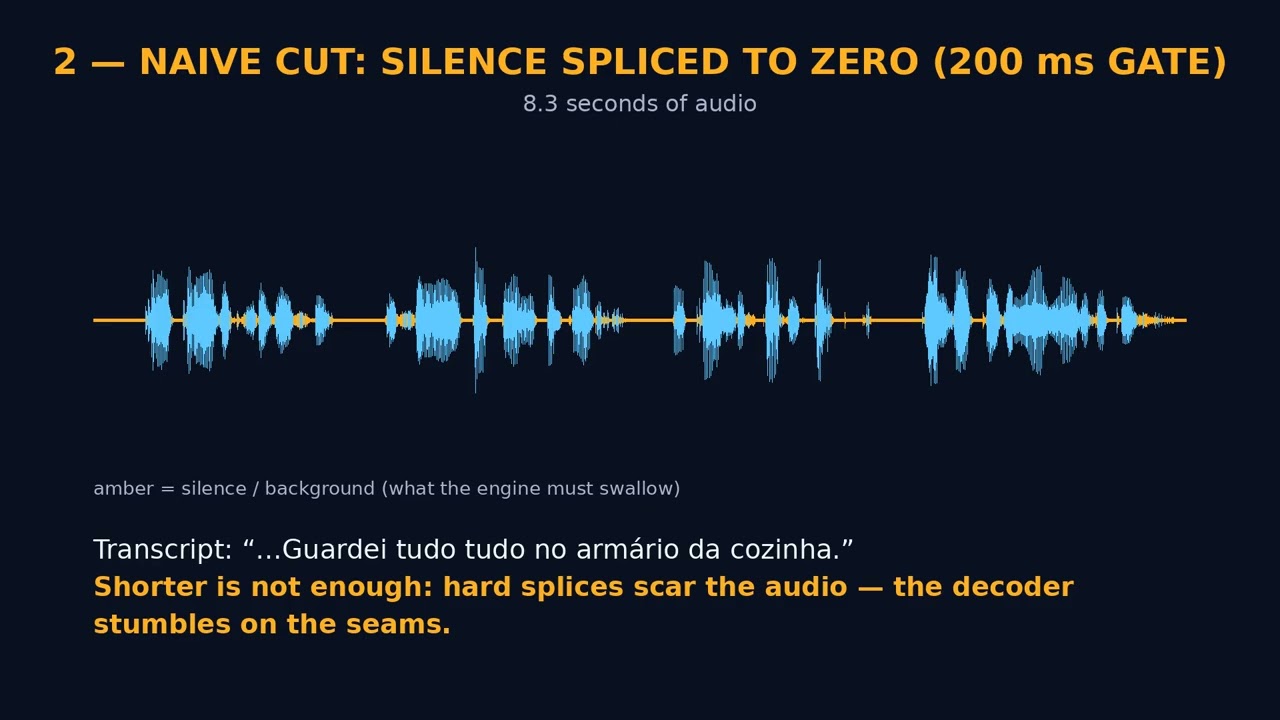
Voice transcription in today's apps hallucinates — and it hallucinates in the pauses. When a dictating user stops to think, streaming decoders keep generating: they invent phrases, insert foreign alphabets, flip languages mid-sentence, and duplicate words out of silence. I documented this live: dictating in Portuguese, an app inserted Swedish text; dictating "Tell Jim" on my way home, it arrived as "Belgium" — the person I was writing to became a country. It happens in every language and every app, and it breaks trust in voice as an input method — worst for the people who depend on dictation most. The failures cluster in one place: the pause. Engines offer no pause or silence control at all — Meta's Muse Voice Transcribe has no silence parameter; its documentation's only guidance is to keep sending PCM silence. The decoder is left alone with a void, and it dreams. O Encaixe ("The Fitting") is a client-side layer that sits in front of Muse Voice Transcribe and treats silence as an action — ESG, Explicit Silence Gating. A local energy VAD classifies each 20 ms frame. Pauses shorter than a tuned threshold (450 ms) are prosody and pass untouched. A longer pause is never handed to the decoder as raw acoustic vacuum: in file mode it becomes a calibrated cadence buffer — a uniform 300 ms of clean silence, context kept on both sides, fades at the seams; in streaming mode the gate holds silence frames locally, so the pause becomes a protocol state. A second layer applies the API's keywords and languageBias parameters to anchor vocabulary, and validates the engine's final transcript against its last partial. Measured during the hackathon (7 scripted clips, real API calls): the gate retained up to ~68 seconds of dead air across the clips — on the stress clip (26 s, 71% silence) only 8.3 s reached the engine. Three findings: (1) the engine is non-deterministic — the same WAV returned different errors on identical calls; (2) naively splicing silence to zero creates its own errors (the Hard-Splice Paradox); (3) with the ESG Tuned calibration, the stress clip transcribed perfectly — 19/19 words, zero invented — where the raw engine erred twice. O Encaixe is a protocol, not a pair of scissors: silence with a shape the decoder can trust. Project by Matheus Filipe Ferreira Lima — discovery, tests and direction his. Built with Muse; architecture analysis in collaboration with Gemini ("Jim").