DataTraces
Built at Meta Global AI Developer Hackathon · Oct 26, 2026 · Remote
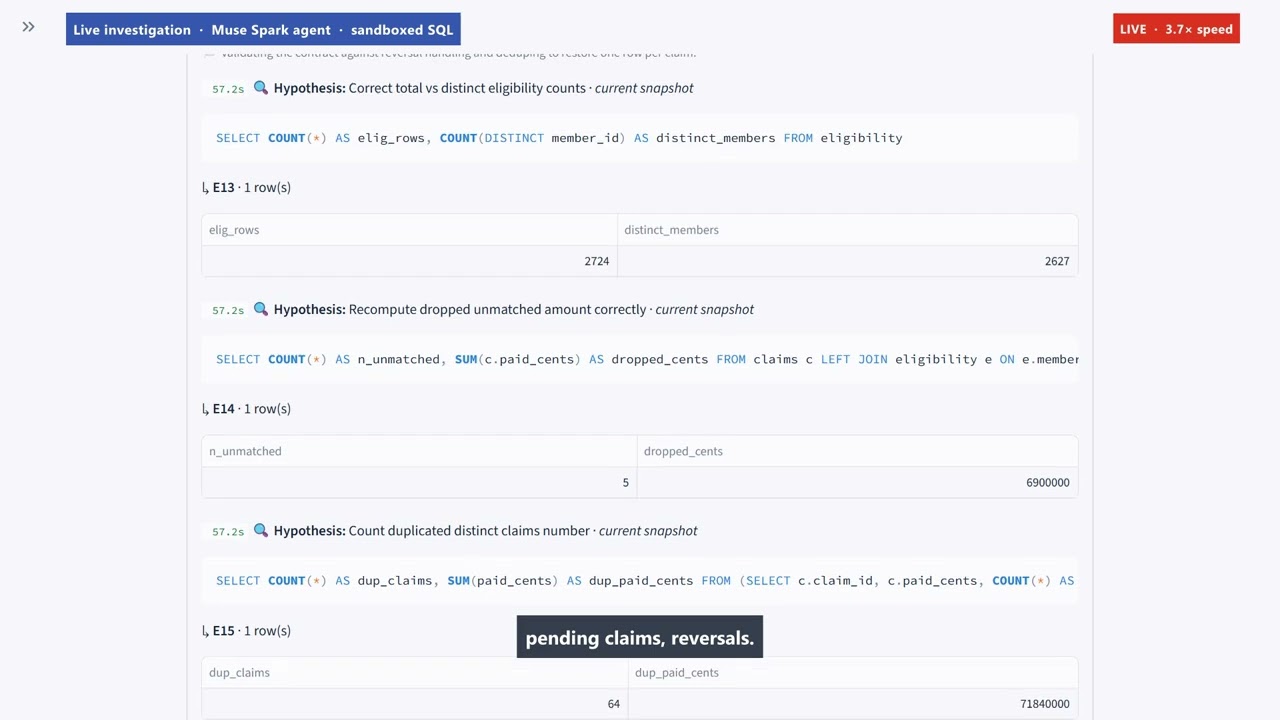
Every month, healthcare finance, actuarial and analytics teams get the same question before the cost review: paid claims jumped, so is it real? Claims data makes it hard. Late claims keep arriving for weeks (run-out), adjudication is pending, reversals net against paid, and eligibility files get rebuilt. A genuine trend and a data defect often land in the same month. DataTrace gives that question to a Muse Spark agent with real tools. Given the previous and current SQL, two data snapshots and the metric definition (or just an actuary's voice note and a dashboard screenshot), it: - replays old and new SQL on old and new data; - tests hypotheses (duplicate eligibility rows, members dropped by joins, service-date boundaries, pending claims, reversals) with bounded, read-only SQL in a local sandbox, never seeing raw rows; - reports a fix only after a deterministic checker verifies the complete per-claim result; - gets an independent review from Muse Wonder, which can send it back to revise; - pauses and asks when the definition is incomplete, instead of guessing. On real-format CMS DE-SynPUF Medicare claims, it showed that of a +$5.21M jump in November paid claims, $4.56M was genuine run-out and $649,400 was an eligibility-rebuild defect across 69 claims. It produced verified corrected SQL and a leadership brief. The same engine runs retail revenue incidents through a domain profile. Across 360 paid benchmark runs against the same model given every raw row and no tools, the agent scored 179/180 versus 168/180. More importantly, it put the right dollar amounts on real change and reporting error in 16/16 claims runs versus 4/16. At 42k rows the no-tools approach cannot run at all (context_length_exceeded). In a planted-error test, the reviewer caught 28/28 errors.