Déjà Vu
Built at Meta Global AI Developer Hackathon · Oct 26, 2026 · Remote
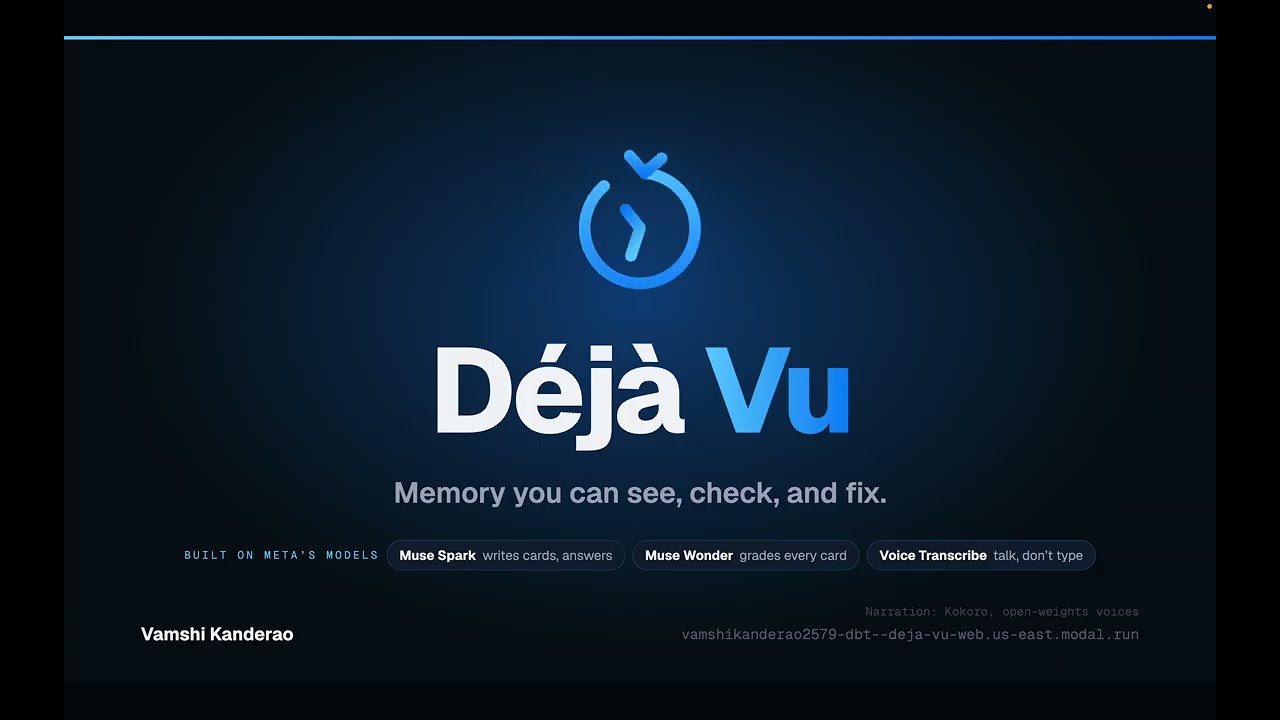
Déjà Vu is a confirmed-memory layer for personal AI agents. It isn't another chatbot: any agent (Muse, ChatGPT, Claude or your own) can plug it in over HTTP with three calls: recall, remember, confirm. The problem: today's agents remember you, but never check if it's still true. You can't see what they guessed or why. Your preferences change every day, but a memory from two years ago still recommends the same dinner. A summary loses details. Re-reading the full history costs too much. Why it matters: personal agents only feel personal when people trust what they remember. Déjà Vu personalizes the right way: it learns from your chats, shows where each guess came from, and checks with you before a guess acts on your behalf. That trust is what lets people hand more of their day-to-day to an agent. How Déjà Vu works: - Learns short memory cards from your chats. Each card is a guess until you confirm it, and every card links to the chat it came from. In the UI, inferred cards are labelled "My guess". - Uses every card that fits a request, guesses included. Confirming is never a gate. - Asks once, in one line, only when a key guess is about to drive something that matters, like a booking or a purchase. The don't-nag rule is code, not a prompt. - Fix memory in one tap: swipe a card right if it's still true, left if not. - Zero setup: import a ChatGPT, Claude or Muse chat export and it writes your first cards. Built on Meta's models: Muse Spark writes the cards and the answers, Muse Wonder grades every card against the chat it cites before it's kept, and Muse Voice Transcribe takes spoken replies. Memory stays bounded (10 topics, 8 cards each, 14 words a card), and secrets are stripped before anything is learned. Plain Node, zero dependencies, 65 tests, MIT licensed. Results (eval on 14 people, 312 checks: 12 synthetic personas plus 2 real chat histories kept private): - Déjà Vu answered 80.4% correctly, vs 72.4% for a memory summary and 75.0% for the full history. - When a preference changed outside the chat: 80.6%, vs 49.2% and 55.6%. - About 381 tokens in per answer, vs 603 for a summary and 6,945 for the full history: 94% fewer than re-reading everything. Try it live: https://vamshikanderao2579-dbt--deja-vu-web.us-east.modal.run Pick a demo person (Alex or Maria) for a guided tour, or import your own chat export. Code: https://github.com/vamshikanderao2579-dbt/deja-vu-confirmed-memory