Mouad El Abbassi
Built at Meta Global AI Developer Hackathon · Oct 26, 2026 · Remote
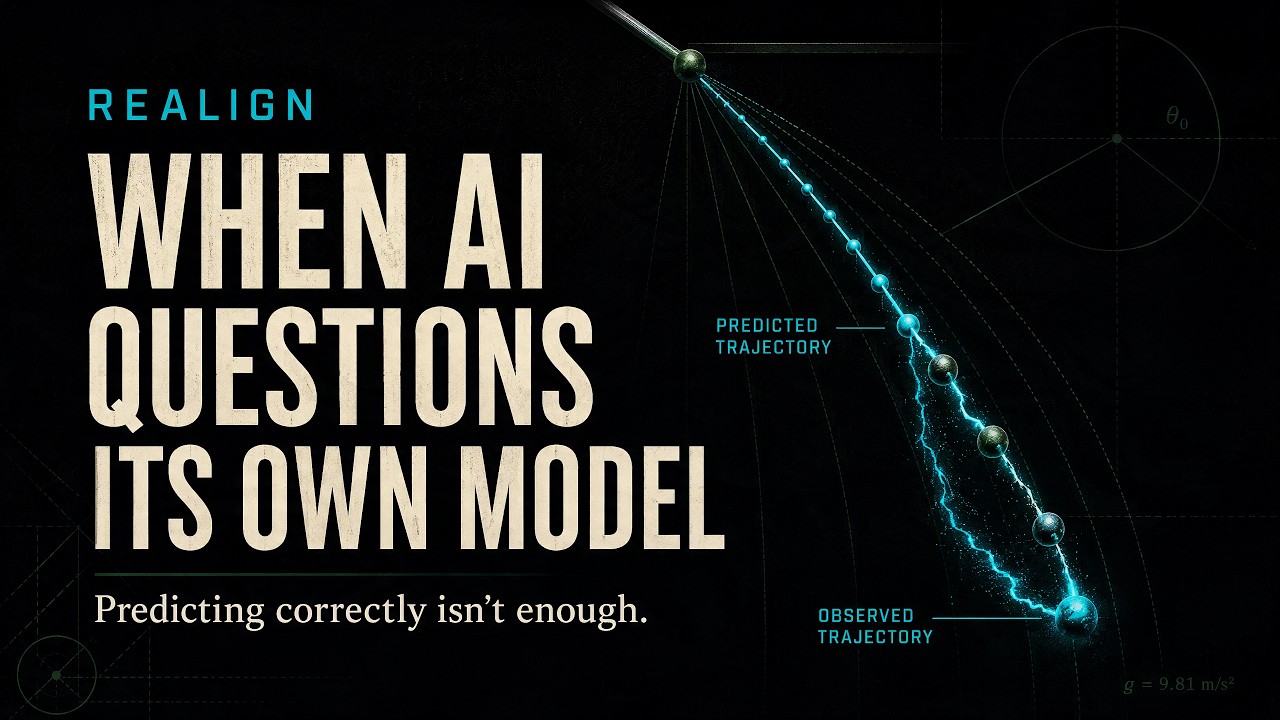
REALIGN - An AI Scientist That Questions Its Own Models What happens when an AI's understanding of the physical world is wrong? Most AI systems make predictions using models they assume are correct. REALIGN takes a different approach: it investigates discrepancies between observed reality and a physics simulator, tests competing explanations, proposes informative experiments, and determines whether the available evidence supports changing the model. Built around a physical pendulum and a controlled peg-contact scenario, REALIGN combines Meta Muse Spark 1.3 for scientific reasoning, Meta SAM 3.1 for visual perception, and a deterministic physics engine for simulation, parameter estimation, and model comparison. The system includes an interactive investigation workspace, live camera capture, asynchronous AI processing, experiment requests, auditable tool calls, and independent model validation. Its defining principle is scientific accountability: REALIGN can preserve an existing model, recalibrate its parameters, select a predefined alternative, request better measurements, or abstain when evidence is insufficient. In a reproducible synthetic challenge, REALIGN correctly rejected a model that predicted motion accurately but recovered the wrong physical geometry. This demonstrates why a good prediction alone is not proof of a correct scientific explanation. REALIGN moves toward an AI that doesn't just predict the world it actively investigates when its understanding of the world may be wrong. Validation boundary: The demonstrated Muse investigation and independent model challenges use synthetic observations. SAM has also been exercised on real external video. A complete, independently validated physical model-repair experiment remains future work.