Shree
Built at Meta Global AI Developer Hackathon · Oct 26, 2026 · Remote
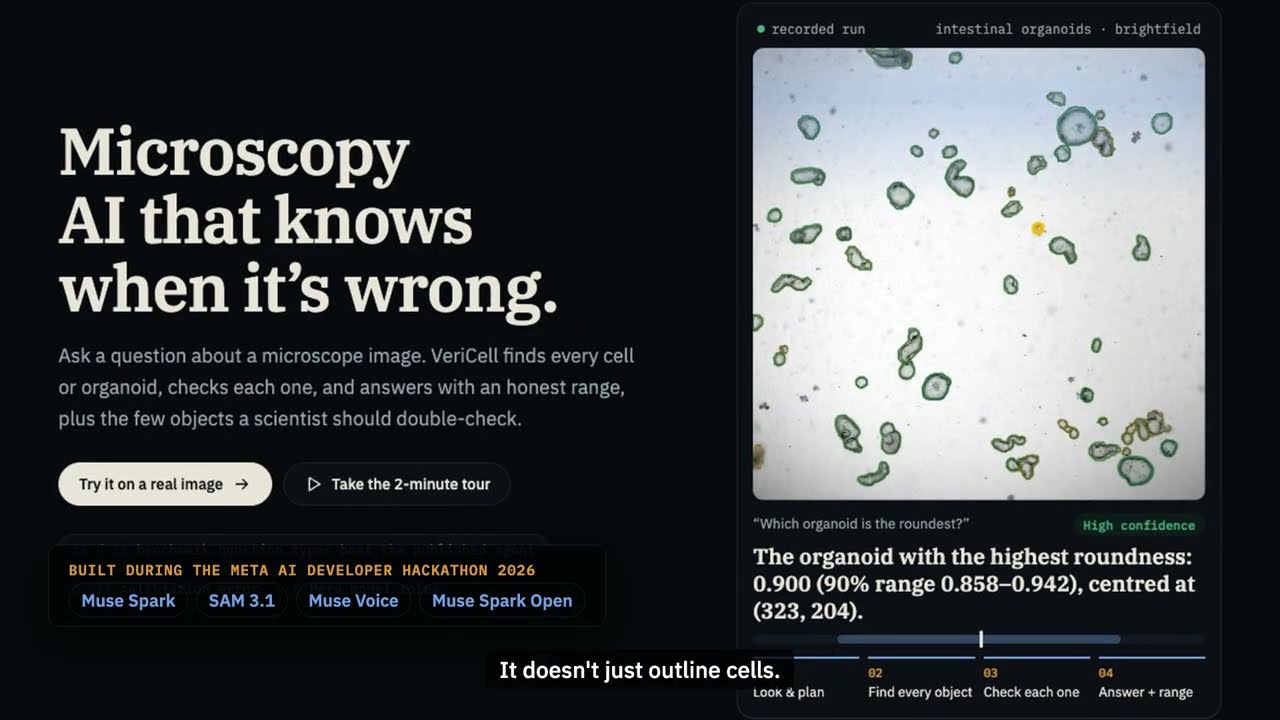
AI can outline every cell in a microscope image in seconds. It also gets about 1 in 5 wrong, and it never tells you. Those outlines feed drug screens, cancer research and published papers, and nobody can re-check hundreds of objects by hand. VeriCell is an AI research assistant for microscopy that knows when it's wrong. A scientist picks or uploads an image and asks a plain question, typed or spoken. It answers with a calibrated 90% range, then does what no other tool we found does: it checks whether the conclusion itself could change. From our demo: asked for the largest organoid in a colon image, VeriCell answers 8,240 px² and warns: "#321 is 6% larger but only 59% likely to be one real organoid. If it is, it becomes the answer." The claim "at most 9,000 px²" comes back 1-organoid fragile. Four human checks later the conclusion holds, the claim is robust, and the answer is 8,772 px² against a hand-measured 8,818: from 7% off to within 1%. How it works: a fixed backbone (Look, Plan, Segment, Verify) feeds an agent loop. Cellpose-SAM runs at 3 scales with merged-lobe candidates; SAM 3.1 adds zoom-tiled text prompts and a zoomed box second opinion. A gradient-boosted verifier turns 22 signals into a calibrated P(real) per object. Plain code computes every measurement. 90% ranges use split conformal calibration, with Monte Carlo over P(real), relative or ratio forms per question type. Answer stability finds challengers, successors and near ties; a greedy minimum-flip search stress-tests claims; the review queue previews the answer if yes or no, with undo. Every run exports JSON evidence, and a re-imaging plan can be written as a Pycro-Manager script. Results, all out-of-fold: - Beats the published MorphoOrgaAgent on 16/16 question types (MorphoOrgaVQA, 68 images; largest area: 3.6% vs 16.8% error). - When it says a "largest organoid" conclusion holds, it is right 87% of the time (within 15% of truth); when it warns, the answer is nearly 4x as likely to be wrong (49% vs 13%). - Spots wrong cells with AUROC 0.866 vs 0.823 for SAM 3.1's own confidence; ECE 0.012. - 90% ranges contain the truth 89-92% of the time on held-out images. We publish what failed too: three Muse Glimmer fine-tunes lost to Muse Spark, the crop judge tops out at 72%, and ranges stay wide on hard images. Live demo with a 2-minute guided tour; 31 unit tests in CI; FastAPI app deployed on Modal. Research use only, never diagnosis. All code was written during the hackathon.