Every Voice Heard
Built at Meta Global AI Developer Hackathon · Oct 26, 2026 · Remote
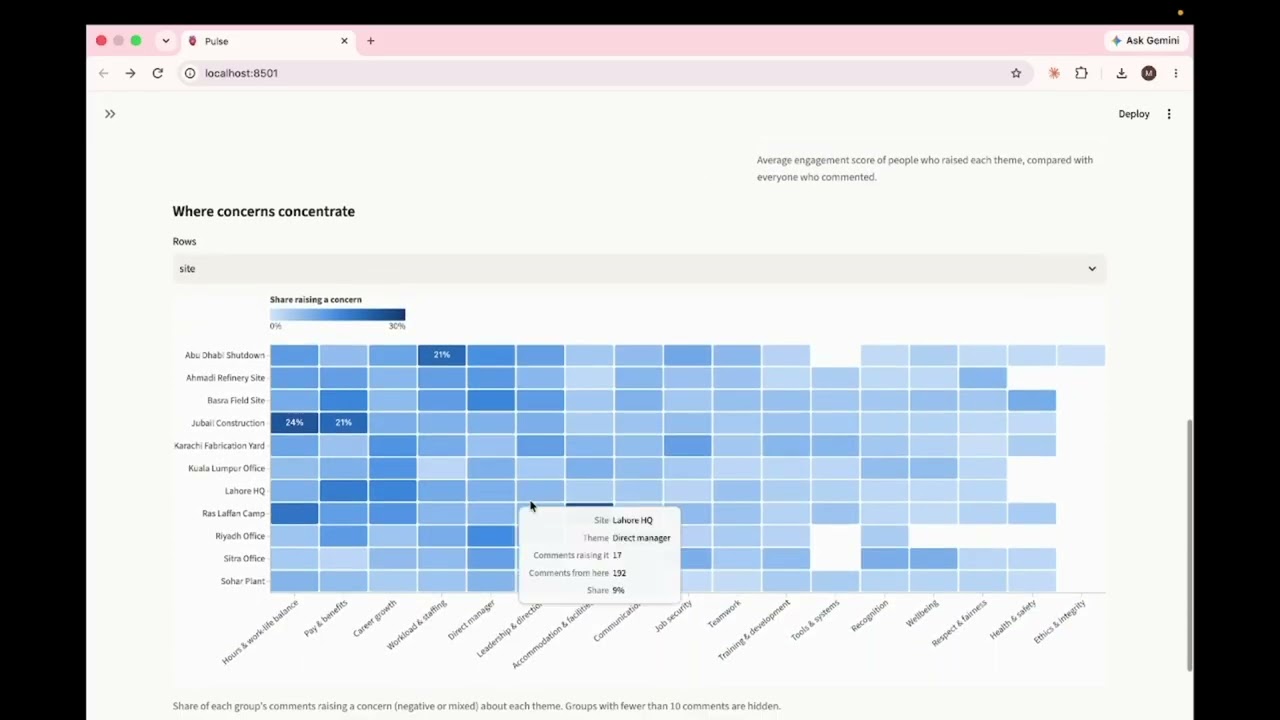
Pulse reads every employee-survey comment in the language it was written in, flags the ones where someone may be at risk, and checks its own work before anything reaches a manager. THE PROBLEM Multinational companies survey thousands of people across countries and languages. Open-text comments are the most valuable part of a survey and the least used. In my previous role I co-led an engagement survey of 3,000 employees across 9 countries in 4 languages. The comments were read by hand, and most never made it into the findings. The ones lost were mostly not in English, and that is often where safety and fairness problems sit. WHAT PULSE DOES - Reads each comment in its original language, with no translation step, and tags it by theme, sentiment and urgency, with an English summary and a verbatim evidence quote that Pulse checks really appears in the comment. - Sends safety hazards, harassment, discrimination, wellbeing risks and misconduct to a confidential review queue. Both the model and an independent multilingual keyword backstop can flag a comment, and repeated reports from one team are surfaced as a cluster. None of these reach a manager. - Checks itself against a hand-coded sample, on themes, tone, urgency, sensitive-comment recall and each language. If agreement is too low, manager briefs stay blocked. - Writes each manager a short action plan in their own language, from counts and paraphrases only. Teams too small to stay anonymous get no brief. HOW IT USES META'S MODELS Pulse runs Meta's Llama 3.1 8B locally through Ollama on an ordinary laptop. No API key and no cloud, so confidential feedback never leaves the machine. It uses Ollama's native API to raise the context window and to enforce a JSON schema built from the theme list, so the model always returns valid, complete tags: the full survey ran with zero failures. Sensitive or uncertain comments get a second, single-comment read. The same code also supports Muse Spark through Meta Model API and Muse Glimmer on a GPU server (tested against simulated servers, not yet live), and the release gate compares any model on the same hand-coded sample. RESULTS On a synthetic survey I built (1,302 comments from 9 countries and 62 teams, in Urdu including Roman Urdu, Arabic, Hindi and English), Llama 3.1 passed the release gate on 230 hand-coded comments; keyword rules failed it. Llama read Urdu tone correctly 86% of the time, against 46% for keyword rules. Pulse routed all 35 sensitive comments in the sample to review: Llama flagged 26 on its own and the keyword backstop caught the rest. The gate earned its place: the first run missed five discrimination reports buried in a second sentence, the gate caught it, and a fix to the backstop closed the gap (found on the same sample, so a fresh one is the real test). The full survey ran in 105 minutes at zero cost. Built with Python and Streamlit, with 69 automated tests. Open source under the MIT License.