CartProof
Built at Meta Global AI Developer Hackathon · Oct 26, 2026 · Remote
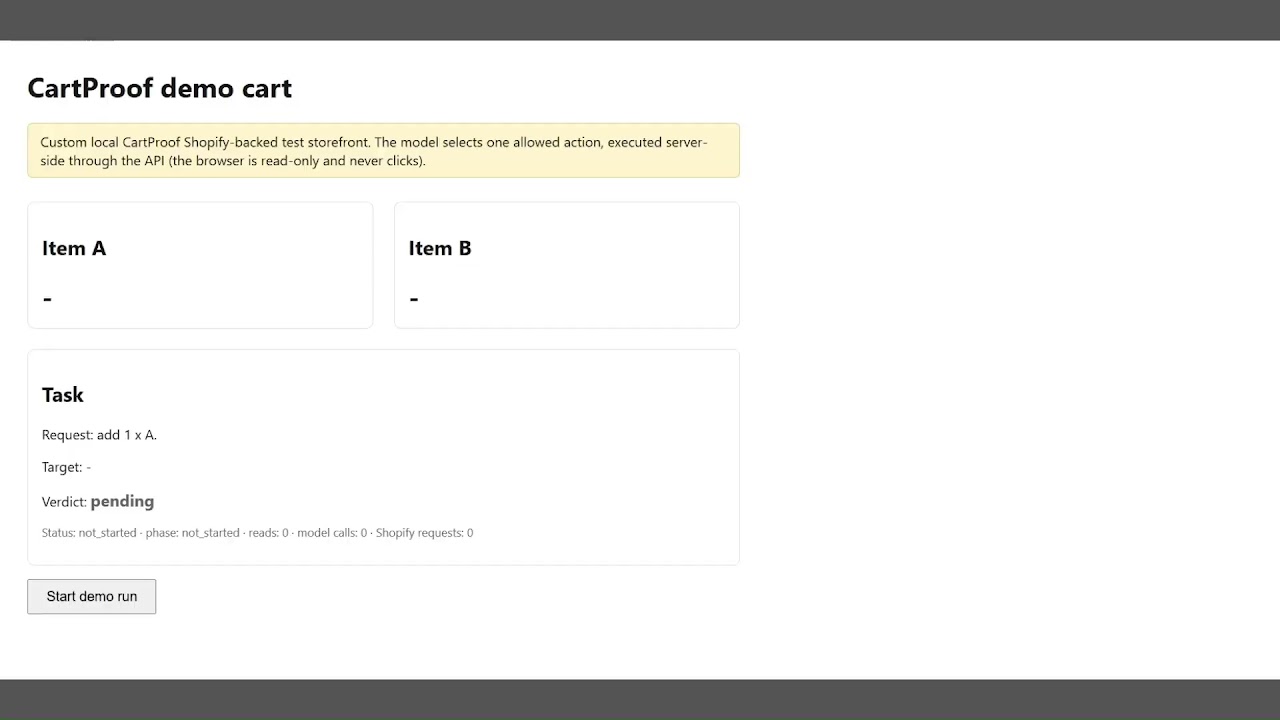
AI shopping agents can report success while the real cart says otherwise. CartProof checks what actually happened: it verifies whether a shopping action produced the requested cart state, and makes one bounded recovery when an item is missing. Built during the hackathon, CartProof pairs a Meta model with a deterministic checker. In the live demo, the customer's cart instruction is resolved by a deterministic, explicit SKU grammar that is authoritative; Muse Spark 1.3 (via the Meta Model API) cross-checks the intent and selects the allowed cart action on a real Shopify development store (Storefront API). CartProof's server executes the chosen action, then re-reads the cart fresh from the same backend and compares it to the requested state - never trusting the agent's own report. The demo shows the full arc on one synthetic test cart: a normal add is verified; then one add is deliberately dropped before it is ever sent to Shopify (a controlled injected fault). The check reports PARTIAL - one item missing. CartProof issues exactly one bounded recovery add and re-verifies from a fresh read: final cart A=2, B=1, with the pre-existing B preserved. The run used 5 model calls and 16 Shopify requests, with no checkout, order, customer or Admin API use. A local read-only browser UI displays that same cart and the checked result. Under the hood: a Python/FastAPI service with an offline mock store for development, an MCP server exposing the store's cart tools, a provider-neutral model interface, and 122 focused offline tests covering receipts and UI behavior. Limits, stated plainly: this is an API-driven test, not browser-clicking automation; the injected fault is deliberate, not a sample of unpredictable failures; a COMPLETE verdict is a saved read at that moment, not a concurrency guarantee. The demo uses synthetic test products on a development store.