Neodustria
Built at Meta Global AI Developer Hackathon · Oct 26, 2026 · Remote
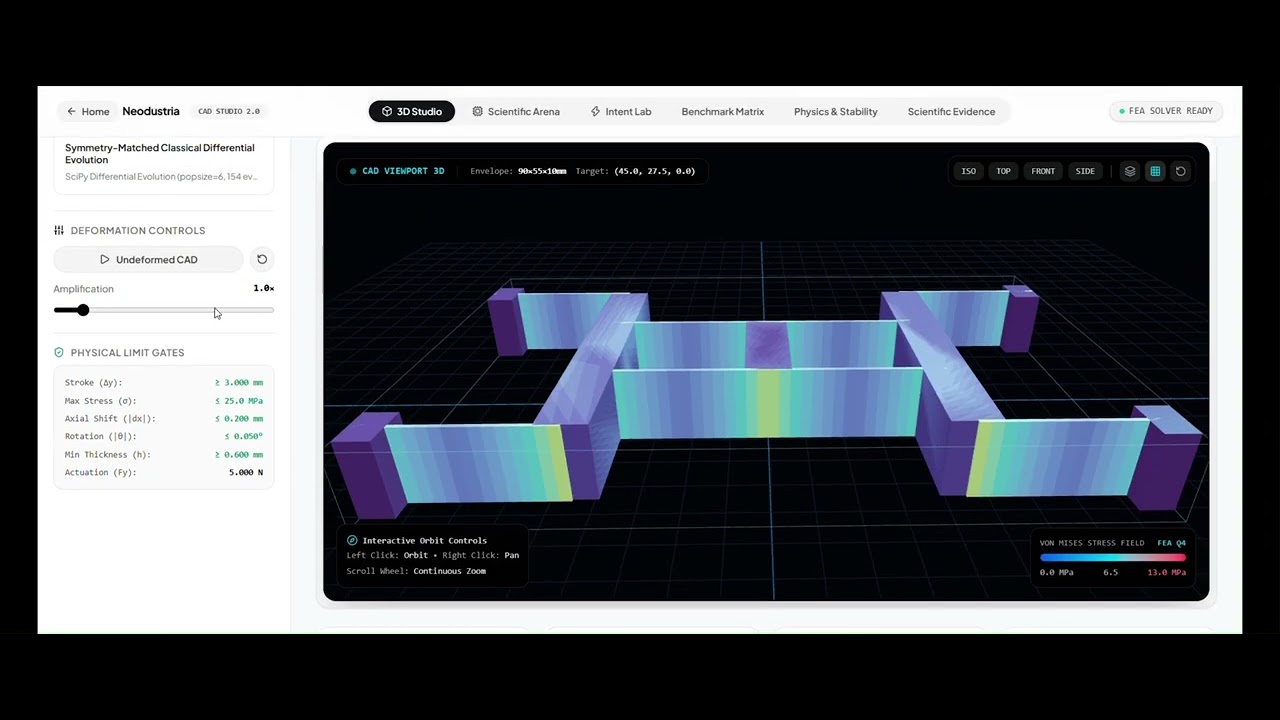
Neodustria — The Autonomous Engineering Scientist What if AI could do more than generate engineering designs? What if it could test its own hypotheses against physics, learn from measured failures, and improve its proposed solutions? Neodustria is a working AI-powered engineering studio that connects Meta Muse's scientific reasoning with nonlinear finite element analysis (FEA), structured design constraints, and interactive 3D visualization. Engineers describe a mechanical design problem in natural language, specifying requirements such as force, displacement, material, packaging dimensions, and allowable stress. Meta Muse interprets these requirements into a structured engineering specification, while independent validation checks for missing, contradictory, or unsupported constraints. Neodustria then investigates candidate compliant mechanisms—flexible mechanical structures that achieve motion through elastic deformation. Its adaptive investigation engine allows Muse to propose geometry modifications, observe actual numerical simulation results, and revise subsequent experiments. A deterministic physics solver evaluates stroke, lateral drift, stress, and declared manufacturing/material uncertainty conditions. In a verified hosted R10.1 investigation, Neodustria performed two sequential engineering experiments.The first candidate failed a robustness check. Muse used the measured feedback to propose another geometry modification, and the second candidate passed the declared fine-mesh and four joint uncertainty checks. The resulting six-connection mechanism can be inspected in an interactive 3D viewer. The system preserves experiment histories, model receipts, physical measurements, and provenance so that AI decisions can be distinguished from numerical solver results. Neodustria demonstrates a practical direction for AI-assisted scientific engineering: not simply generating convincing geometry, but creating testable hypotheses, conducting bounded computational experiments, and improving designs using physical evidence. Current validation is limited to supported planar compliant mechanisms and numerical beam-model screening. Physical fabrication and full 3D structural validation remain future work. Live Studio: https://neodustria-studio.onrender.com/ Open-Source Repository: https://github.com/AmanM006/neodustria-ai