FieldProof
Built at Meta Global AI Developer Hackathon · Oct 26, 2026 · Remote
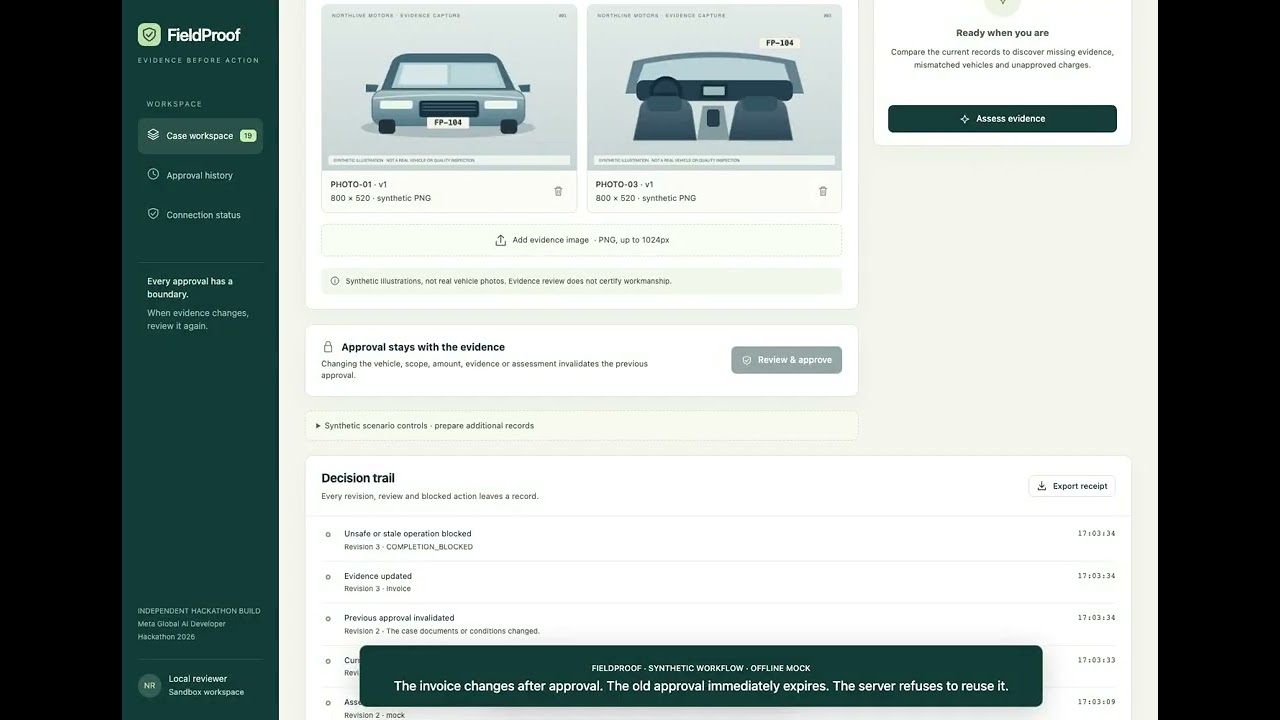
FieldProof — Evidence before action. Vehicle dealerships receive outsourced preparation work orders, photos, reports and invoices as separate records. Reviewers must decide whether they concern the right vehicle, whether evidence is complete, whether charges were authorized, and whether an earlier approval is still valid after a change. FieldProof turns that closeout into an evidence-linked workflow: import synthetic records and images, assess discrepancies, inspect source references, draft clarification, add corrected evidence, reassess, explicitly approve, and complete. SQLite preserves evidence revisions and the decision trail. Approval binds the exact evidence hash, assessment and revision. A later invoice, scope, vehicle or evidence change invalidates that approval; the server refuses completion until a fresh review. AI cannot authorize payment or send vendor messages. The 171.96-second English-captioned demo follows fictional vehicle FP-104 through mismatched records, correction, approval, a later invoice change, rejection of the stale approval and completion after reassessment. It is clearly labeled OFFLINE MOCK. The direct Meta Model API adapter targets Muse Spark 1.3 for joint image/document interpretation with structured source references. November 5 live validation made three inference attempts: two returned structured Muse Spark 1.3 results, one timed out. The initial mismatch was held correctly; the corrected synthetic case also stayed held because the model rejected illustrations as real-vehicle evidence. Live end-to-end closeout did not pass; these limits are published with request IDs and usage. The local workflow has 65 passing Node tests and 26 passing browser checks. Twenty measured mock HTTP requests had median 6.535 ms and p95 8.32 ms; these are local HTTP/SQLite timings, not Meta latency or customer time savings. Node.js 24+, no runtime dependencies, local SQLite and a browser UI make the prototype reproducible. Code, fabricated records and synthetic vehicle illustrations were created for this independent hackathon project. No customer data or existing business assets are included. This is a single-user local prototype, not a production deployment. Customer ROI and real-model accuracy have not been measured.