Saksi
Built at Meta Global AI Developer Hackathon · Oct 26, 2026 · Remote
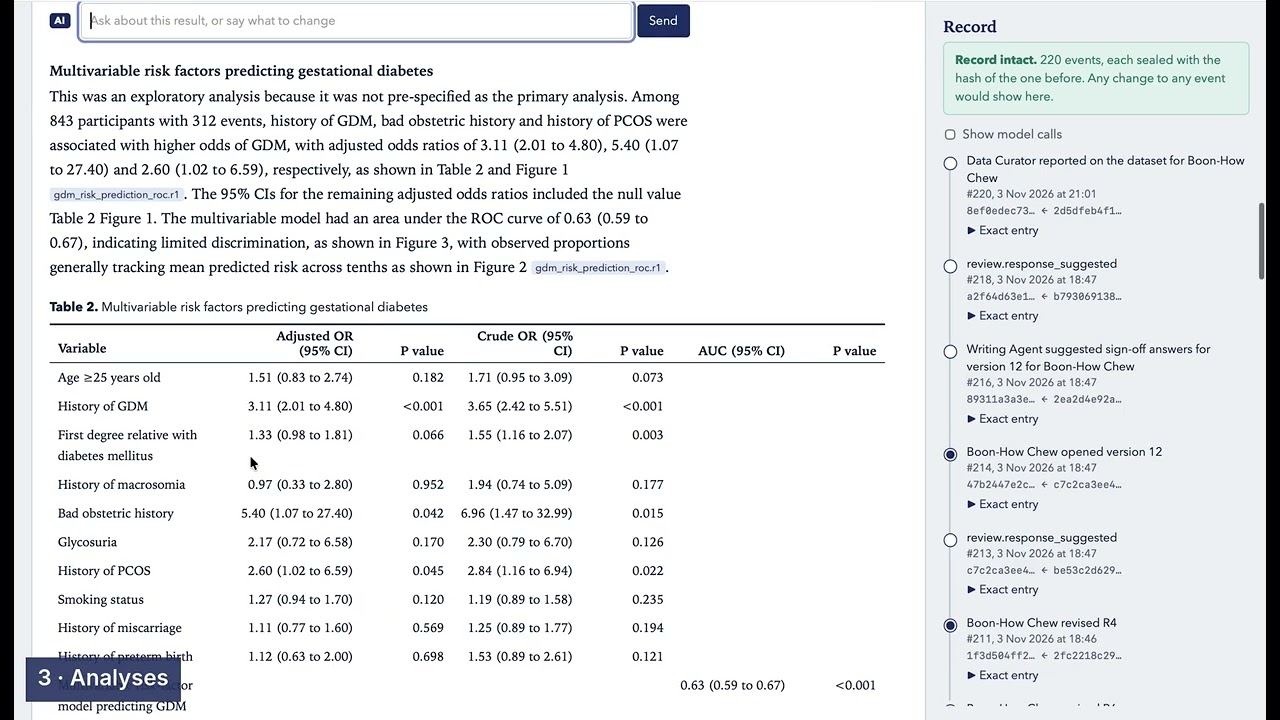
Saksi (Malay for "witness") makes research that is witnessed, not reconstructed. Today a journal receives a finished PDF, and reviewers must guess what was actually done. Saksi takes part while the work happens. Each step by a person or an AI agent is written to a hash-chained, tamper-evident record as it occurs. How it works, from a dataset and a protocol to a manuscript ready for submission: 1. Data: a Data Curator agent profiles the file from aggregates only (it never sees a record), drafts the data dictionary and flags problems. Saksi proposes cleaning steps; the authors tick them; Saksi's own code applies them to a copy and keeps the original. 2. Plan: the Analysis Agent drafts the plan from the protocol, quoting it (code checks every quotation). Labels are fixed by code before any result: confirmatory only when pre-specified as primary and adequately powered, otherwise exploratory. Every author confirms the plan. 3. Analysis: the agent writes Python that runs in a network-blocked sandbox on the real file, in a standard sequence (data checks, Table 1, univariable, multivariable with diagnostics). Results appear as a journal Results section with tables and figures built by code. Authors chat with Saksi beside each result to add variants, redo, merge tables or move sensitivity analyses to the supplement. 4. Draft: the Writing Agent writes the paper to the reporting guideline (STROBE, CONSORT, TRIPOD+AI...), cites PubMed records it fetched, and code checks every number against the computed results. Authors edit on the page; each edit is a signed version. 5. Sign-off: Saksi suggests answers; each author agrees or changes them and discloses CRediT roles, what they verified and their guarantorship. 6. Review: an independent Reviewer Assistant, a different open-weights model that never sees the authors' side, briefs the reviewer with quotations checked against the draft. The reviewer can question the data in words and gets aggregates only. Saksi drafts each response for the authors, with exact changes they accept or reject, shown as tracked changes. The result: every number traced to code that ran, every decision attributed to a named person or agent, and a record anyone can verify.