SheetTruth
Built at Meta Global AI Developer Hackathon · Oct 26, 2026 · Remote
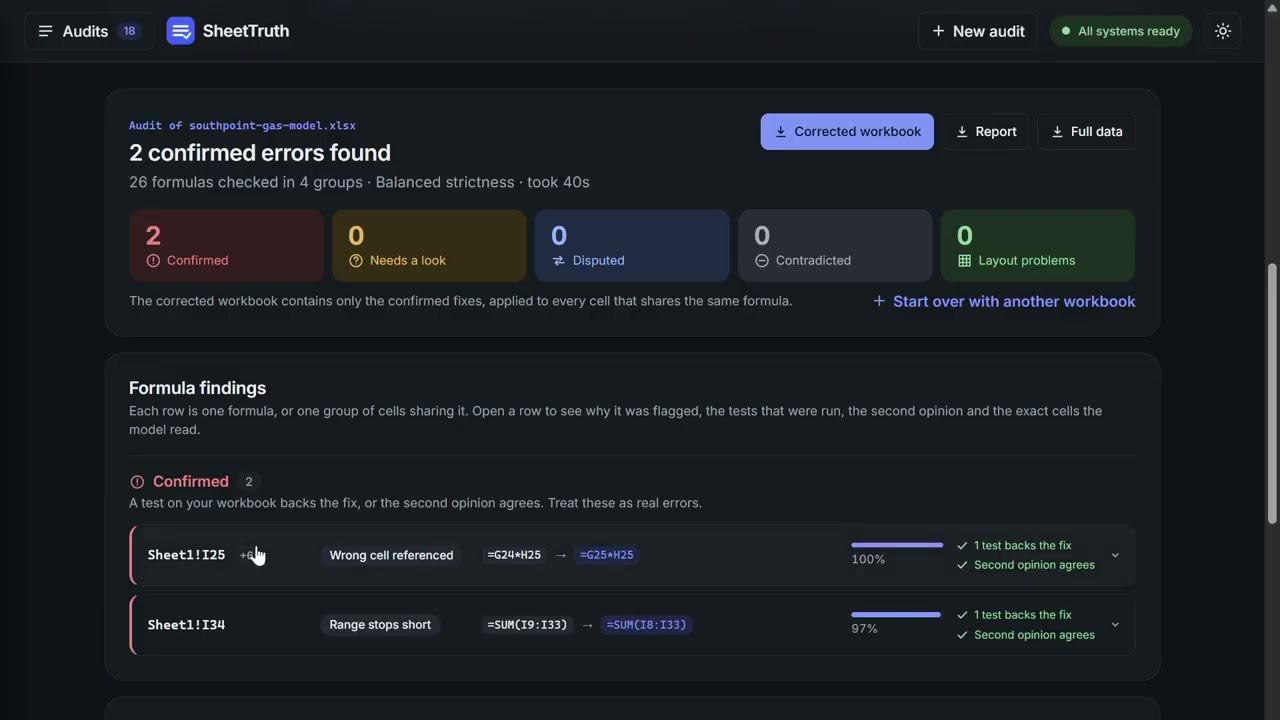
SheetTruth is an AI auditor for spreadsheets. It finds formulas that give the wrong result, and then it proves each finding against the workbook itself before it reports it. The problem. The most dangerous spreadsheet errors are the quiet ones. A total stops one row short. A sum range reaches into the price row. A reference points one row off. A cost is added instead of subtracted. In every case the cell still shows a number, so the sheet looks fine and the wrong figure travels into a budget, a forecast or an invoice. Audits of real business spreadsheets find errors in most of them, and some have cost a lot: in JPMorgan's London Whale case, one cell divided by a sum instead of an average, and the risk model hid a loss of about six billion dollars. How it works. First, the workbook is split into context windows. Every run of identical formulas becomes one window that holds the formula, the cells it reads, and the labels around them. Second, a fine-tuned Muse Glimmer 30B reads each window and answers with a verdict, an error type, a corrected formula, a short reason, and a probability. Third, because a model's verdict is only a claim, a verify agent built with LangGraph tests it with code: it writes the fix into a copy, recalculates it with LibreOffice, compares the formula with its neighbours and with the same cell on other sheets, counts the cells the fix adds or drops, and checks for double counting and sign errors. Fourth, Muse Spark 1.3 reviews each surviving finding and gives an independent second opinion. Every finding ends with one of four statuses: confirmed, needs a look, disputed, or contradicted. The confirmed fixes are written into a corrected copy of the workbook, which the user can download. The data. The model is the heart of the product, and we built its training data ourselves. We took real formulas from public spreadsheets, broke each one in one of nine realistic ways, recalculated the copy so the cached numbers matched the broken formula, and added hard negatives: formulas that look odd but are right. The final set has about 16,000 examples. The results. On the held-out Enron Errors Corpus, 30 real workbooks with 29 documented errors in scope, the base model finds 6 of them when prompted. The same model, fine-tuned on our data, finds 18. The verify agent and the second opinion then cut the false alarms from 222 to 31 while keeping 17 of the 18 finds. We also ran a second benchmark, the ExceLint corpus of 70 hand-audited spreadsheets with 317 documented errors, at the same fixed cutoff, and report it in the README. Because the model is open weights, the whole audit can run inside a company's own network, so no spreadsheet has to leave the building. The app is live at sheettruth.com with a sample workbook to try, and the code, the data recipe and the adapter are all open.