Teslim
Built at Meta Global AI Developer Hackathon · Oct 26, 2026 · Remote
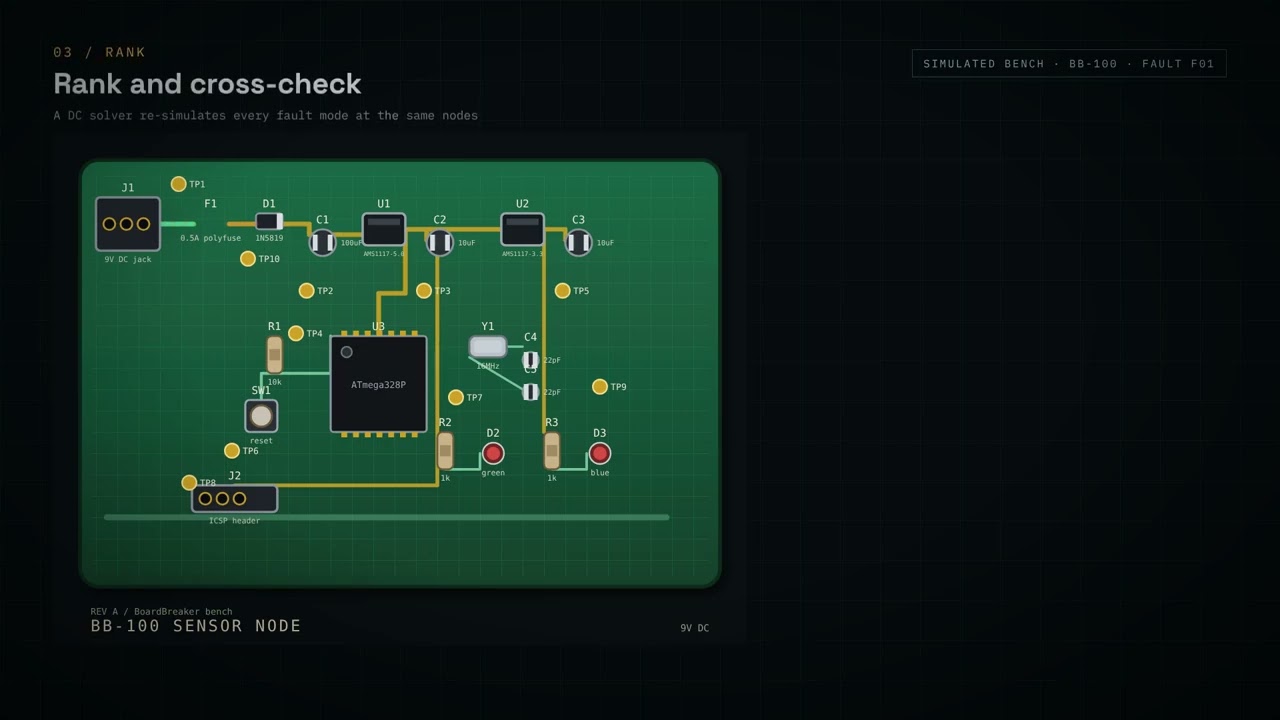
A dead circuit board usually means tracing the power tree by hand: input, protection, regulator, rails, loads. It is repetitive, it takes experience, and the first measurements are the same on every board. BoardBreaker does the tracing. Take a photo of a PCB: SAM 3.1 segments the components and the silkscreen becomes a component map. Give it a symptom and it plans the next measurement, states what it expects to rule out, and updates on the reading - under a hard six-probe budget. It returns ranked suspects with evidence for each. A DC solver then re-simulates every known fault mode at the exact nodes the agent probed and checks which hypothesis actually fits. The model decides where to look; the physics decides what fits. On an 18-fault benchmark at a six-probe budget: the agent alone reaches 16/18 top-1 and 17/18 top-3; the same probes re-checked by the DC solver reach 18/18. A deterministic full 15-probe sweep gets 17/18. So the agent reaches a better answer with less than half the measurements. The BB-100 is a synthetic sensor node with a nodal-analysis solver behind it, so every reading is generated from a board with a planted fault and the ground truth is exact. The product loop is identical with real probes - the bench boundary is two functions.