Akanksha Sharma
Built at Meta Global AI Developer Hackathon · Oct 26, 2026 · Remote
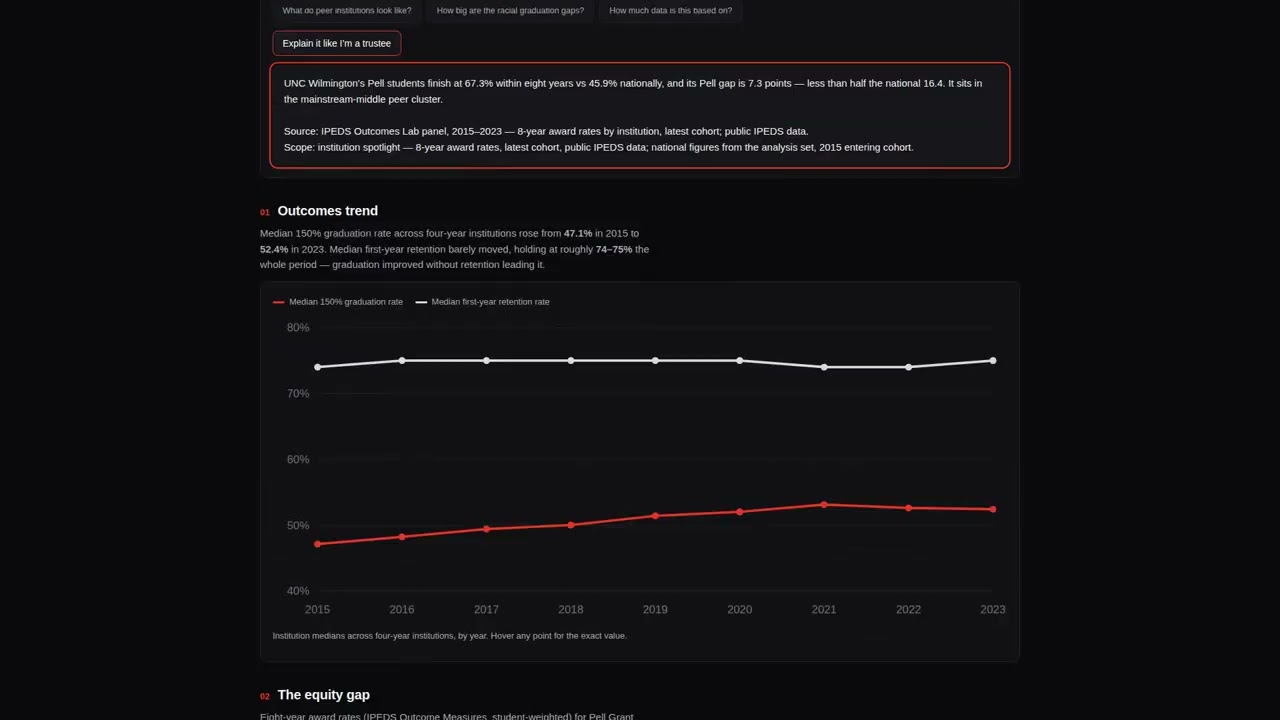
Live demo: https://sharmauncw.github.io/control-tower/ College outcomes data decides real money and real policy — but it lives in federal datasets and dashboards that most stakeholders (trustees, legislators, parents, journalists) cannot interrogate. They get static charts and have to trust whoever summarized them. Ask the Control Tower puts a question box on top of the IR Control Tower, a public dashboard built from the IPEDS Outcomes Lab (U.S. Department of Education IPEDS data, 2015–2023: 60,885 institution-years, 8,670 institutions). A stakeholder asks in plain language — "What's the Pell graduation gap?", "How does UNC Wilmington compare to the national picture?", "What predicts graduation most?" — and gets a plain-language answer in which every figure is cited with its measure, cohort, and scope. When an answer matches a chart, the page scrolls to that chart and highlights it. A one-click "Explain it like I'm a trustee" button gives the headline story: Pell students finish at 45.9% vs 62.2% for non-Pell students (a 16.4-point gap that extra time does not close), first-year retention is by far the strongest predictor of graduation (SHAP 9.49), and a gradient-boosted model predicts an institution's graduation rate to within 7.15 points on average (R² 0.745). Accuracy is by construction, not by prompt. Answers are assembled deterministically from a curated, verified fact store — the only numbers the assistant may state. Questions are matched to that store with weighted intent scoring, institution-name normalization, and multi-part splitting; near-miss questions are answered with the closest supported fact, labeled as such; anything outside the verified set (tuition, salaries, future years, other institutions) is refused, never improvised. A 45-case test suite proves it: every rendered number is checked against the fact store, and every out-of-set probe must be refused. The question-understanding layer is built behind a clean interface designed for a Meta AI model (Muse via the Meta Model API) to rephrase verified answers under a no-new-numbers constraint; for this submission the demo runs fully offline on the deterministic path, so it cannot break live and needs no keys, backend, or login. Built by a working institutional researcher, for the people her field actually serves — because the one true thing this data teaches is that whether students finish depends most on whether they come back for year two, and the people who fund and govern colleges deserve to hear that in plain language, with the receipts. Data sources: U.S. Department of Education IPEDS (Outcome Measures, Graduation Rates, Retention), via the IPEDS Outcomes Lab. Public federal data only; no institutional or student-level private data.