Upscale
Built at Meta Global AI Developer Hackathon · Oct 26, 2026 · Remote
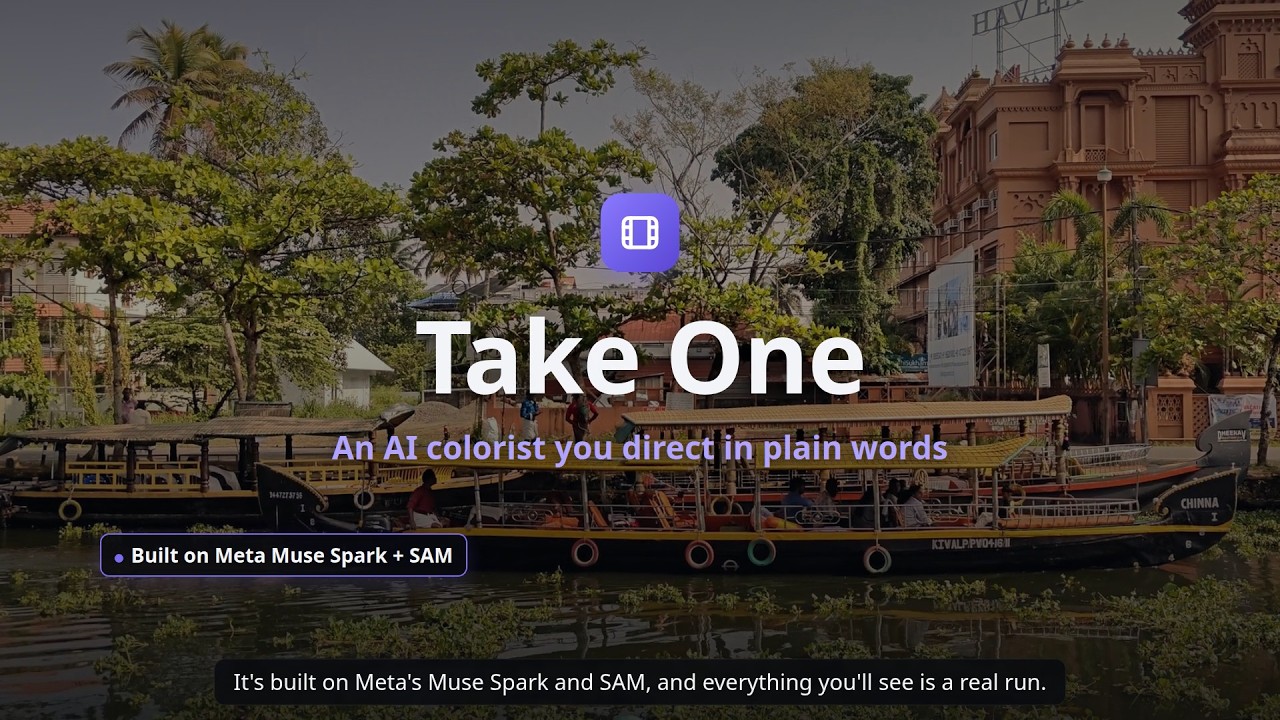
Take One is an AI colorist you direct in plain words. You upload a video and say what you want ("warmer evening feel, keep skin natural, make the sky moodier"). Take One works out what it still needs to know, asks only that, plans an executable color grade, masks the parts of the picture that need their own treatment, and renders the graded video at the original resolution. You compare it with the original, revise it in words, and download it. Its core idea is a creative-direction rubric. Before any pixel changes, Muse Spark checks what the footage and your request leave open across five dimensions: meaning (what the clip should communicate), appearance (tonal and color character), attention (which subject or region matters most), boundaries (what must not change) and continuity (stability within and across shots). It also weighs the technical limits of the source. Muse is instructed to ask only about genuine preference gaps, never to make you resolve a measurement or tool problem. Questions are few (three by default, five at most), and each option states the edit it leads to. The backend checks every question against real evidence and the tools that can actually run, and fails visibly instead of guessing. Your answers become a traceable creative brief: your request, constraints quoted from your own words rather than invented, default protections, what you skipped or delegated, and what remains unresolved. Meta's models make the decisions. Muse Spark 1.3 watches the video, runs the rubric, writes the grade as a structured plan that the backend validates against a schema, and reviews renders against measured evidence, asking for a bounded revision when needed. SAM 3.1 finds and tracks the subject and regions such as sky, wall or water, frame by frame. Both run through the Meta Model API. The engineering is what makes the result trustworthy. The models never touch pixels: FFmpeg and OpenColorIO render from the original file in 16-bit. Masks are checked for coverage, edges and temporal stability, and Take One stops rather than quietly falling back to a global grade. It converts real phone footage (10-bit HEVC, full range, BT.2020, with HDR tone-mapped to SDR), preserves audio and frame timing, and shows an estimated cost per video from the usage Meta reports.