Uniq minds
Built at Meta Global AI Developer Hackathon · Oct 26, 2026 · Remote
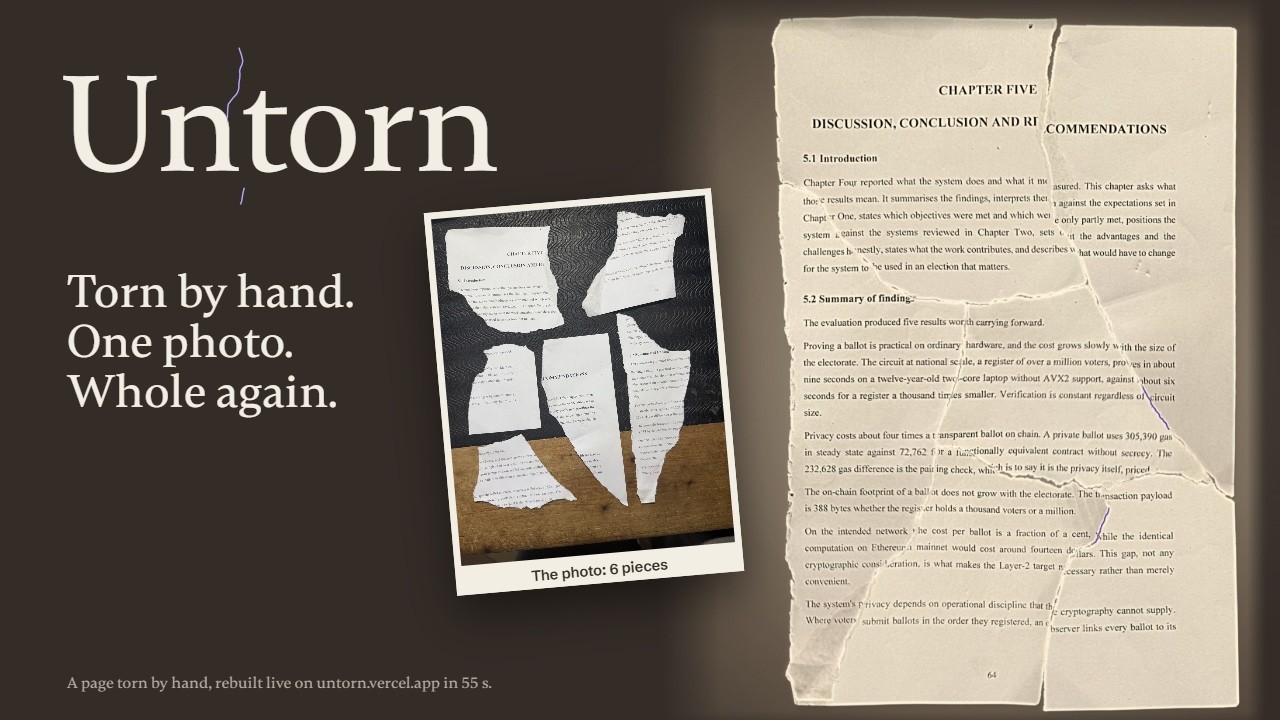
Untorn puts torn documents back together from one photo. Meta's SAM 3.1 cuts out every piece to the pixel, a geometry solver fits the torn edges, and Muse Spark reads the half-words across each tear, like a crossword, to confirm which pieces belong together; every read can also run on Meta's open weights, Muse Spark Open. Then Muse Spark reads the rebuilt page back as a transcript (translated into English if it is in another language), Muse Wonder catalogues it for the archive (date, sender, recipient, places, every field quoted from the page and checked), and Muse Voice Transcribe writes down the archivist's spoken note of where it was found. Try it: https://untorn.vercel.app/?for=judges (free, no sign-up; live runs from this link draw on a share of the daily cap kept for judges). Press "Run it live" on the first screen, or "Tear your own": tear a printed page into about 6 pieces, lay them flat and apart on something dark, scan the QR code with your phone and take one photo from above. THE PROBLEM 3.5 million people have asked to read their Stasi files. 15,400 sacks of those files are still in pieces: the Stasi tore them up by hand in 1989-90, and Germany's Federal Court of Audit puts the job at about 847 years at the current pace. Since 2021 the law has made it the Federal Archives' task, in the hope that victims get their files in their lifetime. In a 2023 market survey, no vendor could offer a system that already did this in production. Archives after a disaster face the same job (Cologne's city archive expected about 2 million fragments after its 2009 collapse), and so does anyone holding a torn letter. Shape matching alone breaks down where pieces share the same torn edges, which is what happens when a stack of pages is torn at once. Untorn adds the clue geometry lacks: it reads. Only the true neighbour completes the words. WHAT WE MEASURED - Real paper: a printed page torn by hand into 6 pieces came back whole in 5 of 5 live runs on the live site, in 48-61 s, its transcript running line by line across every tear (12 of 15 counting our own runs of it, across four reader setups). A recorded live run of that page replays at https://untorn.vercel.app/?sample=hand-torn-6 - A published benchmark: on a 64-document replica of the ShredBench protocol (Findings of ACL 2026), Untorn makes 8x fewer text errors than Muse Spark alone on the same photos (normalised edit distance 0.050 against 0.404). On ShredBench's 3 official images with published answers: 0.002 against 0.528. - Stacks: where pages were torn together and outlines repeat, Muse picked the right piece in 22 of 22 reads (chance: 1 in 3). - Other languages: a German letter of 1922 torn into 10 pieces, rebuilt 10 of 10 in both runs, transcribed (character error 0.0% and 1.4%) and translated. - The archive record: on 7 sample pages against an answer key, Muse Wonder got 108 of 112 field checks right over 4 rounds (date, place, sender, recipient, kind), with no quote that isn't on the page, in 6-7 s. - Meta's open weights: on the same tests Muse Spark Open read 23 of 24 seams right (Muse Spark 22) and transcribed pages as accurately (2.4% against 2.6% character errors), at 10.4 s a call against 15.5 s. With it answering Muse Spark's slow reads, the 6-piece real page came back whole in 3 of 3 of our runs. The files hold personal data the Stasi Records Act protects, and both models that rebuild and read a page have published weights, so an archive could run Untorn on its own servers. HONEST BY DESIGN Two clues or no join: the edges must fit and the words must continue across the tear. Where no letters cross a tear, the page itself is the second clue: its text lines running on in step, or its straight border lining up. Pieces without a confident place are set aside, never forced, and gaps in the transcript stay marked as gaps. Every result has a join map: for each seam, the edge fit and the exact image Muse read, with its answer and reason. The rebuilt page downloads as a searchable PDF, and its record as Dublin Core, the format archives exchange. KNOWN LIMITS Real tears are harder than simulated ones. Two pages torn into 10 small pieces each put 6-8 and 2-5 of 10 in the right place; touching pieces, curled pieces and photos shrunk by a messaging app lose the edge detail, and the run says which applies. Fewer, larger pieces laid flat and apart do best. The sample letters in the app are simulated tears of real public-domain letters, and each is labelled as such; the hand-torn page beside them is real. Every number and how it was measured: https://untorn.vercel.app/accuracy Built during the hackathon, from Oct 26, 2026.