Konstantin Sofeikov
Built at Meta Global AI Developer Hackathon · Oct 26, 2026 · Remote
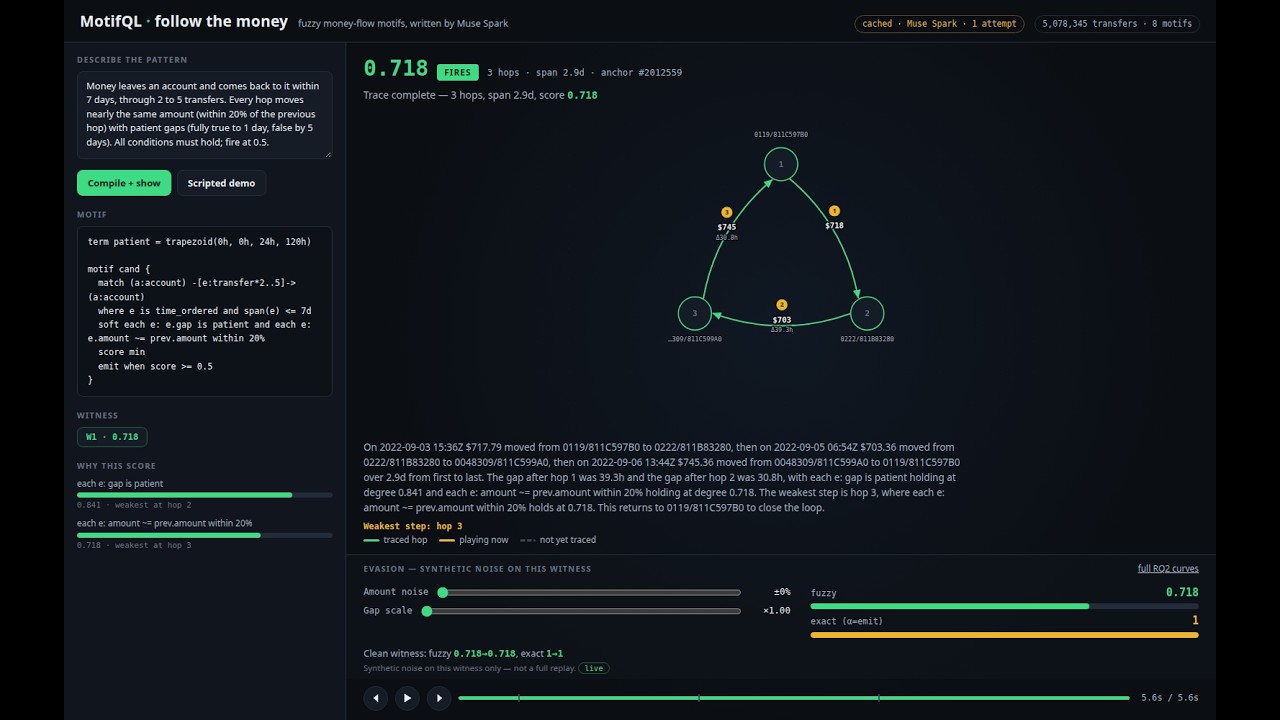
MotifQL is a fuzzy graph search engine for time-ordered streams that lets compliance analysts describe complex financial crime patterns in plain English. Meta's Muse Spark translates human intent into a structured query, and our custom Python backend executes an anchored, backward path-matching engine to track down multi-hop laundering shapes across millions of streaming transactions. How it Works & Technical Innovation • AI Compiler & Self-Repair Loop: Built with Muse Code. Muse Spark compiles English to a custom DSL via a formal Lark grammar and typed AST. A programmatic loop feeds syntax exceptions directly back to the AI for automated self-correction. • Fuzzy Traversal Engine: Replaces brittle boolean rules with continuous scoring (0.0–1.0). If a criminal subtly shifts an amount or introduces a time delay to evade exact thresholds, the engine degrades the score gracefully instead of killing the alert. • Explainable Graph AI: Delivers a complete "witness" chain with a localized, human-readable narrative identifying the weakest link in the laundering chain. Empirical Proof (IBM AMLworld Benchmark) Tested against a strong LightGBM machine learning baseline at a strict real-world budget of 50 alerts/day: • Cycles (Money loops): MotifQL caught 24 transfers vs LightGBM's 1. • Layering Chains: MotifQL caught 13 transfers vs LightGBM's 0. (Provenance: My transaction rule workspace, ezrules, and the IBM dataset existed prior to the hackathon. The entire MotifQL language, Lark compiler, fuzzy path-matcher, self-repair loop, and evaluation framework were built completely from scratch this week.)