PetroMind
Built at Meta Global AI Developer Hackathon · Oct 26, 2026 · Remote
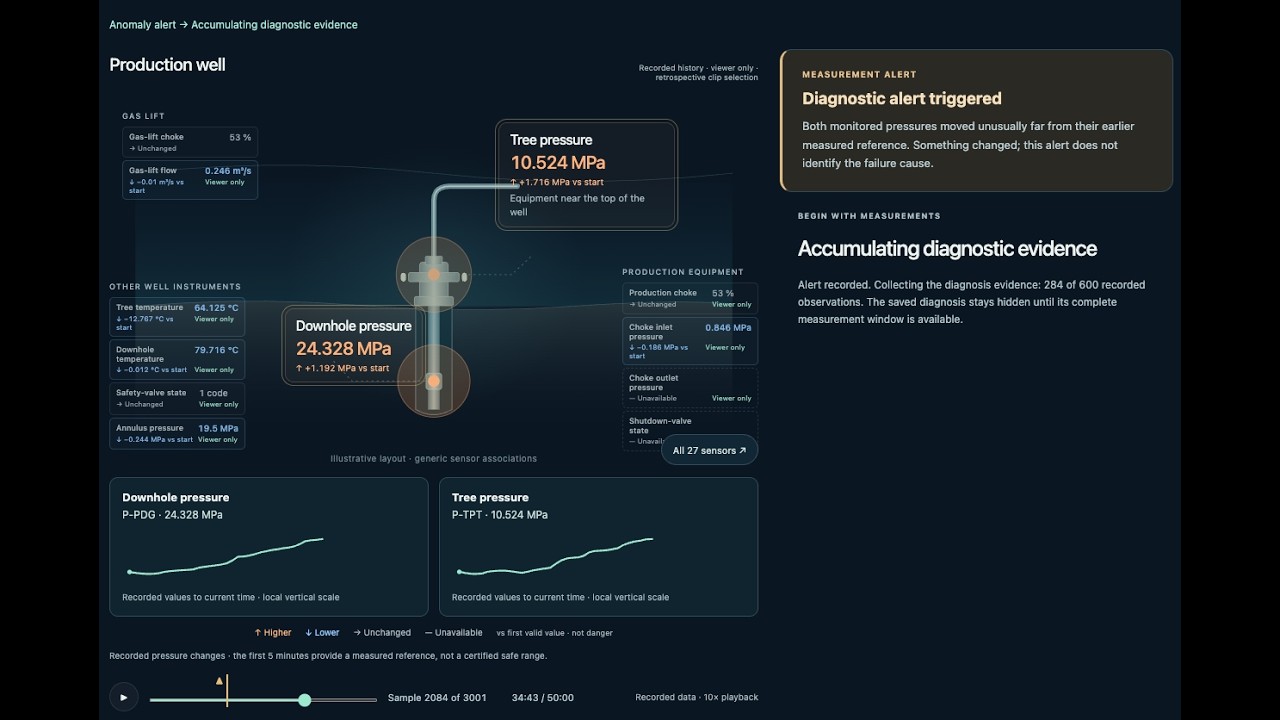
PetroMind: Beyond Prediction, Toward Understanding PetroMind explores a frontier challenge for AI: can a reasoning model move beyond recognizing anomalies to investigating their physical causes? We tackle this challenge using real industrial sensor data from Petrobras oil wells, not simulated measurements or hypothetical failures. Diagnosing industrial failures remains difficult: different faults can produce nearly identical sensor patterns, critical measurements may be missing, and a confident prediction does not establish causality. Traditional anomaly detection tells operators something is wrong. PetroMind explores whether AI can help determine why. Built with Meta Muse Spark, PetroMind combines sensor measurements, engineering knowledge, physical relationships, and adaptive evidence gathering to investigate competing explanations. We developed and experimentally evaluated the platform using recorded Petrobras oil-well incidents. PetroMind distinguishes observations from hypotheses and can explicitly conclude that the root cause is not established when the available evidence cannot support a causal explanation. What We Discovered Our experiments revealed a critical insight: better reasoning requires more than better knowledge. We evaluated five investigation strategies across 33 real Petrobras oil-well incidents. Providing engineering knowledge through GraphRAG alone achieved 15.2% correct fault classification. But combining sensor investigation, engineering knowledge retrieval, and structured, adaptive reasoning increased the correct-classification rate to 60.6%. The key wasn't just what Muse knew. It was giving Muse a structured way to investigate. We also developed a separate synthetic hydraulic extension to demonstrate evidence-based physical reasoning through pressure, flow, and hydraulic resistance. The Frontier AI excels at recognizing patterns. But industrial failures aren't merely patterns in data. They're physical events governed by engineering principles and the laws of physics. The frontier we're pursuing is AI that can investigate physical systems like an engineer—forming hypotheses, gathering real-world evidence, reasoning through physical principles, testing competing explanations, and recognizing when the evidence is insufficient to establish causality. PetroMind is our step toward that frontier: moving beyond predicting failures, toward understanding them.