SparkBench
Built at Meta Global AI Developer Hackathon · Oct 26, 2026 · Remote
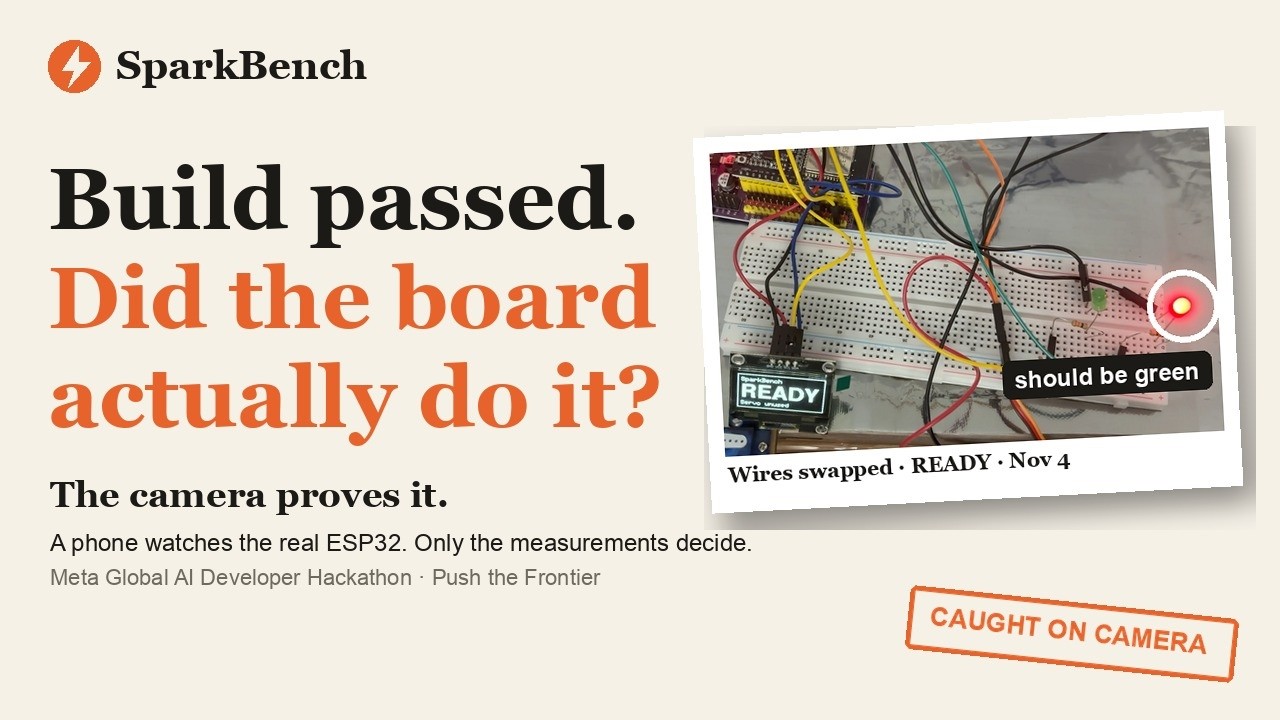
SparkBench proves that the firmware an AI wrote does what you asked for on a physical board. A build that compiles and flashes says nothing about what the LEDs and the display actually did, and checking by eye is slow and unreliable. SparkBench closes that gap for makers, students and small hardware teams who use AI to write firmware. You type or speak an idea for a classic ESP32 with two LEDs and an OLED. Muse Spark turns it into a reviewable plan of up to eight steps. After approval, the bench agent takes over: SAM 3.1 outlines the display and both LEDs in the camera view, trusted local code builds and installs the firmware and confirms its identity, and an iPhone records the board as the plan runs. Local code measures the LEDs from pixels, and Muse Spark reads the OLED without being told what to expect. A deterministic verifier compares both with the frozen plan and returns pass, mismatch or incomplete. Missing or unreadable measurements never count as a pass. When the camera finds a mismatch, the agent investigates. In the recorded session on 4 November I swapped the two LED wires and did not tell the model. The test failed with 38 mismatched readings across 28 samples. The agent ran a fixed pin probe, Muse Spark worked out the swapped mapping from the measurements alone, local code checked the proposal against the probe, I approved the exact change, and a fresh test passed 27 of 27 samples with the wires still swapped. The steps, labels and timing never changed. The same night a second plan's fault was fixed by hand and passed on retest, and two incomplete tests from that session stay on record. This is Push the Frontier in a small, honest form: Meta's models give a machine the ability to check its own work in the physical world, with an explicit trust boundary. Models plan, perceive and propose; local code controls the hardware and computes every verdict. Everything in the repository and the video was built during the hackathon, 27 October to 4 November 2026, with development assistance from Codex and Claude Code. The supported bench is one ESP32 with two LEDs and an OLED; the mounted servo is not verified.