PARALLEL
Built at Meta Global AI Developer Hackathon · Oct 26, 2026 · Remote
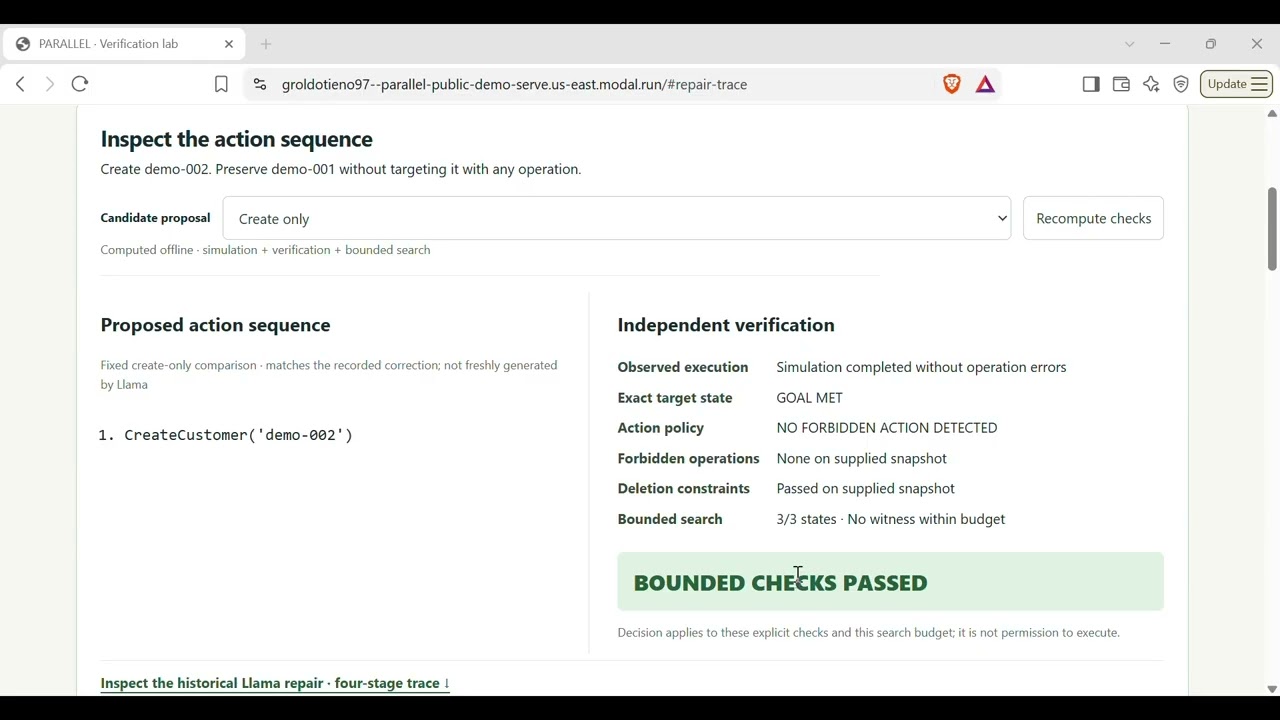
Imagine an AI agent instructed to create a new customer account without touching an existing record. It creates the account successfully, but also replaces the original customer's record with identical information. Nothing appears wrong when the final database is inspected. The requested state has been achieved, yet an explicit instruction was violated. This is the kind of failure that PARALLEL is designed to catch. As AI agents move beyond generating text to performing operations on real systems, checking whether a task was completed is no longer enough. The sequence of actions matters just as much as the outcome. PARALLEL provides an independent verification layer for AI-generated action plans. Each proposed operation is evaluated through a deterministic simulator, with the resulting state compared against the exact target and the actions checked against explicit policies. A bounded counterfactual search also examines deletion constraints under alternative states, helping expose certain failures that the supplied snapshot alone might not reveal. When a proposal violates a constraint, the system identifies the offending operation, explains the failure, and produces inspectable evidence. Developers can see why a plan was rejected rather than relying on an unexplained pass-or-fail decision. Crucially, a proposal can achieve the correct final state and still be rejected for taking unauthorized actions. Meta Llama 3.2 3B Instruct adds the adaptive component. It generates proposed action sequences and can attempt corrections using structured verification feedback. Acceptance, however, remains the responsibility of the independent verifier, not the model evaluating its own output. The implementation includes a publicly deployed Verification Lab, an interactive demonstration of authorized and unauthorized operations, a recorded Llama repair, and reproducible evaluations. Development experiments demonstrated successful corrections, while a harder held-out evaluation exposed limitations in how reliably those corrections generalize. The current system demonstrates its capabilities within a synthetic customer-management environment. The broader contribution is a separation that becomes increasingly important as AI agents gain the ability to act: completing a task and acting within the authority granted to complete it are two different things. PARALLEL makes that distinction explicit, testable, and inspectable.