Lannister
Built at Meta Global AI Developer Hackathon · Oct 26, 2026 · Remote
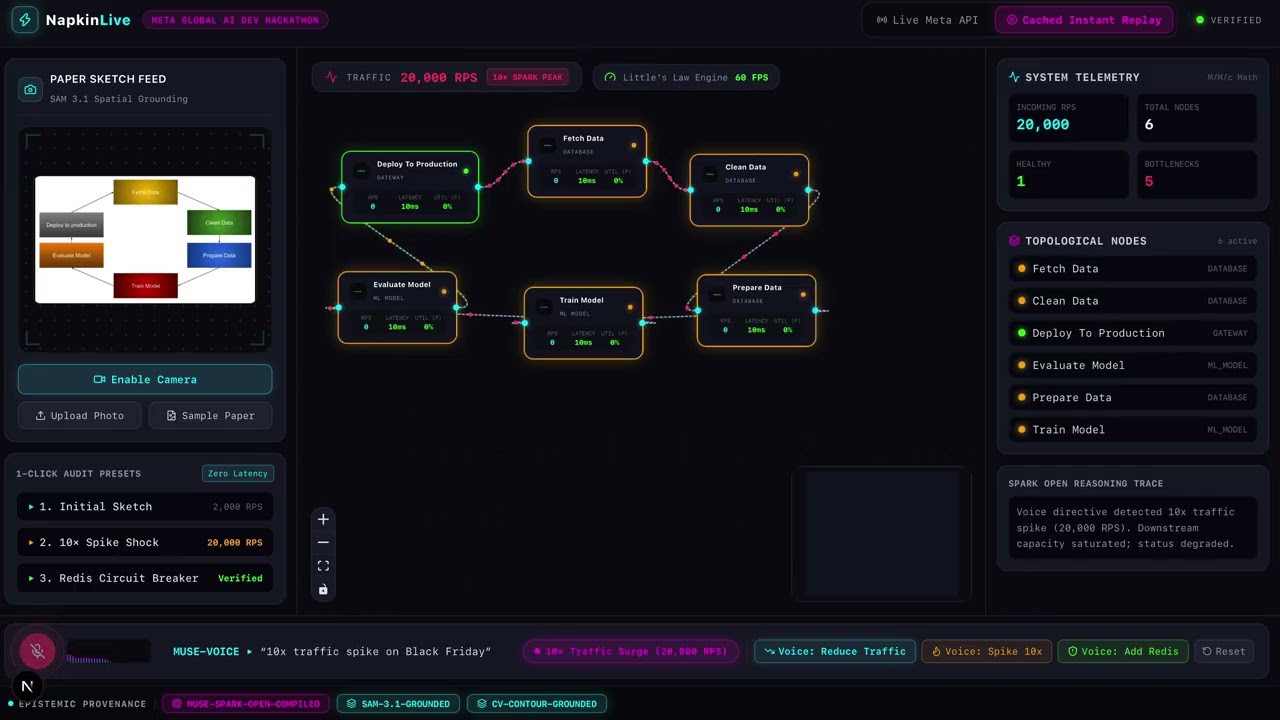
### NapkinLive — Physical Sketch to Live 60 FPS Interactive System Simulation #### 1. Problem Engineers, CS students, and ML researchers spend 8–12 hours manually drawing static architecture slides in PowerPoint, Excalidraw, or Mermaid for system design reviews, pitch decks, and defenses. But the moment a judge, manager, or professor asks: "What happens if this shard fails under a 10× traffic spike?", static diagrams become dead, useless pictures. #### 2. What NapkinLive Does NapkinLive replaces dead slides with a live, bi-directional physical-to-digital simulation stage: 1. Place a piece of paper or napkin under your webcam or phone camera. 2. Sketch boxes, databases, models, and flowcharts with a marker as you talk. 3. Meta AI models segment your strokes, compile the topology, generate 3D isometric icons, and spin up an interactive 60 FPS queueing simulation with animated packet traffic. 4. Speak voice directives hands-free (e.g. "Inject a 10x traffic spike on Black Friday" or "Add a Redis Circuit Breaker") to watch Little's Law queueing physics saturate bottlenecks and heal in real time. #### 3. How NapkinLive Uses Meta AI Models We orchestrate 6 Meta AI models into an end-to-end multimodal pipeline: • SAM 3.1 (`sam-3.1`): Real-time spatial grounding and segmentation of hand-drawn boxes, cylinders, and arrows from physical camera frames. • Muse Voice Transcribe (`muse-voice-transcribe-1.0`): Continuous presenter speech recognition for hands-free interactive stage control. • Muse Spark Open (`meta-models/muse-spark-open-1026` on Baseten): High-reasoning graph compiler translating ink masks and voice intent into deterministic graph mutations. • Muse Image & Muse Wonder (`muse-image-1.0` / `muse-wonder-1.0`): Procedural synthesis of dark-mode glassmorphic 3D icons within segmented component geometries. • Muse Code & Muse Spark 1.3: Real-time generation of runnable FastAPI microservice remediation code tested through a deterministic verification gate. #### 4. Deterministic Verification ("Model Proposes, Code Verifies") Unlike purely generative demos that hallucinate metrics, NapkinLive computes latency, utilization (ρ = λ/μ), and packet drops at 60 FPS using deterministic M/M/c queueing physics. All synthesized microservice code is validated through an isolated compilation gate before provenance badges turn green. #### 5. Judge Zero-Failure Reproducibility Includes a navbar toggle `[Live Meta API | Cached Instant Replay]` allowing judges to run full multi-stage simulations with zero latency and zero API keys required.