Naksha
Built at Meta Global AI Developer Hackathon · Oct 26, 2026 · Remote
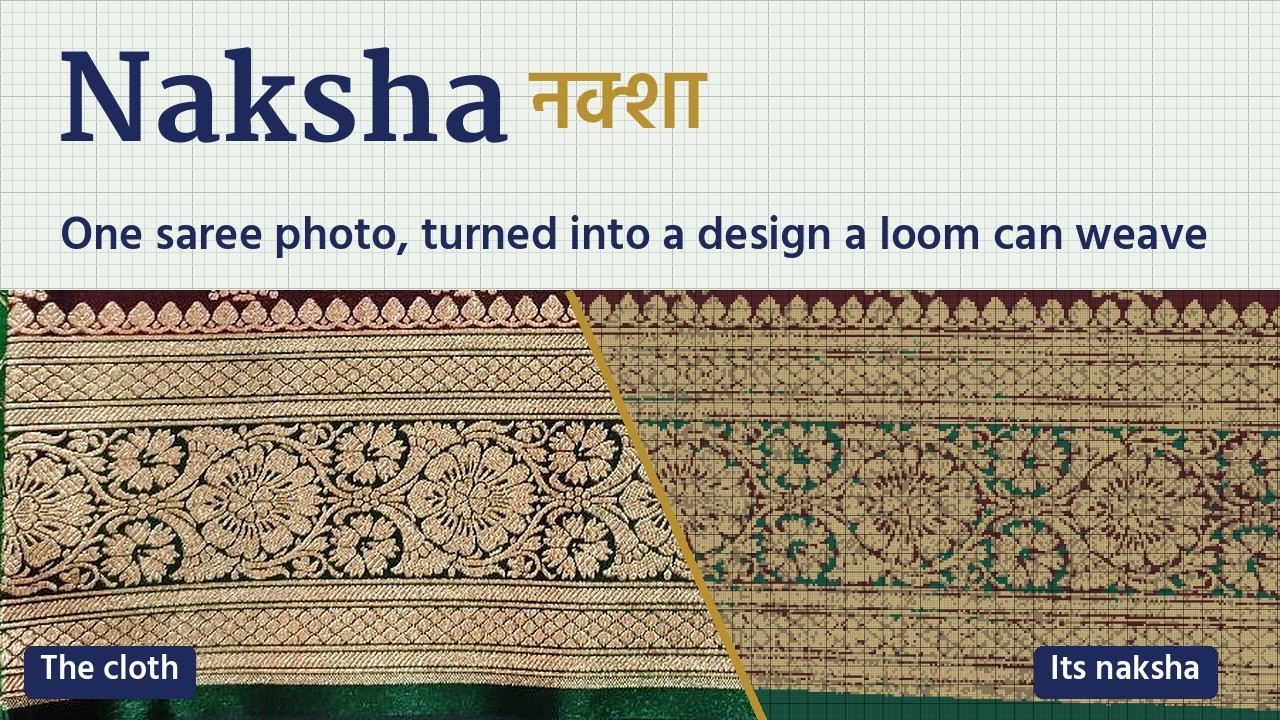
Naksha turns a phone photo of a woven saree into a naksha a loom can weave, and checks it thread by thread. The problem: brocade sarees are woven from a naksha, a graph-paper design where every square is one thread crossing. One saree border in our demo is 900 x 278 = 250,200 squares. Redrawing a naksha from an existing cloth is slow, skilled work done by few people, so when an old saree wears out, its design is usually lost. I built this around my mother's sarees. How it works: 1. The weaver photographs the cloth and marks the border or motif to save (or SAM 3.1 finds the cloth on its own). 2. Muse Spark reads the cloth like a naksha-maker and names the actual threads, e.g. maroon, dark green and gold zari, with their colours. 3. Code measures thread spacing and repeat from the image, then decides the thread at every pixel (hue fixed, lightness free, so zari shine and shadow don't become fake threads) and gives each naksha cell the thread most of its pixels show. 4. Mandatory verification the agent cannot skip: the naksha is re-woven in simulation and compared with the photo; a master-weaver reviewer, Muse Spark Open on Baseten, compares the photo and simulation and returns concrete changes (more colours, fewer colours, more detail). The agent applies them and re-checks, up to 2 revisions, then escalates to a person instead of claiming success. In the demo run the reviewer caught that the green ground had turned maroon; the agent added a thread and the reviewer then agreed. 5. A weaving-rule check finds zari threads that would float more than 8 threads without being tied down and proposes binding points. 6. Nothing is final until a person signs off. 7. Outputs: the naksha on graph paper, one repeat unit, a jacquard design bitmap (one pixel per crossing), the grid as CSV and a full report. Weavers can also create new designs: type a change in Hindi or English ("this same border in blue with silver zari"), Muse Image draws two variations, and each goes back through the engine to become a checked naksha. Results: on a benchmark of 30 synthetic woven designs with camera noise, uneven light, shine and blur, it recovers 94.5% of thread crossings by colour clustering alone and 98.0% when the threads are named. On real sarees it reproduced floral borders, diamond-lattice bands and paisley butis, an elephant pallu with 7 threads, and a South Indian temple border. Built for weavers here, useful wherever traditional weaving survives.