Discovery Clock
Built at Meta Global AI Developer Hackathon · Oct 26, 2026 · Remote
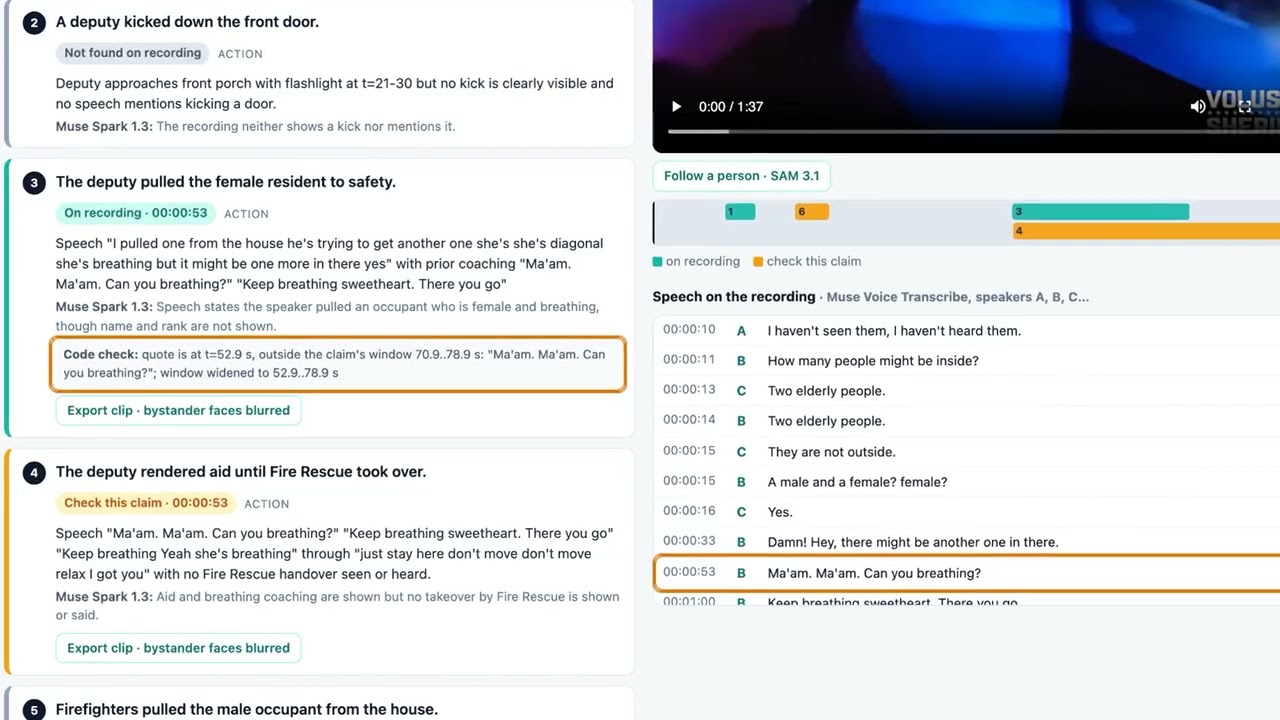
Discovery Clock checks every claim in a written incident report against the body-worn camera recording. Body-camera footage now arrives faster than lawyers can watch it. One county prosecutor in New York reported about 6,818 hours of footage in eight months, which works out to more than 568 hours, or fifteen full work weeks, per attorney (Finger Lakes Times, Sep 13 2025). Public defenders face the same pile, usually with fewer staff. So the report gets read and the video gets skimmed. You give Discovery Clock the report and the recording. Each claim in the report comes back as "on recording" (with the timecode and what is seen or said there), "not found on recording", or "check this claim" when the recording shows something different or only partly supports it. Click a claim and the player jumps to that second. The output is a list of places for a lawyer to watch; it makes no finding about whether anyone lied. Four Meta models do the work: - Muse Voice Transcribe splits the audio into speaker turns with start and end times. - Muse Spark Open, served on Baseten, splits the report into single claims. - Muse Spark 1.3 reads the whole video with the transcript and the claims in one call and places each claim on a timecode. It also reads the date and time the camera burns into the frame. - SAM 3.1 follows the person you click through the recording and finds bystanders' faces so we can blur them. Our code checks every model answer before a lawyer sees it: a timecode outside the video, a quote found nowhere in the transcript, or a report time that disagrees with the camera clock moves the claim to "check this claim", and the model's original answer is kept. We tested it on five videos published by the Volusia Sheriff's Office (Florida public records), using sentences from the office's own written accounts plus claims we planted that are false or absent. All 5 planted contradictions were flagged "check this claim", and none of the 10 planted claims was marked "on recording". 21 of the 29 account claims got a timecode, 3 of them flagged; the other 8 are not in the published clip, so a lawyer knows what to request from the full footage. We checked 8 timecodes against the frames by eye and all 8 matched. The answer keys were sealed by hash before the first model run. For long input we joined ten public clips into one 31.7-minute file: Discovery Clock split it into 4 pieces and checked all 74 claims in 9.7 minutes for $0.74, with 50 of 51 timecodes inside the right clip. Every model call is logged with its request, response, latency and cost, and the /calls page shows the calls live. Everything in the repository was written on Nov 4, 2026, during the hackathon. It runs with your own Meta Model API key, or without a key from the recorded runs it ships with. Bonus prize: Best Build on Meta Open Weight Models (Muse Spark Open on Baseten extracts the claims).