Ghostline
Built at Meta Global AI Developer Hackathon · Oct 26, 2026 · Remote
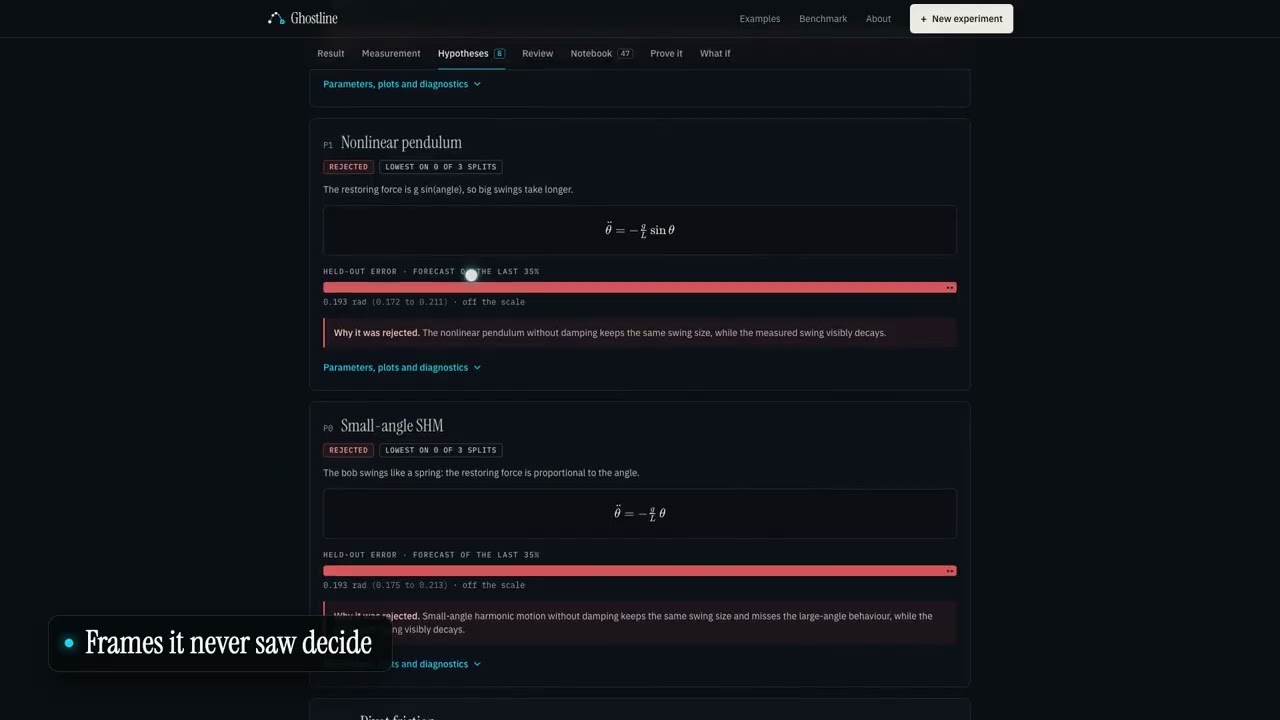
Ghostline is a physics lab in your phone. You film something that moves (a pendulum, a dropped ball, a bounce) in front of an ordinary sheet of paper, upload it, and Ghostline measures the motion, works out which physical law explains it, and then proves that law by predicting a motion it has never seen. The problem: measuring real motion is expensive or tedious. Labs rely on motion sensors and photogates that cost hundreds of dollars, or on students clicking through video frame by frame to mark positions by hand. Most curious people, including students without a well-funded lab, never get to measure anything. And general AI chatbots, asked about physics, will confidently produce numbers they never measured. How Ghostline works: 1. Meta's SAM 3.1 tracks the object in every frame. 2. The sheet of paper is the ruler. Its known size converts pixels to millimetres, and Ghostline measures and removes small camera drift, so a phone propped on a shelf is good enough. 3. Muse Wonder watches the clip and proposes competing laws, for example simple harmonic motion, a nonlinear pendulum, or a pendulum with damping. 4. Every candidate is fitted on part of the motion and judged on frames it never saw. Laws that fail the held-out test are rejected, with the reason shown. 5. Muse Spark Open reviews the winner as a skeptical second opinion and adds caveats before anything is reported. 6. Prove it: you film a new trial and the winning law must predict it with no fitting at all. The prediction is drawn as a "ghost" ball over the real one. When the ghost drifts, Wonder looks at where it went wrong, proposes a reason, rewrites the law and predicts again. In our demo, version two cut the mean error from 60 mm to 53 mm. 7. What if: change gravity to Mars and watch the simulation change, or export the measured physics to a simulator. Honesty is built in. Every number on the site comes from the measurement code, not from a language model; the models propose and critique, while held-out data decides. Results carry uncertainty intervals and a confidence level, and when a clip cannot settle the question, Ghostline says "can't tell" and explains why. We benchmarked it on 21 clips we filmed with known answers. Pendulums measured gravity within 0.2% to 3.3%, and bounciness came within 1.1% of the value measured independently from the sound of the bounces. Dropped balls read 10% to 27% high, most likely because the ball fell in front of the paper's plane, and the public benchmark page shows those misses rather than hiding them. Who it helps: students and teachers without lab equipment, makers, and anyone who wants to test an idea about motion with the phone in their pocket. It turns AI from something that answers physics questions into something that runs the scientific method end to end: measure, hypothesize, test, predict, and revise. Judges: browsing the examples needs nothing. To analyze your own clip, enter the passcode '5AiBU7z73WO3GDrfj4' when asked.