Ansatz
Built at Meta Global AI Developer Hackathon · Oct 26, 2026 · Remote
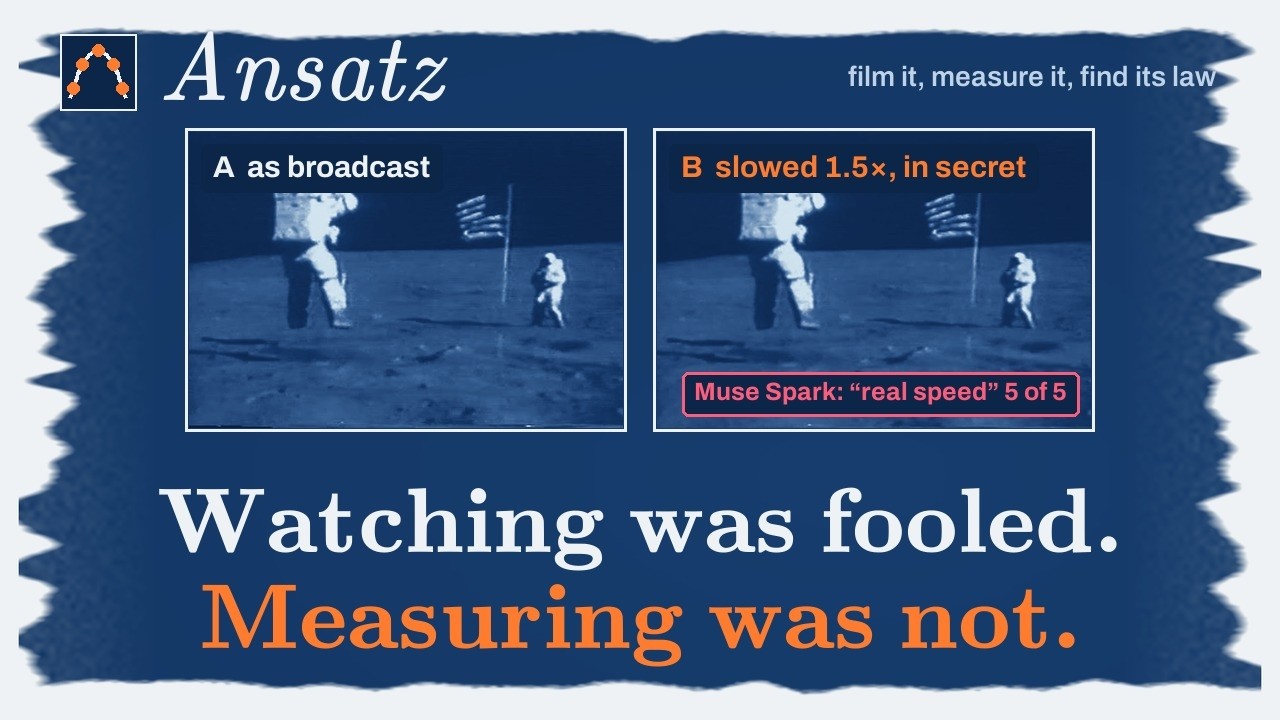
Ansatz finds the law of motion in a video: SAM 3.1 measures, Muse Spark proposes equations, each law must predict motion it was not fitted to. Apollo slowed 1.5× in secret: Muse Spark said real speed 5 of 5; Ansatz measured 1.494 ± 0.015×. https://ansatz-lab.vercel.app/judges Ansatz is a law-finder: it returns the equation, every constant with its error bar, and the held-out test that chose it. Because gravity is a clock, the same law says how fast real footage plays, where Muse Spark, watching, often cannot. (On Apollo, a single ask before the five said slowed 2×, of the real broadcast too; Ansatz's jump windows were set by hand.) From the 1972 broadcast it measures the Moon's gravity as 1.72 ± 0.11 m/s² (true 1.625); from gravity alone, the slowed copy reads 1.50 ± 0.05× slower and a museum film its maker sped up 5× reads 4.97× faster. A blind test on the home page lets you judge six real clips first. Given the lengths Ansatz was told, at medium effort, Muse Spark ties Ansatz at 5 of 6 on the verdict; on the right factor for the three retimed clips, by majority answer, it gets 1 of 3 and Ansatz 2 of 3 (0 of 3 at low effort). How it works: - Watch and listen. Muse Spark watches the whole clip (up to 300 frames) to say what moves, when, which world and how long the ruler is; Muse Voice Transcribe hears what the person filming says, in seven languages, and in two published lite runs set the length alone (synthetic voices, labelled): Hindi over a stranger's pendulum, g about 9.9 m/s², no error bar (8.1× the noise); English over a render, 9.806 ± 0.098 m/s² (0.04% low against the render's 9.81). - Measure. SAM 3.1 tracks the object, up to 450 frames a run; each mask becomes a sub-pixel position timed by the file's own clock. - Hypothesise and falsify. Muse Spark writes two to four laws in a small equation language, and code adds laws built from the models' terms. Code fits each to the first 70% and ranks it on the last 30%; within the noise, the simpler law wins. Muse Spark referees; when every law misses, Muse Wonder fits laws on the seen frames with its tools (fit_law, residual_spectrum) and submits one, which must win the same way. - Report. A print made from SAM's masks, every constant with its uncertainty, given kept apart from measured, a clock check, a lab report in seven languages and every model call with its cost. What it measured: - On 28 rendered clips with known physics, 26 of 27 constants within 5% (median 0.11%); Muse Spark by eye: 32%. - Laws nobody chose: fifteen spring laws drawn by public randomness, hashes pushed before any clip. Found: 4 of the 5 undriven laws (all by a model: 2 Muse Wonder, 2 Muse Spark), 0 of the 10 driven in full; the winner carried the drive at the right frequency on 4 of 10, once written by Muse Wonder itself (11.720 ± 0.038 vs 11.65 rad/s) and three times with code's help. No false drive on the 5 undriven runs. Sets 3–5 named their rounds in advance. The 600 s run budget cut off code's moves on the leading law on rounds 6606498 (before Muse Wonder was called) and 6606500. Misses published. - Of nineteen springs with a hidden law (four we built, fifteen drawn), Ansatz found six; Muse Wonder wrote four of those laws (the hardening one Muse Spark later proposed itself). On the dry-friction spring the models hand off: Muse Spark, refereeing, named the friction; Muse Wonder fitted it (0.430 ± 0.028 m/s², true 0.45) and missed the unseen motion 14× less. - A museum's Foucault pendulum sped up 5× by its maker, label cropped: Muse Spark, told the length at medium effort, said sped up, 3× to 12×; Ansatz reads 4.97× from the swing's period, which needs no law, and 4.987 ± 0.007× against its own real-time stretch. - Sixteen clips strangers filmed, told only their makers' words: two measured (a 50 cm pendulum filmed in Aachen, g = 9.82 ± 0.10 m/s², 0.16% off; ThinkTac's 60 cm, 9.83 ± 0.10), four where the number landed but the law did not, one with nothing to check and nine misses, all on /proof. Why it matters: about 1.25 lakh of India's 2.96 lakh schools with secondary classes have no integrated science lab (UDISE+ 2025-26). For their teachers, /lab maps the nine CBSE Class XI practicals about motion and force to runs (two in full, two in part, five not yet), with a worksheet in English and Hindi and a 40-minute lesson. A class link runs in lite mode: a student films the pendulum and says its length, in Hindi if they like, and gets g; the two published lite runs (synthetic voices) took about 40 s and at most 7 cents each. Both strangers' clips Ansatz measured are this practical's pendulum. Honest limits: most accuracy figures come from renders; no clip was filmed on a phone yet, and no teacher or class has used it; the voice languages were tested on synthetic speech; one object at a time. It fails when the object does not stand out: a dark weight on a dark chalkboard gave no usable g.