FaultLine
Built at Meta Global AI Developer Hackathon · Oct 26, 2026 · Remote
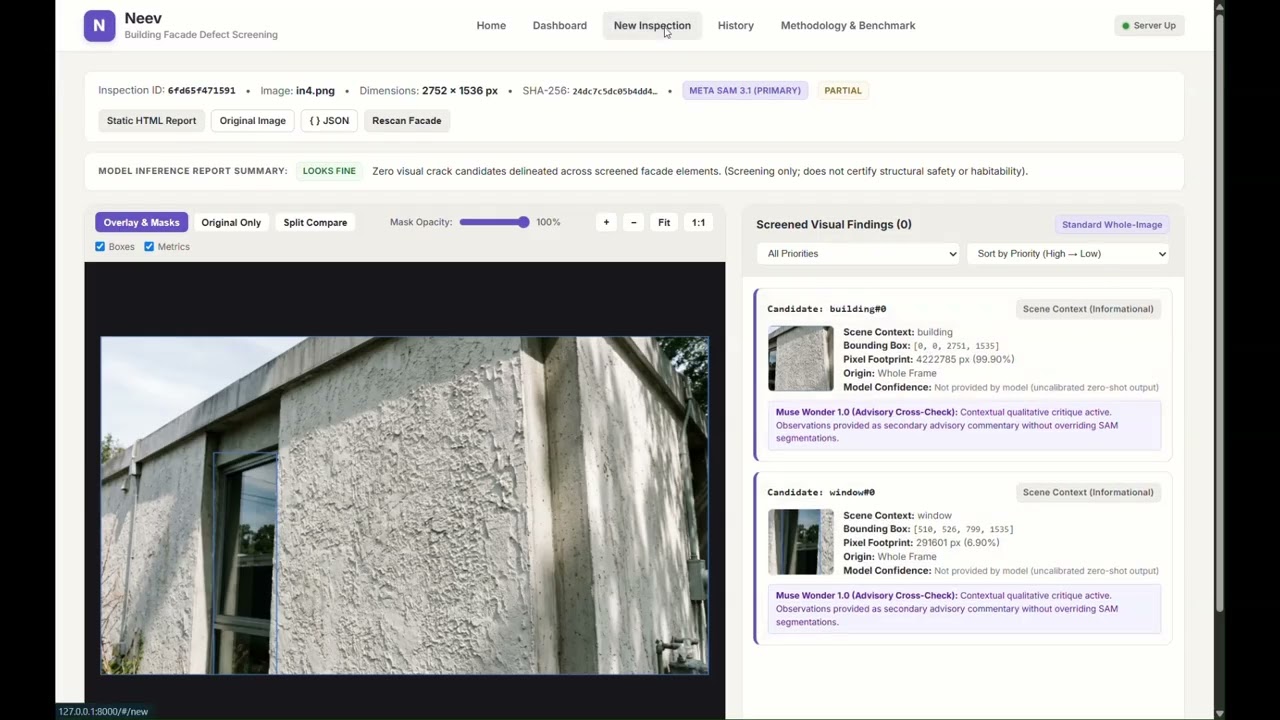
Neev is an AI-powered building facade defect screening system that I built to make visual inspection of building deterioration faster, more structured, and explainable. Building facades can develop visible cracks and surface deterioration over time, but manually identifying and documenting these defects across large structures is time-consuming. Neev lets users upload facade photographs and examine potential defect regions through AI-assisted visual screening, with visual evidence behind every candidate. At its core, Neev integrates Meta SAM 3.1 through the Meta Model API for prompt-based segmentation. I developed a multi-view inference pipeline to examine images at different scales and an optional U-Net hybrid mode to improve candidate coverage. Meta Muse Wonder adds an advisory reasoning layer for contextual observations without silently overriding the primary segmentation results. I evaluated the detection pipeline on the CUBIT-Seg benchmark, containing 1,320 images and 2,357 annotated cracks. The SAM 3.1 baseline achieved 80.3% precision, 74.6% recall and a 77.32% F1-score, with a mask IoU of 0.5248. The SAM + U-Net hybrid achieved 76.3% recall, compared with 74.6% for the baseline, demonstrating a different precision-recall trade-off. Beyond model integration, I built the complete inspection workflow using FastAPI, Python and vanilla JavaScript: image preprocessing, multi-view inference orchestration, mask decoding, candidate management, evidence visualization, persistent inspection records and automated report generation. Neev includes an interactive evidence explorer where users can inspect segmentation masks, bounding boxes and individual findings rather than relying on black-box predictions. The goal was to turn foundation-model capabilities into an actual, inspectable engineering workflow. Built independently for the Meta Global AI Developer Hackathon, Neev explores how Meta's vision models can be applied to infrastructure inspection. It is a preliminary visual screening tool, not a structural safety assessment, and detection reliability across diverse real-world facade conditions remains an ongoing area of evaluation.