Ayna
Built at Meta Global AI Developer Hackathon · Oct 26, 2026 · Remote
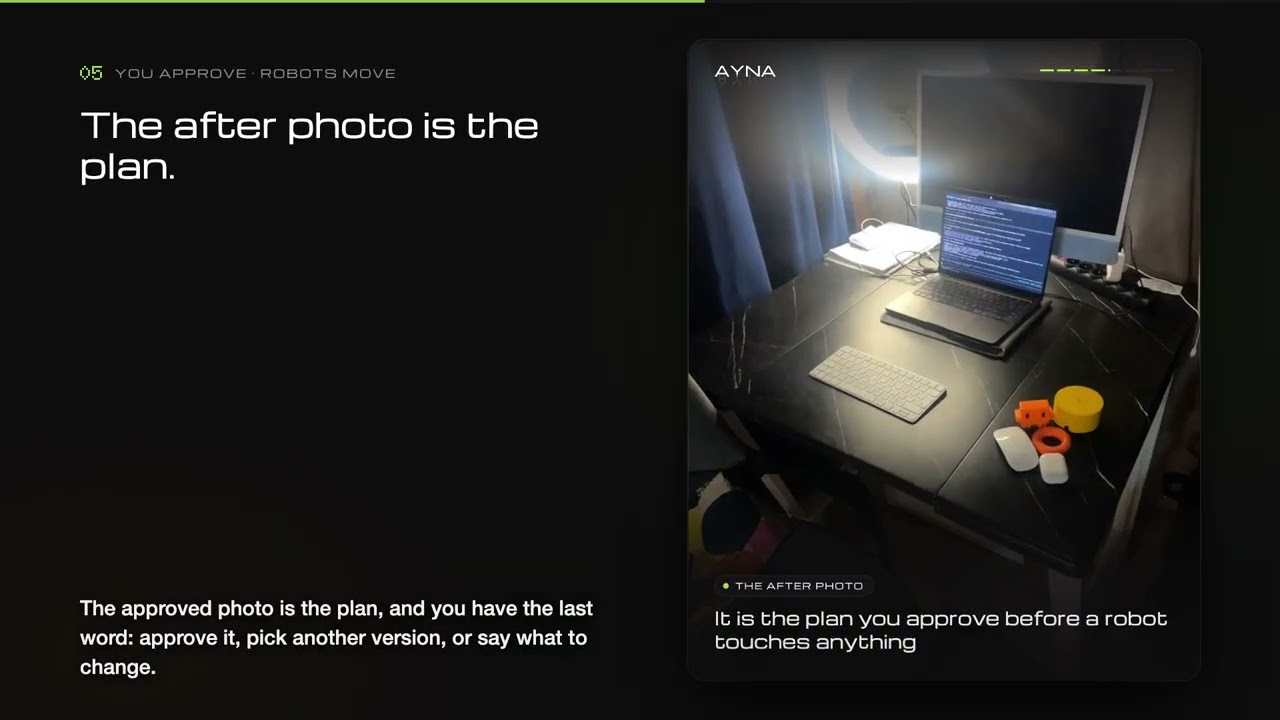
Ayna: show your robot the after. Say how your table should look. Ayna develops the after photo of your own table, checks that nothing in it vanished or changed size, turns it into centimetre goals, has robots carry it out in a physics twin of your room, and hands you a receipt: where every object ended up, in centimetres. The problem: "tidy my desk" hides a hundred decisions, and nobody wants a robot touching their things blind. People already share plans as pictures, so Ayna makes the picture the interface. The approved after photo is the plan you sign off before anything moves, and it is the goal image that goal-conditioned robot planners (Meta's V-JEPA 2-AC) need but cannot get in a stranger's home. Every scan + after photo + automatic check is also a ready evaluation episode for robot policies in a real home. How it works: 1. Scan: the Ayna iPhone app records LiDAR, RoomPlan and a hero photo. Our scan2sim pipeline builds a MuJoCo twin: Muse Spark lists the objects, SAM 3.1 masks them, SAM 3D Objects turns each mask into a mesh placed on the LiDAR points. 2. Ask by voice (Muse Voice Transcribe, English or Russian) or by text. 3. Imagine: Muse Spark writes an edit for this exact photo; Muse Image develops 3 versions of the after photo in parallel (same camera, same light). 4. Check: SAM 3.1 finds every object again and rejects versions where something vanished, appeared or changed size; a reach and put-down test rejects what the robots cannot do. When a whole round fails, Spark reads the reasons and redraws, narrows the request or stops. 5. Approve: the person approves, picks another version that passed, or says "not this, because ...". 6. Act: masks become (x, y, θ) goals on the table; Spark orders the moves and assigns them to our own robots (a 7-joint arm and a mobile manipulator, written in code), honestly refusing what they cannot reach or grip; they execute in MuJoCo in the browser. 7. Verify: the twin is rendered from the photo's camera over the imagined photo; each object gets its error in cm, a score and Spark's verdict. Final round with live models: 12 runs, SAM 3.1 rejected 29 of 47 versions, 43 of 50 requested moves ended within 3 cm, about 67 s and $0.09 per run. Live demo, no sign-in: https://ayna-brown.vercel.app/app/ (replays are free; live runs within a daily allowance). Pre-existing: the iPhone capture engine starts from Wes Bos's open-source 3D Model Anything (MIT); everything else was built during the hackathon (see NEW_WORK.md in the repo).