Cog & Code
Built at Meta Global AI Developer Hackathon · Oct 26, 2026 · Remote
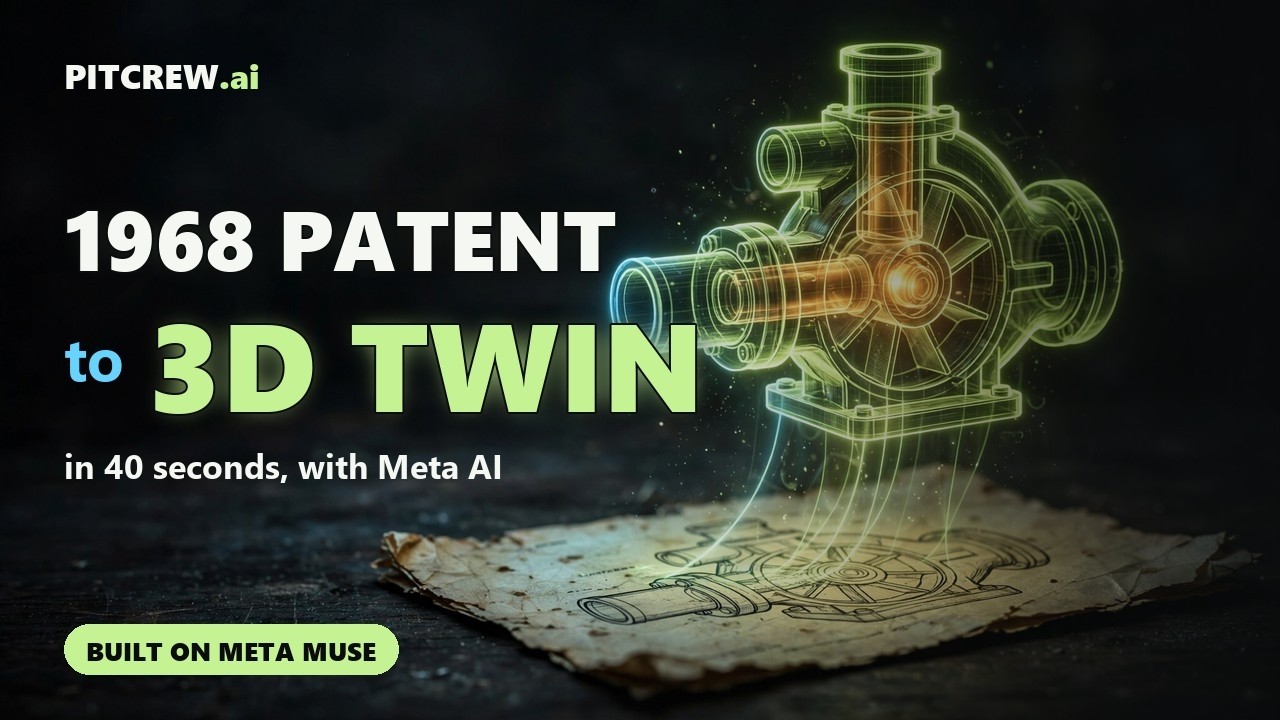
Heavy machinery maintenance is plagued by fragmented, analog workflows: static 2D paper blueprints, complex vibration sensor telemetry, tribal knowledge, and paper parts catalogs. When equipment fails, technicians struggle to translate 2D patent/OEM drawings into 3D understanding, and identifying subtle acoustic signatures (such as bearing race spalls) requires specialized vibration analysis that leads to costly downtime or misdiagnoses. PitCrew gives heavy machinery an autonomous diagnostic brain and interactive 3D twin: Any Drawing to 3D Twin: Technicians upload any 2D drawing or legacy patent PDF (tested on public-domain USPTO patents like the 1968 Wilfley pump US 3,402,671). Meta's muse-spark-1.3 extracts physical dimensions, bore/stroke, and numbered callouts, while local SAM 2.1 segments components to construct an interactive Three.js 3D assembly with what-if kinematic physics. Closed-Loop Visual Verification: SAM 2.1 and muse-spark-1.3 visually inspect the generated 3D render directly against the original source blueprint, grade layout accuracy, fix component placement, and distill lessons into reusable render skills. Shop-Floor Voice & Acoustic Diagnosis: Using on-device speech models (wav2vec 2.0 and MMS-TTS), technicians talk hands-free. Capturing a 5-second phone microphone or accelerometer recording triggers envelope demodulation and structural-band SNR analysis, isolating critical faults (such as a 76.2 Hz outer-race bearing fault at 95% confidence). Defensible Evidence & Automated Procurement: PitCrew defends its diagnosis with spectral evidence and manual citations (0 unverified claims across 164 evaluation runs), highlights the suspect component in exploding 3D, and auto-drafts a replacement Bill of Materials (BOM) purchase order. Self-Improving Harness: Every confirmed teardown and technician correction distills into an auditable diagnostic rule that subsequent investigations consult first.